
Short Answer
To reduce ceramic breakage, buyers should control the product shape, inner protection, retail box, master carton, pallet loading, and transport testing together. Strong ceramic dinnerware packaging is not only a thicker box. Ask your supplier to prove movement control, pressure control, carton strength, packing photos, and a test plan before shipment.
When a buyer tells me, “Kitty, the samples arrived safely, so bulk packing should be fine,” I slow down the conversation. A courier sample and a full export shipment are very different. In real ceramic production, a plate can pass final inspection and still fail because the carton lets it move for thirty days.
Definition Box: What Export Packaging Means for Dinnerware
Dinnerware export packaging is the full protection system used to move ceramic pieces from factory to buyer. It includes product nesting, paper or foam protection, dividers, retail boxes, inner cartons, master cartons, labels, pallet loading, and transport-test evidence.
Start With the Product, Not the Carton
Packaging starts before the first box is opened. The product shape decides where stress will gather.
A wide flat plate needs rim protection and flat stacking control. A deep bowl needs enough space so the rim does not press into the next bowl. A mug needs handle protection because handles are often the weakest shipping point. A coupe plate may look soft and modern, but if the curve lets pieces rub during vibration, you need better separators.
From a factory point of view, I check these product points before choosing packing:
- Is the rim thin, sharp, or easy to chip?
- Does the foot ring touch the glazed surface of another piece?
- Do plates stack evenly or rock inside the pile?
- Are mugs packed handle to handle, handle to wall, or handle to empty space?
- Is the set heavy enough to crush a weak retail box?
The Six-Layer Packaging Walkthrough
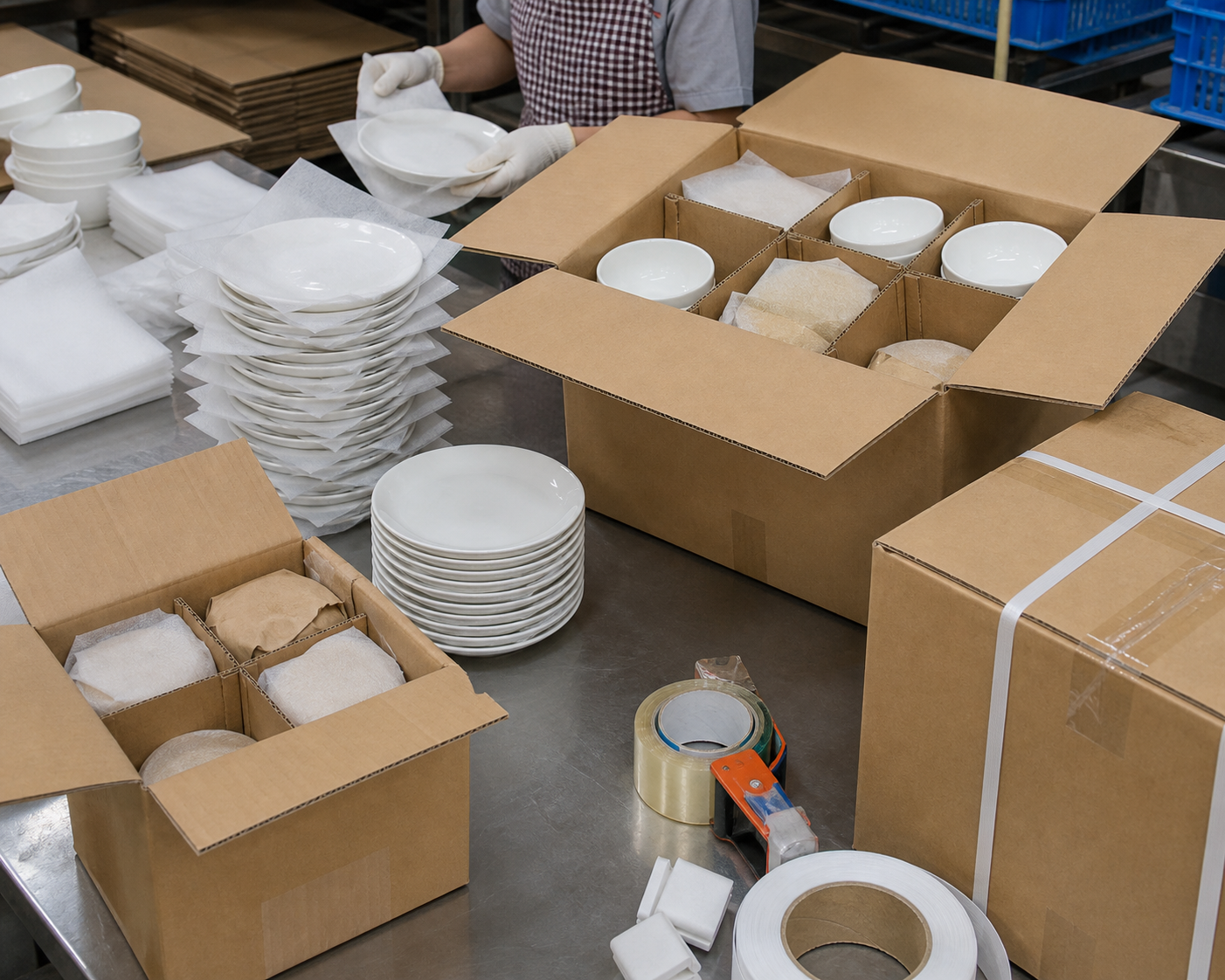
For dinnerware export packaging, I like to review protection in six layers. Each layer has a different job.
| Packaging Layer | Main Job | What Can Go Wrong | Buyer Check |
|---|---|---|---|
| Product contact layer | Stop scratches and rim chips | Plates rub, bowls grind, mugs touch handles | Ask for photos of paper, foam, sleeve, or separator contact points |
| Item group layer | Hold nested pieces stable | Stack is too tight or too loose | Shake one packed group gently and check movement |
| Retail box or inner box | Protect the selling unit | Gift box looks nice but has weak corners | Check board strength, inserts, and empty space |
| Master carton | Carry weight and pressure | Carton bulges, collapses, or has wrong flute strength | Ask for carton size, gross weight, and packing drawing |
| Pallet or container layer | Control stacking and transport pressure | Heavy cartons crush lower cartons | Review pallet pattern, corner protection, wrap, and loading plan |
| Documentation layer | Help warehouse teams handle correctly | Wrong marks, mixed SKUs, unclear fragile labels | Check carton marks, item codes, quantity, barcode needs, and packing list |
Instead of asking, “Is the box strong?”, ask, “Which layer controls movement, and which layer controls pressure?”
Inner Protection Must Control Movement
Ceramic pieces often break because they move. Small repeated movement during truck, sea, or warehouse handling can create rim chips or cracks.
For plates, I like to see protection between each piece or at least enough paper or foam at the rim contact area. For bowls, the nest should be stable without forcing the rims together. For mugs, the handle needs space and a buffer. The handle should not become the part that takes side pressure.
The supplier should show a packed piece before the carton is sealed. If you cannot see how the rim, foot ring, and handle are protected, you cannot judge the packing.
My practical test is simple: after packing one inner group, lift it, turn it gently, and listen. If pieces knock inside, the packing is not finished.
Retail Boxes Need Both Beauty and Strength
Many dinnerware brands want giftable packaging. I understand this. A nice box helps the product sell.
But a beautiful box is not always protective. Window boxes, thin printed boxes, loose inserts, and tight set layouts can create breakage risk.
For boxed sets, ask:
- Are plates separated or only stacked?
- Is the bowl rim protected from the plate edge?
- Is the mug handle suspended, wrapped, or pressed against another piece?
- Can the box survive being lifted from one side?
- Does the master carton support the retail box, or does the retail box carry too much pressure?
I prefer to approve a plain structural mockup before final artwork. Fix the insert and carton first, then print the pretty box.
Master Cartons Should Match Weight and Route
A master carton is not only a container. It is a small shipping structure.
For ceramic dinnerware shipping, check carton size, board grade, gross weight, carton count, stack height, and how many retail boxes sit inside. A carton that is too large allows movement. A carton that is too heavy is easier to drop. A carton that is too weak can collapse in storage or inside a container.
Ask the supplier for the packing specification. It should show:
- product count per inner box and master carton
- carton dimensions and gross weight
- divider or insert material
- sealing method
- carton marks and item codes
- pallet or container loading plan if available
If the answer is only a finished carton photo, ask for more detail.
When to Use Drop or Transport Testing
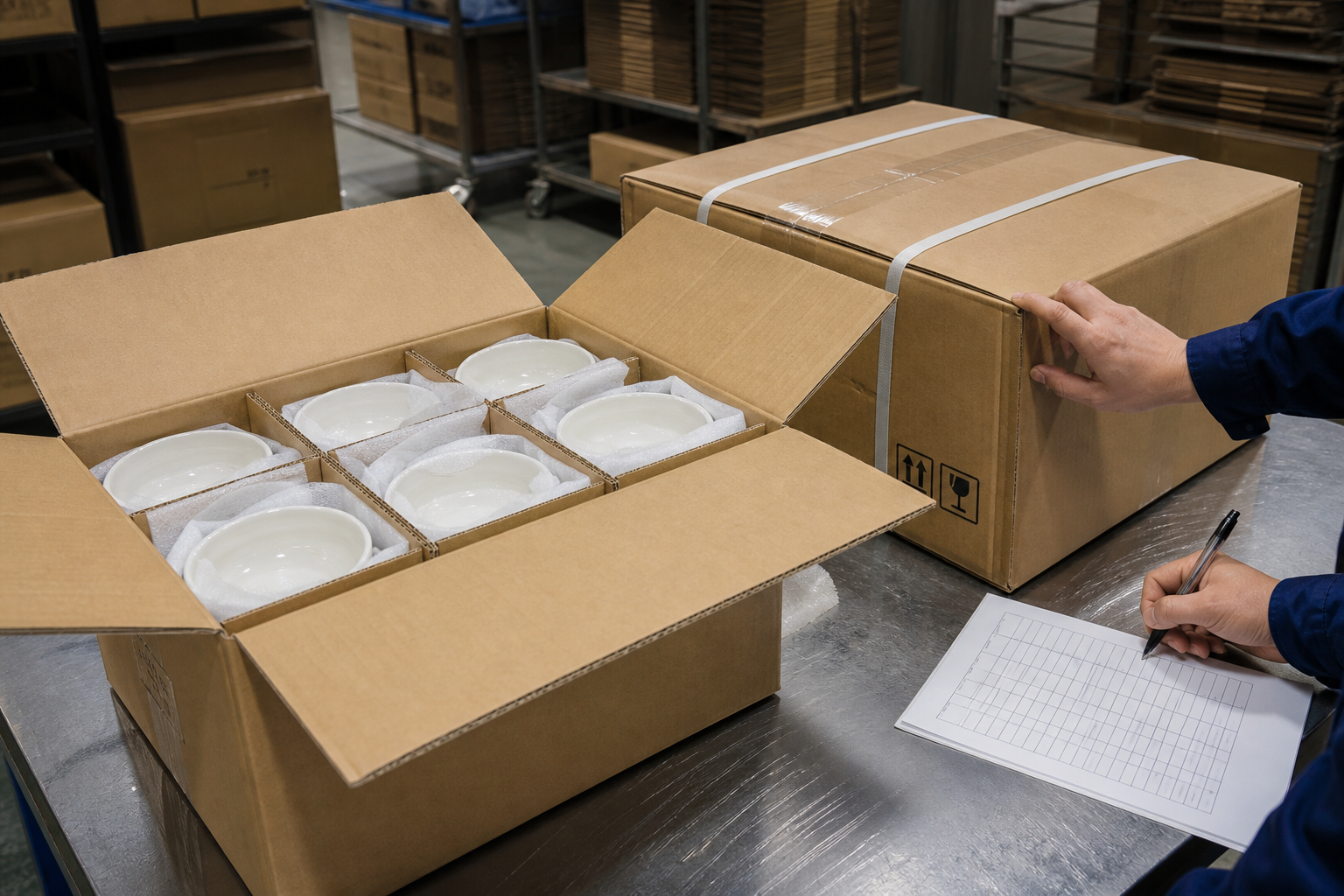
For higher-risk dinnerware, buyers may discuss ISTA transport testing, ASTM D5276 free-fall drop testing, or ISO 2248 drop testing with a lab or packaging engineer.
ASTM D4169 is another useful reference when the team wants a broader performance-test discussion for shipping containers and systems. The exact plan should match the product, pack format, shipment route, retailer requirement, and risk level.
I usually suggest stronger testing when:
- the product is heavy or has thin rims
- the order is a new gift set
- the shipment route is long or mixed between sea, truck, and parcel
- the retailer has packaging rules
- the buyer had breakage before
- the launch cost is high and replacements would be painful
If formal testing is not possible, ask for an internal pack review, carton drop trial, vibration-risk check, and clear photo record.
Breakage Prevention Checklist Before Shipment
Use this checklist before approving bulk packing. It is a simple decision tool for buyers and supplier teams.
| Check | Pass Standard | If It Fails |
|---|---|---|
| Product stack | Pieces sit stable without rim pressure or rocking | Adjust separator, stack count, or item layout |
| Mug handle | Handle does not touch carton wall or another hard piece | Add buffer, change direction, or reduce box count |
| Retail box | Box holds the set without empty space or crushing | Improve insert, board, or internal support |
| Master carton | Gross weight is manageable and carton does not bulge | Reduce count, strengthen board, or change carton size |
| Shake check | Packed unit has no clear knocking sound | Add fill, tighter insert, or better grouping |
| Drop evidence | Internal or lab test matches shipment risk | Revise packing before mass sealing |
| Carton marks | SKU, quantity, fragile mark, and orientation are clear | Correct artwork and packing list before shipment |
| Pallet loading | Lower cartons are not overloaded or leaning | Change stack pattern, wrap, or corner protection |
Open a packed carton and check the real pieces.
Pallet and Container Loading Still Matter
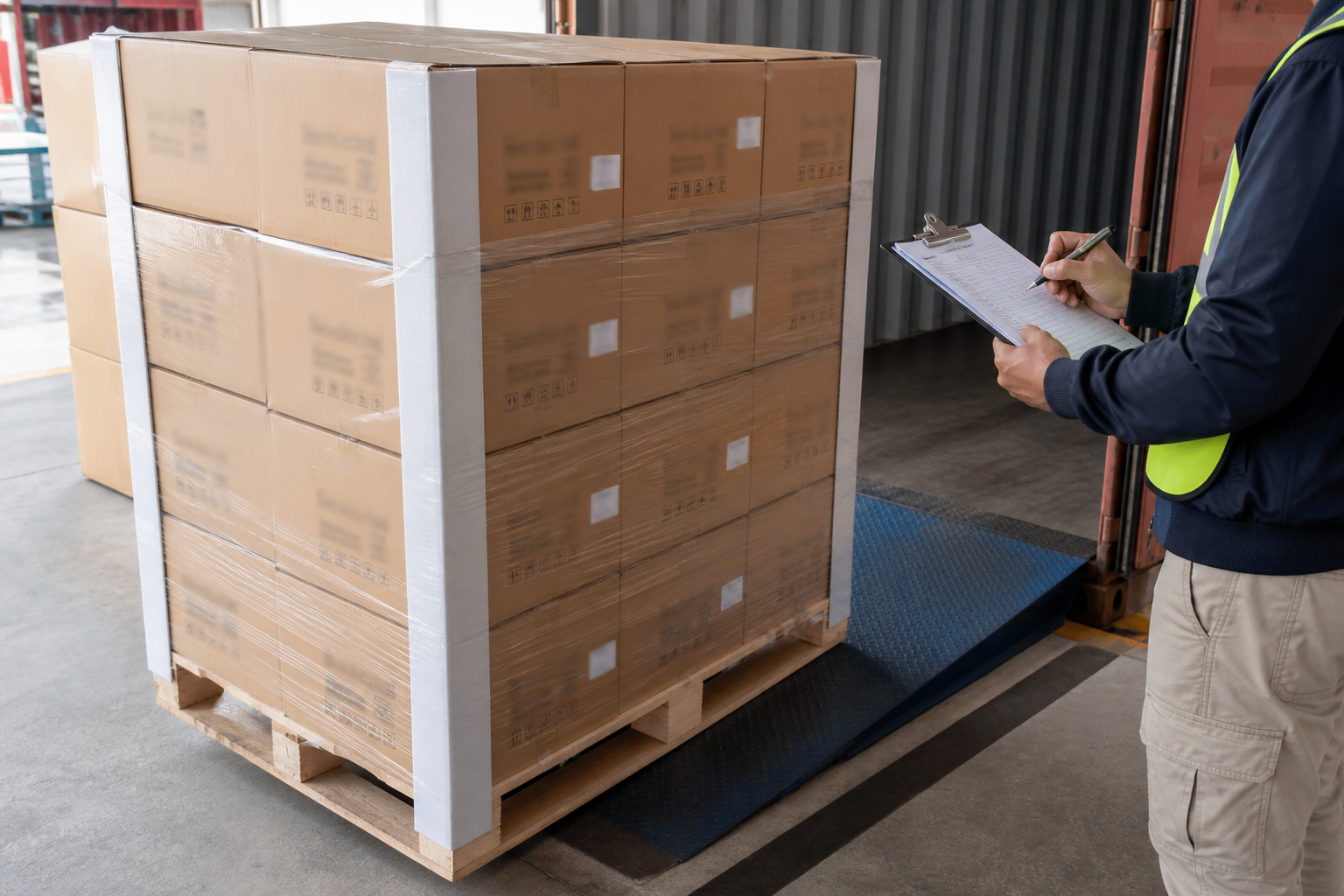
Even good cartons can break if the loading plan is poor.
Heavy cartons should not crush lighter cartons. Mixed SKUs should be arranged so warehouse teams can count and unload correctly. Pallet wrap should hold cartons without bending them. Corner protectors can help when cartons are stacked high. If goods are floor-loaded in a container, the supplier should think about pressure, gaps, moisture risk, and unloading.
For international shipping, I also ask buyers to check whether their logistics partner has special carton, pallet, barcode, GS1 carton labels, or warehouse rules.
What Evidence to Request From the Supplier
Before shipment, ask for:
- packing specification with carton size, quantity, and gross weight
- photos of inner protection before sealing
- photos of retail box and master carton packing
- carton mark proof with item code and quantity
- internal drop-test or handling-test photos if no lab test is used
- formal packaging test report if your channel requires it
- final inspection photos showing packaging condition
- retained packing sample or packing record for repeat orders
My Advice as a Manufacturer
My advice is to approve packaging at the same time as product samples, not at the end.
When we develop dinnerware at FENN, I prefer to review the shape, set layout, retail box idea, and master carton together. Sometimes we reduce breakage by changing the insert, reducing the carton count, or adjusting the rim or stacking gap.
If you are trying to reduce ceramic breakage, send FENN your product photos, set count, target sales channel, current packing photos, carton size, and breakage details. I can help you find whether the problem is product contact, box structure, master carton strength, or loading control.
Questions Buyers Often Ask
Is thicker packaging always better for ceramic dinnerware?
No. Thicker material can help, but the first job is to stop movement and pressure points.
Should I use foam, paper, or molded pulp?
It depends on product shape, brand position, cost, sustainability goals, and breakage risk. The material should protect rims, handles, and glazed surfaces without creating too much movement.
Can I skip drop testing for a small order?
Maybe, but do not skip packing review. For low-risk small orders, internal handling checks and clear photos may be enough. For fragile sets, retailer programs, or long shipping routes, formal ceramic packaging test evidence is safer.
Why did samples arrive safely but bulk goods broke?
Samples often travel in small parcels with extra hand packing. Bulk goods face stacking pressure, container movement, warehouse handling, and longer transit. Sample packing does not prove bulk export packing.
What should I do if breakage happens after delivery?
Collect photos of broken pieces, inner packing, retail box, master carton, pallet condition, carton marks, and where the breakage happened.
Conclusion
Ceramic dinnerware packaging should be designed as a full protection system. To reduce ceramic breakage, check product shape, inner protection, retail box structure, master carton strength, testing evidence, pallet loading, and repeat-order records before shipment.
If you want to review dinnerware export packaging before bulk production, send FENN your set plan, product photos, target channel, and packing idea. I can help you find weak points before the cartons are sealed.
Need Help Reviewing Dinnerware Export Packaging?
Send FENN your set plan, product photos, target sales channel, current packing photos, carton size, and breakage concerns. I can help you check weak points before bulk cartons are sealed.