
Short Answer
To communicate with a ceramic supplier clearly, give each request a product code, sample reference, exact change, unchanged details, and reply deadline with a time zone. Ask the supplier to explain the request back, flag production effects, and name the next action. Keep approvals in one shared record; a friendly acknowledgment is not a production release.
I like short messages. But in overseas dinnerware sourcing, a short message still needs a clear job. “Please make it a little deeper” sounds easy until the sample room, sales team, and buyer each picture a different bowl.
My aim is simple: the person doing the work should understand the same thing as the person paying for it.
Start With a Message the Supplier Can Act On
Here is a supplier communication checklist you can copy into an email or project record. Use one message for one decision.
- Product and reference: SKU, sample ID, drawing revision, and attached photo names.
- Problem: What does the current piece fail to do?
- Requested change: Which feature should change, and how will it be checked?
- Keep unchanged: Which shape details, glaze, logo, or packing choices must stay?
- Reply needed: Feasibility, proposed measurements, cost effect, and sample timing.
- Decision boundary: Advice only, sample work authorized, or bulk work released?
- Owner and deadline: Who answers, by what date, and in which time zone?
A useful reply addresses the fields that matter. It also names anything the factory cannot confirm yet. “Yes, no problem” leaves too much hidden.
Read-back means the supplier restates the requested action in their own words before work begins. I use it to check shared understanding, not to test anyone’s English.
Follow One Bowl Comment From Request to Reply
Let us use an imagined shallow bowl project. The buyer likes the green glaze but wants more room for a sauce-based meal. This is an example, not a FENN specification.
The first message says: “Make the bowl deeper, same as the photo. Need it next Friday.”
Three questions are already open. Does “deeper” mean more internal depth or a taller outside profile? Does the photo define the color too? Does “need it” mean a sample ready at the factory or delivered to the buyer?
Turn the comment into a bounded request
I would rewrite it like this:
Example request
Product B-07, sample S2, drawing R2. The current bowl leaves too little space above the serving portion. Please propose a revised internal profile with more working capacity. Keep the outside rim diameter and approved green glaze reference G1 unchanged. Send a side drawing showing internal depth, overall height, and foot height. State how you will measure capacity. Please confirm feasibility, extra sample cost, and the earliest sample dispatch date by 2026-09-21 at 16:00 Beijing time, UTC+08:00. This request is for a proposal only; do not start revised tooling or bulk production.
Notice what I have not guessed: the new depth. If the buyer has a fixed serving requirement, I would add it with the measuring method. Otherwise, the supplier should propose a workable shape before either side promises a result.
Ask for measurements that describe the finished piece
For this bowl, “height” needs a drawing arrow. Total height includes the foot; internal depth describes the space inside. Increasing one does not always increase the other by the same amount.
I also separate brimful capacity from working capacity. A bowl filled to the rim may hold the stated volume yet leave no room for carrying or stirring. Define the fill level, the measuring method, and the accepted range together.
Specify whether dimensions refer to the finished fired product. Firing shrinkage changes a ceramic body’s dimensions, so a mold measurement cannot simply stand in for a finished-bowl measurement. Ask the factory to explain which stage its drawing describes.
Use one agreed measurement system throughout the project. The NIST guide to expressing measurement values is useful for writing units clearly. My practical rule is to place the unit beside every dimension and avoid mixing inches and millimeters across attachments.
A professional answer gives a proposed range and a checking method. It does not invent a universal tolerance for every ceramic shape.
Make photographs answer one question each
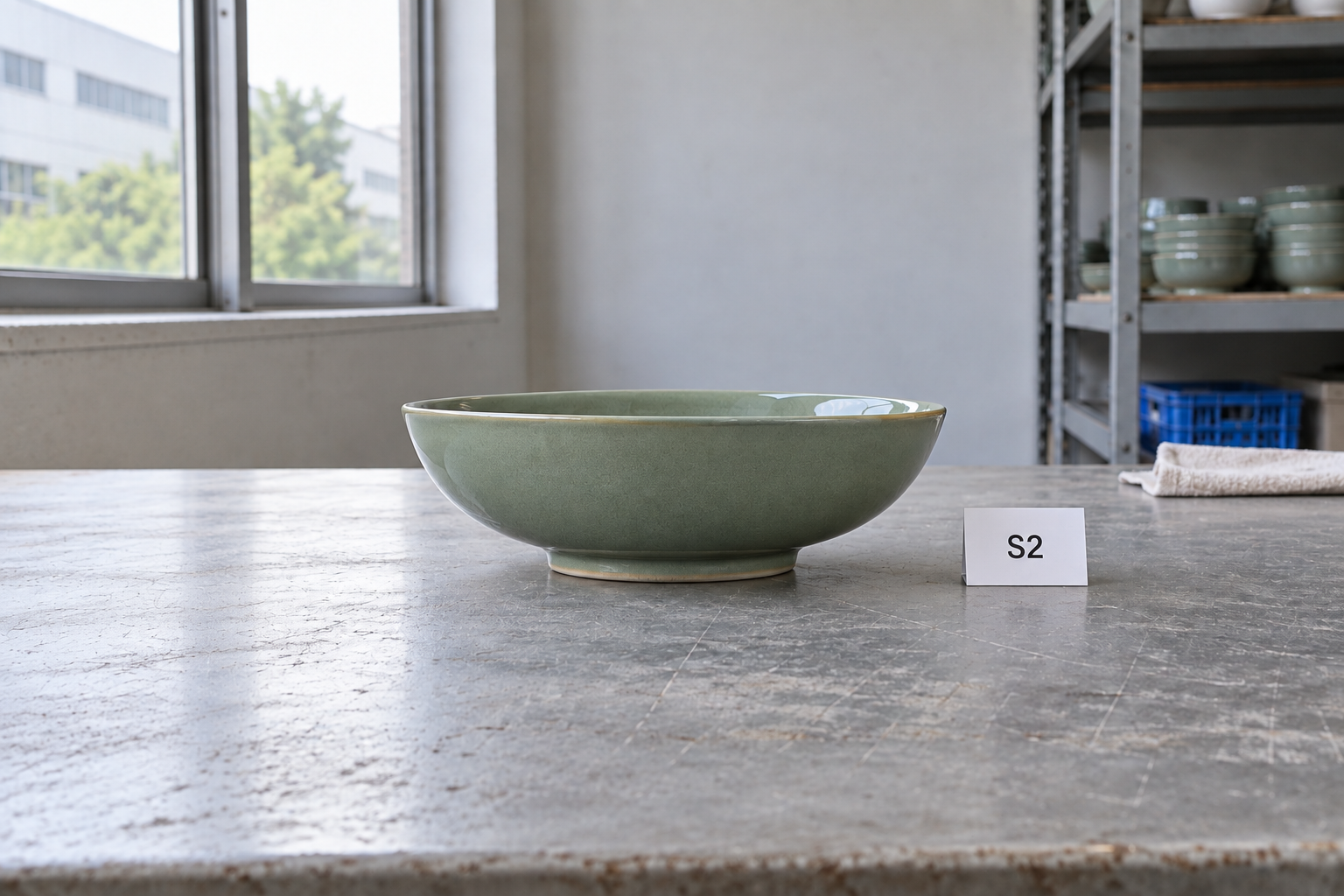
For the bowl, I would request a side view for the profile, a top view for the opening, and an underside view for the foot. Keep the sample ID visible in the record and mark the exact area being discussed.
An arrow should land on the rim if the rim is the issue. “This edge” can mean three different places when a photograph is forwarded without its original message.
State what each reference controls. A restaurant photo may show a serving idea; it should not quietly become the glaze standard. Use the agreed physical glaze sample for color decisions, supported by comparison photos under consistent light.
How to Communicate With a Ceramic Supplier After the First Reply

Now imagine the supplier replies: “We will increase the overall height and keep the diameter. New sample next Friday.”
That is progress, but it does not yet answer the request. The reply says nothing about internal capacity, the foot, or dispatch versus arrival.
I would ask for one short correction:
Follow-up message
Please confirm that the added height creates more usable space inside the bowl, rather than only a higher foot. Show the proposed profile against S2. Confirm whether Friday means sample completion or courier collection, and list anything still waiting for our decision.
Once the drawing is clear, check the consequences. A deeper profile may affect how the bowls nest, how many fit in the current carton, or whether an insert still protects the rim. Ask which checks need repeating and who will do them.
Here is the distinction I want everyone to share:
| Reply or record | What it tells me | What should happen next |
|---|---|---|
| Received | The message reached someone | The named owner reviews it and gives a reply time |
| Technically confirmed | The factory has checked the proposal and stated limits | The buyer reviews the drawing, cost, timing, and open points |
| Approved for a named step | An authorized person has accepted a specific revision and scope | Only that stated step moves forward |
These are suggested project labels, not a universal factory system. Agree the words at the start. Approval for a revised sample should not be read as approval for mass production.
Make the Handoff Work While One Team Sleeps
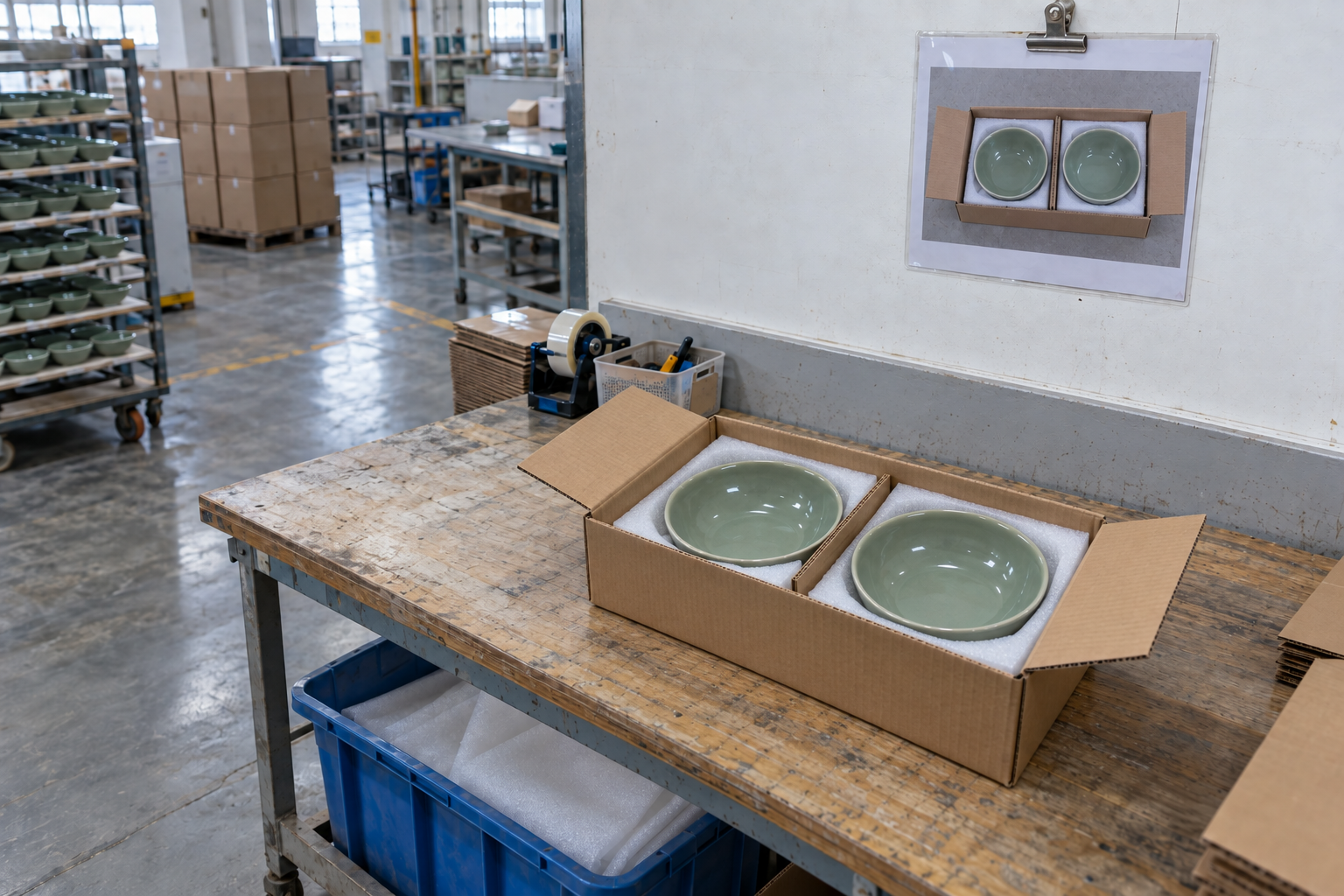
A time-zone gap is manageable when the next person can work without guessing.
Use a clear date and time rather than “tomorrow afternoon.” The ISO date and time format helps avoid day-and-month confusion. Include the city and UTC offset for the actual date; some locations change their clocks during the year.
At the end of a working day, I prefer a short handoff:
- Decided: B-07 drawing R3 is accepted for sample preparation only.
- Still open: The revised packing fit needs checking; packing lead owns the reply.
- Next action: Sales sends the sample dispatch plan by the agreed date and time.
Set a realistic response rhythm together. Acknowledging a message can be quick; confirming a glaze trial or packaging fit may require another team. The useful commitment is a named next update, not a promise to solve everything immediately.
For bilingual files, keep the same product codes, revision numbers, and picture references in both versions. Ask someone who understands the ceramic terms to check the translation. Keep a shared glossary for recurring words such as foot ring, rim, inside depth, and glaze pooling.
After a call, send the decisions back in writing. Store the current file in one agreed place, mark older versions as superseded, and ask the factory contact to confirm that the sample room and packing team received the relevant revision.
My Advice as a Manufacturer
I judge communication by whether the next action is clear. Long emails can still leave a factory guessing.
When a reply feels vague, ask where the uncertainty sits. Is sales waiting for the technician? Is the technician waiting for a measurement? Has the packing team received the old drawing? That question is more useful than sending another “urgent” message.
I also want buyers to make disagreement easy. A supplier should be able to say that a request needs another trial, changes the cost, or puts a date at risk. Ask for the reason and an alternative. An early, specific concern gives you something to decide.
Questions Buyers Often Ask
Is email better than a messaging app?
Use whichever channel both teams follow reliably. I keep decisions and current attachments in one agreed record. A chat is useful for speed, but the approved revision should be easy to find later.
Should every message be bilingual?
No. Translate where it improves understanding, especially technical instructions passed to production. Matching codes, drawings, units, and revision dates often matter more than translating a long introduction.
Does a thumbs-up mean approval?
I would ask for explicit wording when money, tooling, production, or shipment depends on it. Record the item, revision, authorized step, and approver. Do not leave the scope to an emoji.
What if the supplier stops replying?
Send a short list of unresolved decisions with an owner and required update time. Use the agreed backup contact if the deadline passes. Where a step depends on missing approval, keep that step on hold rather than treating silence as agreement.
Conclusion
To communicate with a ceramic supplier well, make each request easy to repeat, check, and close. A clear sample reference, a useful read-back, and an honest deadline can prevent many expensive assumptions.