
Short Answer
A good ceramic mug handle needs more than a nice outline. It needs broad, smooth attachment points, enough room for the intended hand, balanced weight, comfortable edges, and safe clearance from logos and packaging. Buyers should test several fired samples with hot liquid, repeated lifting, washing, stacking, and the final carton—not approve a custom ceramic cup handle from a drawing alone.
When a buyer sends me a beautiful mug sketch, I look at the handle before I look at the color. That small loop carries the full mug, meets the user’s fingers, and often becomes the widest point in the shipping pack. I have seen elegant handles pinch fingers and heavy handles pull a filled mug sideways.
Read the Failure Clue Before Changing the Shape
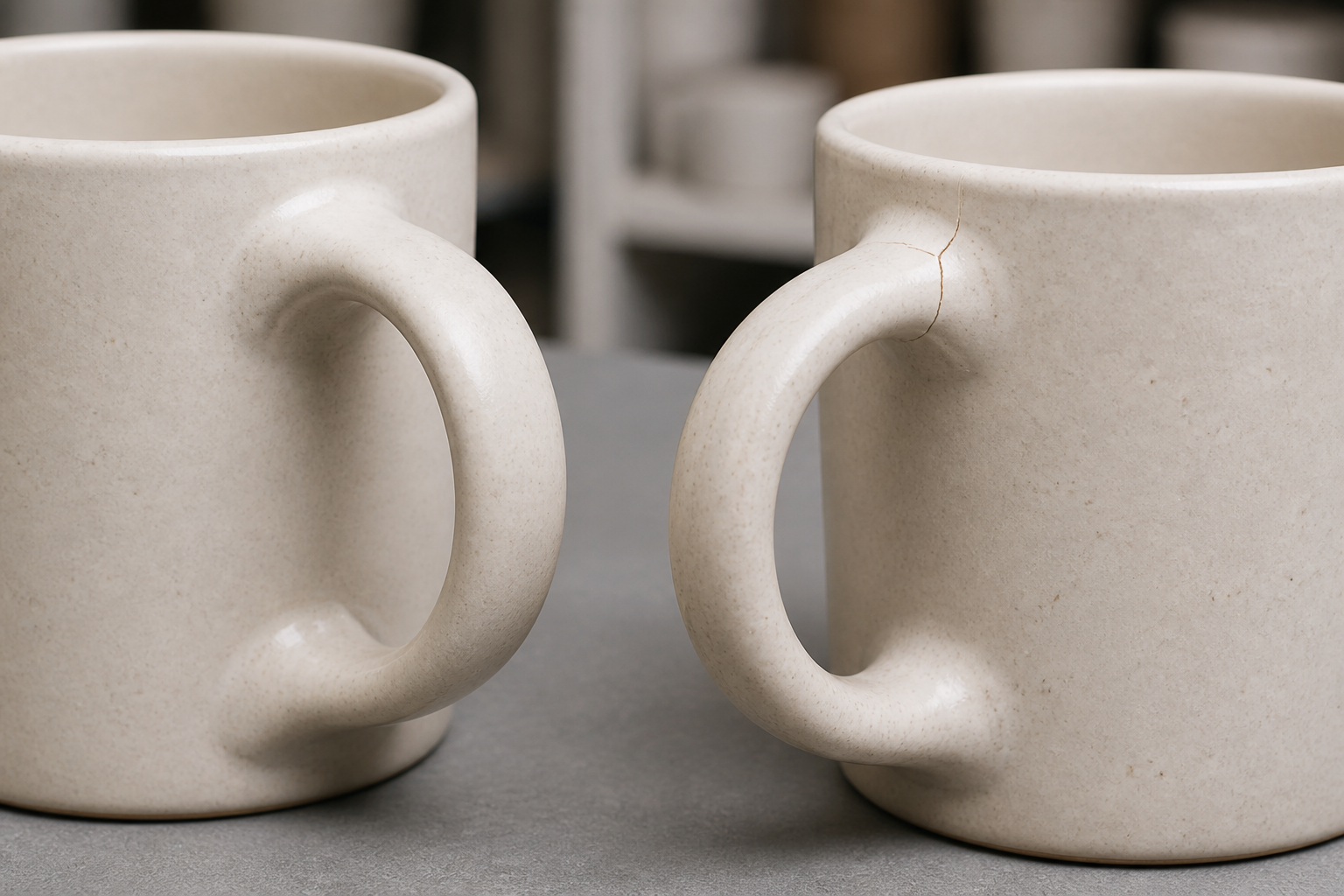
When a mug handle crack appears, the crack location tells us where to investigate. I do not start by saying, “Make everything thicker.” More clay can add drying stress and weight without fixing the real cause.
Use this diagnosis card during sample review:
| What You See or Feel | Likely Cause to Check | Better Buyer Question | Approval Action |
|---|---|---|---|
| Fine crack at the upper or lower joint | Weak attachment, sharp transition, uneven moisture, or drying stress | Is the joint broad and blended on both sides? | Pause and section several samples to review the joint |
| Handle pulls away from the body | Poor joining control or mismatched moisture at assembly | How are body and handle moisture controlled before joining? | Request process records and another fired sample round |
| Handle twists or sits at different angles | Soft ware moved during handling or the setting method is inconsistent | What fixture or visual standard controls alignment? | Add front and side alignment photos to the approval standard |
| Fingers feel squeezed | Opening is too small, lower curve is too high, or wall thickness steals space | Which target hand and grip is this opening designed for? | Test with several users, including the filled mug |
| Edge presses into a finger | Cross-section is too thin, sharp, or flat at the contact point | Can the contact surface be rounded without changing the silhouette? | Revise the section, not only the outside outline |
| Mug tips or wrist feels loaded | Handle position, cup weight, and center of mass are not balanced | How does it feel at the intended fill level? | Run a hot-fill carry and drink test |
| Logo looks crowded or distorted | Decoration is too close to the joint or curved area | Is there a flat, repeatable decoration zone? | Approve logo size and position on fired samples |
| Handle touches the carton divider | Pack cell ignores the mug’s widest and weakest projection | What clearance remains after production tolerance? | Test the real production-style pack before approval |
This is a starting point, not a remote diagnosis. A crack can have more than one cause, so compare its position across several pieces and production stages.
Follow the Handle From Wet Clay to Fired Mug
1. Shape and Joining
A handle is normally formed separately or created as part of a production method, then joined to the cup body at controlled moisture. If one part is much wetter than the other, they may shrink at different speeds. If the joint is narrow or the curve changes suddenly, stress can gather at that point.
From a factory point of view, I want the upper and lower attachment areas to look intentional. The transition should flow into the body, not resemble a thin strip glued onto a wall. I also check the inside of the joint. A smooth outside can hide a weak or sharp inside transition.
2. Drying and Handling
The cup body and handle do not dry in the same way. Fast or uneven drying may pull the parts against each other. Ask how alignment is checked before firing. A front-view and side-view sample board should show the approved angle, opening, joint position, and acceptable natural variation.
3. Firing and Glaze
Ceramic shrinks during firing, and a long thin loop may move more than a compact handle. Glaze should cover the handle without heavy pooling, bare touch areas, or sharp drips underneath.
For decorated mugs, buyers should keep market-specific food-contact review in the project file. The FDA guidance on lead in foodwares and the European Commission food contact materials overview are useful official starting points. A general material statement is not a substitute for the correct test scope for the product, decoration, and sales market.
Run a Fill–Lift–Drink Approval Loop
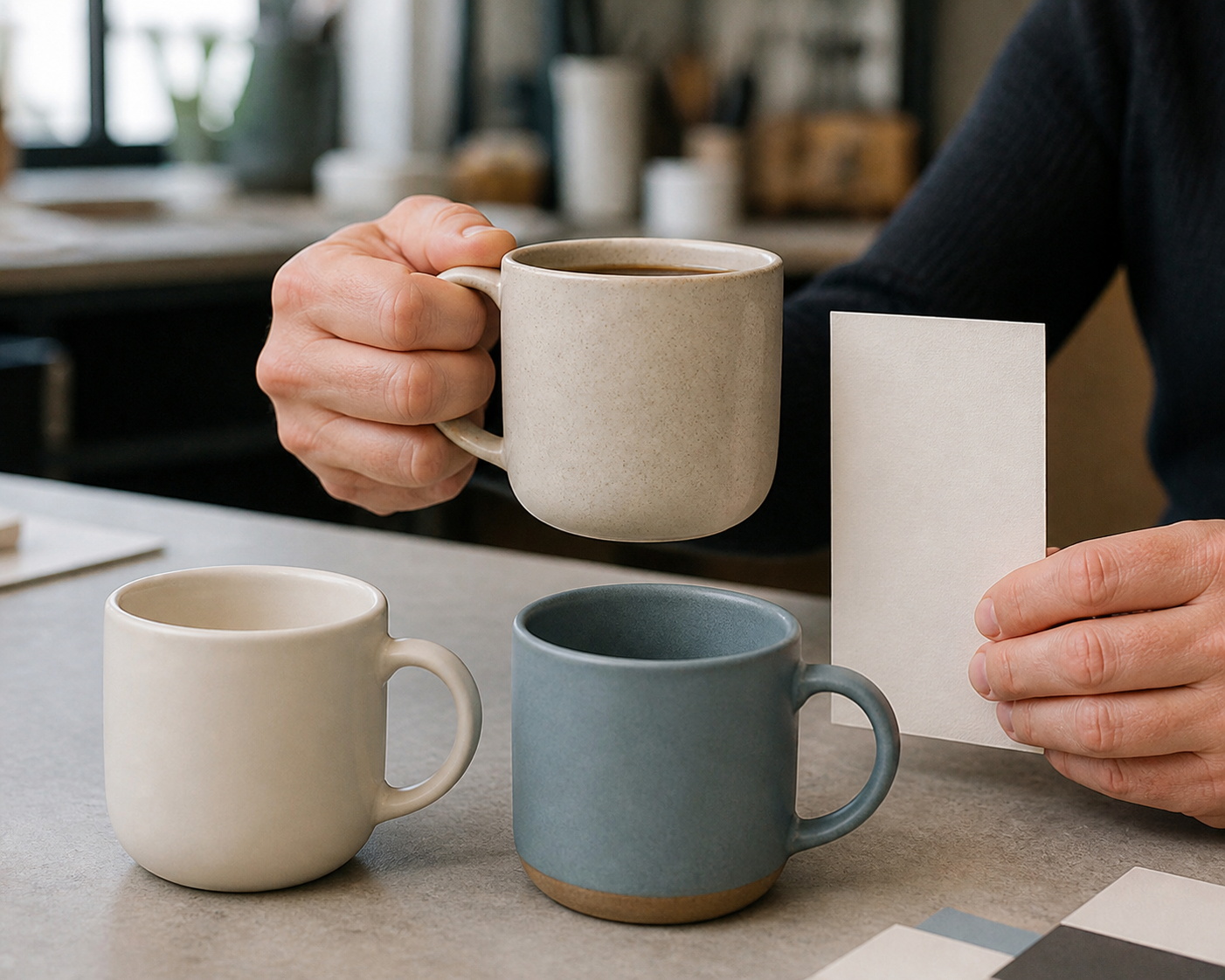
Catalog photos cannot show pressure on a finger or load on a wrist. I use a simple loop that follows real use.
1. Fill: Use the intended serving volume, not only the mug’s brim capacity. Add a safe warm or hot test liquid appropriate to the sample.
2. Lift: Pick up the mug from a table ten times with the normal grip. Note finger clearance, joint flex concerns, and whether the handle rotates in the hand.
3. Carry: Walk a short service route. Check balance, wrist angle, and whether a thumb naturally finds a comfortable resting point.
4. Drink: Bring the mug to the mouth. Confirm that the rim, handle angle, and hand position work together.
5. Set down: Watch whether the mug lands flat or is pulled toward the handle side.
6. Wash and inspect: Check the inner curve, joint areas, and underside for cleaning access, glaze faults, and trapped water.
Test more than one fired piece and more than one hand. Hand size, grip style, and intended channel matter. A small espresso cup, a cafe mug, and a large home-use mug should not inherit the same handle opening by habit.
Record What “Comfortable” Means
“Comfortable” is too loose for a bulk order. Record the fill volume, finger count, clearance, grip comments, filled weight, and front and side photos. A simple 1-to-5 review for finger room, edge comfort, balance, thumb support, and drinking control can make your team’s judgment repeatable. Keep the approved fired sample too.
Check Decoration and Brand Space Early
The handle affects logo space and what the customer sees while holding the mug. Approve the actual mark on a fired, glazed sample. Check both holding directions if relevant. Metallic or special decorations may change microwave-use instructions, so claims and care wording must match the decoration route.
For ceramic release testing context, buyers may review the ISO 6486 ceramicware standard overview. The exact test and compliance plan should still be confirmed for the destination market and product construction.
Give the Handle Its Own Packaging Clearance
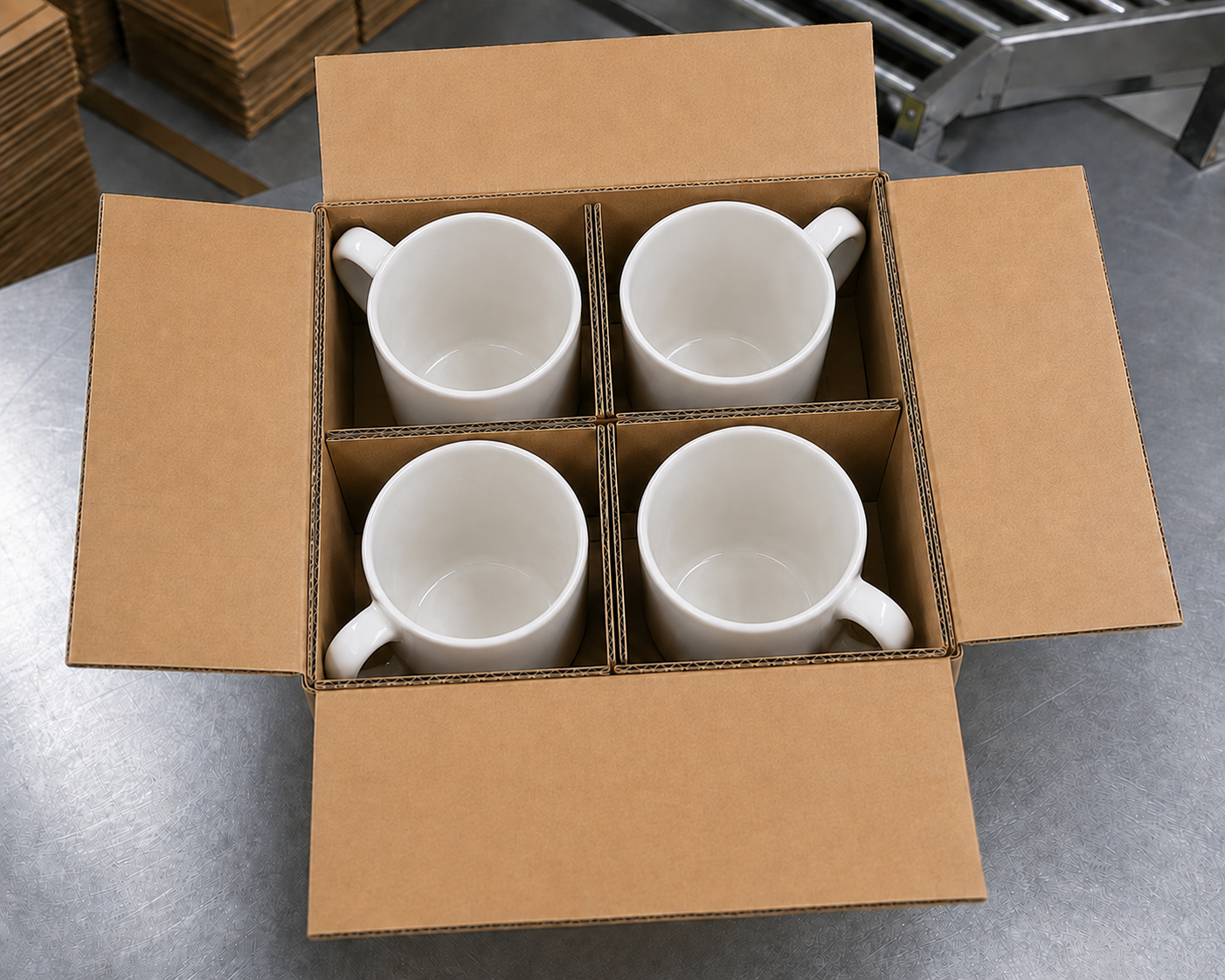
The handle is a projection and a possible impact point. It should not carry carton pressure or touch a hard divider after normal production variation is considered. I want to see the actual mug orientation, divider clearance, protective contact zones, carton closure, and movement after handling.
Do not judge the pack from an empty display mockup. Use production-style samples and the planned quantity. The ISTA test procedures overview explains how packaged-product tests relate to distribution hazards. The chosen test plan must match the sales channel and pack system; a generic “drop tested” claim tells a buyer very little.
My Sample Approval Gate
Before I release a handle design toward bulk production, I want these answers in one place:
- Are the upper and lower joints broad, smooth, and visually consistent?
- Does the handle stay aligned across several fired samples?
- Can the intended user grip a filled mug without pinching or sharp pressure?
- Does the mug feel balanced at its real serving volume?
- Is the glaze clean on the inside curve, joints, and underside?
- Is there a stable logo zone with enough clearance from curves and joints?
- Do care claims match the body, glaze, and decoration method?
- Does the final packaging protect the handle without loading it?
- Are the approved sample, photos, dimensions, and acceptance notes retained for bulk QC?
A professional supplier answer connects shape, process, and evidence. Past mug experience is helpful, but it is not an approval record for your design.
My Advice as a Manufacturer
My simple advice is to protect the handle’s job before its sketch. Define the user, fill volume, grip, logo position, and pack. Then adjust joint transitions, cross-section, and clearance while keeping the design character.
Review several fired pieces, use the fill–lift–drink loop, and place the same pieces in the intended pack. Small discomfort becomes a daily complaint; small joint weakness becomes a repeat production risk.
FENN can help review a private-label mug brief, fired samples, decoration zone, and packaging clearance. Send the volume, target user, reference shape, logo method, market, and pack plan.
Questions Buyers Often Ask
Should a ceramic mug handle always fit four fingers?
No. Grip depends on mug size, use, and design. The goal is comfortable control at the intended fill volume, not a finger count copied from another product.
Does a thicker handle prevent cracking?
Not automatically. Too much clay may add weight and uneven drying. Joint shape, moisture control, transitions, handling, and firing all matter.
Can we approve the handle from a 3D drawing?
A drawing helps with dimensions, but it cannot prove fired movement, glaze quality, balance, finger pressure, or pack fit. Approve several fired samples.
Where should a logo sit on a mug with a large handle?
Keep it on a stable, repeatable area with enough distance from the handle joint and strong curvature. Confirm the view in a real hand and approve the actual decoration on a fired sample.
What should bulk inspection check?
Check cracks, joint integrity, angle, opening, sharp glaze, glaze gaps, decoration position, rocking, and pack clearance against the approved sample and written acceptance rules. Pay special attention to repeated defects at the same joint.
Conclusion
A reliable ceramic mug handle is comfortable in the hand, stable in production, clear for decoration, and protected in shipping. Follow the failure clues, review the production path, and approve the mug through real use. That is how a small design detail becomes a controlled product decision.
Reviewing a custom ceramic mug handle?
Send us your mug drawing, target volume, grip requirements, decoration plan, and packaging layout. We can help review handle comfort and production risk before bulk approval.