

Jurisdiction Scope: European Union, United States, and California
Editorial Note: This guide is for general information only and should not replace product-specific legal, laboratory, or toxicology advice.
I learned this early: a ceramic plate can look perfect on a shelf and still create a compliance problem the moment food touches it.
If I sell ceramic tableware in the EU or the US, I treat it as a food-contact product first. My main risk check is lead and cadmium migration. In the EU, I review Regulation (EC) No 1935/2004, Regulation (EC) No 2023/2006, and Directive 84/500/EEC as amended by 2005/31/EC. In the US, I review FDA ceramicware action levels under CPG Sec. 545.450 and CPG Sec. 545.400. If California is involved, I also review Proposition 65 exposure and warning risk.
The goal is simple: classify the product correctly, test it correctly, document it clearly, and avoid lazy assumptions.
Key Takeaways
If I need a fast compliance summary, this is the version I keep in front of me.
- EU: I check the general food-contact framework, GMP, ceramic lead/cadmium migration, and the written declaration.
- US: I check FDA action levels for ceramicware by product category, not by marketing name.
- Testing: Ceramic migration testing commonly uses 4% acetic acid. In EU-style ceramic testing, the usual condition is 24 hours at 22 ± 2°C.
- California: FDA compliance does not automatically close Prop 65 risk.
- Documents: I keep the product specification, test report, declaration, traceability records, and labeling review together.
- Retesting: If glaze, pigment, decal, firing, size, capacity, or intended use changes, I review retesting.
What rules apply to ceramic tableware in the EU and the US?
When I map compliance, I start with the legal framework, not the product photo.
In the EU, I usually work from three layers: the general food-contact rule, GMP, and the ceramic-specific lead and cadmium migration rule. In the US, I work from FDA ceramicware lead and cadmium action levels. In California, I add Proposition 65 because it focuses on exposure and warnings, not just lab results.
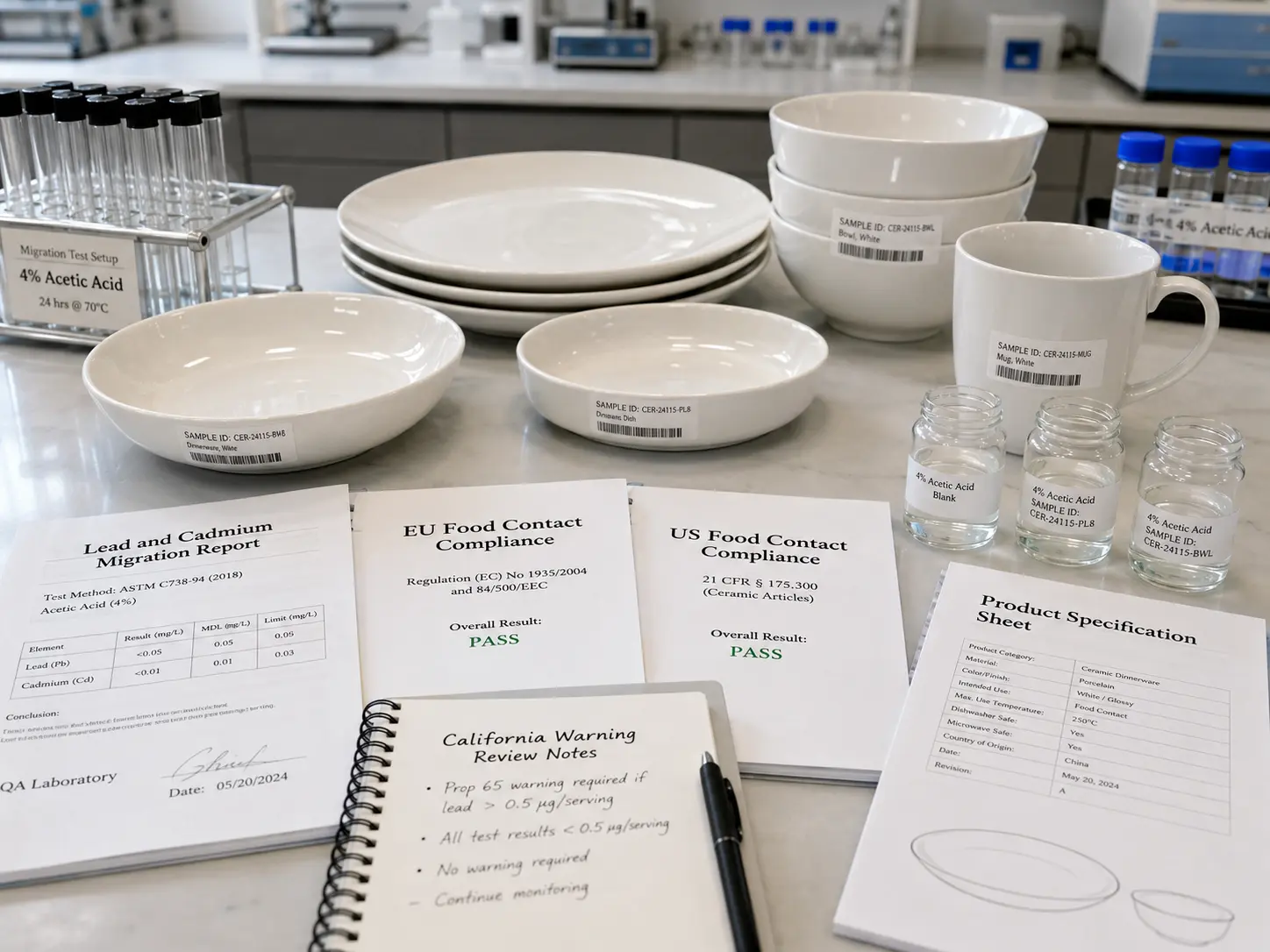
In the EU, the core framework starts with Regulation (EC) No 1935/2004. That is the general food-contact rule. It says materials and articles should not transfer substances into food in a way that harms health, changes the food too much, or damages taste and smell.
Then I add Regulation (EC) No 2023/2006 for good manufacturing practice. This matters more than many people think. A passing report is helpful, but a factory that cannot show stable materials, controlled firing, and basic traceability still leaves me exposed.
For ceramic articles specifically, I look at Directive 84/500/EEC, as amended by Directive 2005/31/EC. That is where the EU ceramic lead and cadmium migration logic lives, along with the written declaration requirement for ceramic articles not yet in contact with food.
In the US, I focus on the FDA ceramicware framework. The main practical references are:
- CPG Sec. 545.450 for lead contamination
- CPG Sec. 545.400 for cadmium contamination
That framework is very category-driven. A mug is not judged like a flat plate. A pitcher is not judged like a bowl. I never ignore that.
Then there is California Proposition 65. This is where many exporters get too comfortable. Prop 65 is not just about whether a ceramic article passes one migration screen. It is about whether the product may expose a person to a listed chemical above the relevant safe-harbor level, and whether a warning may be required.
Here is the simple map I use:
| Market | Main rule set I check | Why it matters |
|---|---|---|
| EU | 1935/2004 + 2023/2006 + 84/500/EEC / 2005/31/EC | Covers food-contact safety, GMP, migration, and declaration |
| US | FDA CPG 545.450 + CPG 545.400 | Sets action levels for lead and cadmium in ceramicware |
| California | Prop 65 Article 6 safe-harbor warning rules | Adds exposure and warning analysis |
That is why I never treat “EU/US compliant” like one neat stamp. It is really a market-by-market review.
What tests and limits should I check for plates, bowls, mugs, and pitchers?
This is where many teams make avoidable mistakes. They test the item, but they classify it badly.
I always classify the product before I order a test. In both the EU and the US, lead and cadmium limits depend on the article type. Flatware, hollowware, cups, mugs, and pitchers are not treated the same. If I classify the article badly, the whole test plan starts weak.
In the EU, ceramic migration testing is built around the ceramic directive method. The common extraction condition uses 4% acetic acid for 24 hours at 22 ± 2°C. That technical detail matters because it tells me what kind of migration result I am really looking at.
In the US, the FDA action levels are easier to use when I put them into a table:
| Product category | FDA lead action level | FDA cadmium action level |
|---|---|---|
| Flatware | 3.0 µg/mL | 0.5 µg/mL |
| Small hollowware | 2.0 µg/mL | 0.5 µg/mL |
| Large hollowware | 1.0 µg/mL | 0.25 µg/mL |
| Cups and mugs | 0.5 µg/mL | Category reviewed under hollowware framework |
| Pitchers | 0.5 µg/mL | Category reviewed under hollowware framework |
I do not let a sales description drive the test request. “Artisan breakfast mug” means nothing to a regulator. I need category, capacity, food-contact surface, intended use, and decoration details.
And then there is decoration. Bright inner glaze. Gold rim. Red, yellow, or orange decorative paint. A decal close to the lip. Those details can change the risk picture fast.
The test condition detail I never skip
If I want a serious result, I do not send one hand-picked beauty sample.
I ask for production-representative samples made with the real:
- clay body
- glaze
- pigment
- decal
- firing condition
- finished dimensions
Otherwise, I get a comforting report that may not describe the real shipped product.
What documents should manufacturers, importers, and brands keep?
I have learned that failed testing is painful, but missing paperwork is even worse.
Before shipment, I build one simple file: product specification, test report, declaration or compliance statement, traceability records, and labeling review. In the EU, the written declaration matters. In the US, the category-linked test report matters just as much.
For EU shipments, I keep the technical story tight. I want:
- product name and SKU
- product photos
- dimensions and capacity
- intended food use
- glaze and decoration details
- migration report tied to that exact product
- written declaration for ceramic articles where required
- GMP and traceability support records
For US shipments, I keep the report tied to the correct FDA category. That sounds obvious, but I still see general ceramic reports with no real category logic behind them.
This is the document pack I trust:
| Document | Why I keep it |
|---|---|
| Product specification sheet | Links the report to the real item |
| Lead and cadmium test report | Shows actual migration results |
| EU declaration / compliance statement | Supports EU placement and audit readiness |
| Bill of materials | Helps track material changes |
| Glaze and decal details | Shows where heavy metal risk may sit |
| Batch and production records | Supports traceability and GMP |
| Packaging and labeling review | Prevents bad claims and mixed messages |
| Supplier change log | Flags when retesting may be needed |
One tiny file mistake can create a big problem. One mug version has a metallic rim. Another one does not. Somebody forgets to update the product file. Suddenly the wrong report is being used for the wrong item.
I have seen that happen. It gets expensive fast.
Is FDA compliance enough for California Proposition 65?
This question sounds simple. It rarely is.
No. FDA compliance is not automatically enough for California Proposition 65. FDA ceramicware action levels and Prop 65 do different jobs. FDA focuses on ceramicware leaching and enforcement action levels. Prop 65 focuses on consumer exposure to listed chemicals and whether a warning may be required.
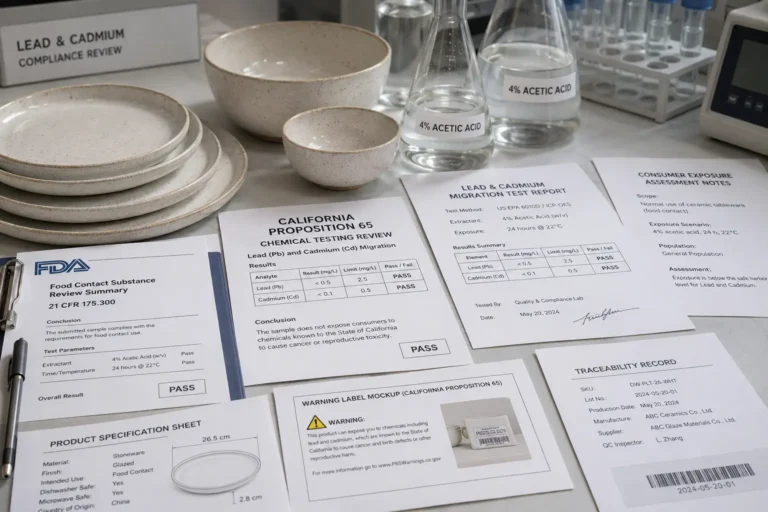
For lead and cadmium, I ask a different question in California:
Could this product expose a consumer above the relevant safe-harbor level during normal use?
That is not the same question as:
Did this ceramic article fall below an FDA action level?
That difference matters.
I also do not assume testing is mandatory under Prop 65. Businesses can use testing, product knowledge, or an exposure assessment. But if they want safe-harbor protection for warning format, they need to follow the Article 6 warning rules.
A practical warning example
If a business decides a consumer product exposure warning is required, a common full-length safe-harbor format for a chemical listed as both a carcinogen and reproductive toxicant is:
WARNING: This product can expose you to chemicals including [name of one or more chemicals], which are known to the State of California to cause cancer and birth defects or other reproductive harm. For more information go to www.P65Warnings.ca.gov.
That is only an example format. I would still confirm the right endpoint, chemical naming, delivery method, and online display rule before I publish anything.
What I check for Prop 65
- Is lead or cadmium present in a way that may create consumer exposure?
- Does the product design make exposure more likely?
- Does the item need a full-length warning or a compliant short-form warning?
- Is the warning clearly tied to the product?
- Is the same warning shown online if the product is sold online?
Here is the comparison I keep in my head:
| Question | FDA lens | Prop 65 lens |
|---|---|---|
| Main focus | Leaching against action levels | Consumer exposure and warning duty |
| Category matters? | Yes | Yes, plus use pattern matters |
| Passing lab report ends review? | Sometimes | Not always |
| Warning format controlled? | No | Yes, if using safe-harbor warning content |
What mistakes cause ceramic tableware compliance failures?
Most compliance failures are not dramatic. They are ordinary. That is why they are dangerous.
The biggest mistakes I see are simple: testing the wrong sample, using the wrong category, changing glaze after testing, ignoring decoration near food contact, keeping weak records, and assuming one market’s pass result covers every market. I avoid these by locking the tested sample, the process, and the destination market together.
A team gets one passing report. Everyone relaxes. Then:
- the decal supplier changes
- the pigment changes
- the firing curve shifts
- the customer adds California
- the cup size changes
- the rim decoration moves closer to the lip
And suddenly the “same product” is not the same product at all.
Here is the shortlist I keep close:
| Common mistake | What I do instead |
|---|---|
| Testing prototype only | Test production-representative samples |
| Weak category definition | Classify by use, shape, and capacity |
| Assuming one report covers all colors | Review every glaze and decoration change |
| Ignoring lip or inner-surface decoration | Treat food-contact and near-contact zones carefully |
| Weak traceability | Keep batch, supplier, and process records |
| Treating California as “just part of the US” | Review Prop 65 separately |
My personal rule
If I change body, glaze, pigment, decal, firing, size, capacity, supplier, or intended use, I stop and ask whether the old report still makes sense.
Not because I love paperwork.
Because I love fewer disasters.
FAQ
Is ceramic tableware regulated as a food-contact product in the EU and US?
Yes. In both markets, ceramic tableware is usually treated as a food-contact product when it is intended to touch food or drink. The main compliance concern is whether lead or cadmium can migrate from the finished article during normal use.
What is the main compliance risk for ceramic plates, bowls, and mugs?
The main risk is lead and cadmium migration. This can come from glazes, pigments, decals, or decorated surfaces. That is why product category, food-contact area, and decoration placement matter during testing.
What test liquid is commonly used for ceramic migration testing?
A common extraction liquid is 4% acetic acid. For EU-style ceramic migration testing, the usual condition is 24 hours at 22 ± 2°C.
Do ceramic mugs and pitchers have different limits from plates?
Yes. In the US, FDA ceramicware action levels differ by product category, and cups, mugs, and pitchers are treated more strictly for lead than many other ceramic articles. In the EU, migration limits also depend on the article category.
What documents should I keep for ceramic tableware compliance?
I would keep the product specification, lead and cadmium test report, EU declaration or compliance statement where needed, bill of materials, glaze and decal details, batch records, and packaging or labeling review records.
Is FDA compliance enough for California Proposition 65?
No. FDA ceramicware action levels and California Proposition 65 do not work the same way. FDA focuses on ceramicware leaching and action levels, while Prop 65 focuses on exposure to listed chemicals and whether a warning may be required.
When should ceramic tableware be retested?
I would review retesting whenever the clay body, glaze, pigment, decal, firing condition, capacity, size, decoration, supplier, or intended use changes in a meaningful way.
Conclusion
For ceramic tableware, good compliance is not luck. It is clear rules, clean testing, strong records, and fewer assumptions.