
Short Answer
Good ecommerce dinnerware packaging must protect ceramics through repeated drops, vibration, stacking, and careless parcel handling—not only look attractive at unboxing. Start with the real product and shipment format, stop pieces from touching or moving, protect rims and handles, use a strong outer box, then test production-representative packs through an agreed parcel test plan. Record damage by location and cause before approving the pack.
When a buyer asks me for a beautiful mailer box, I ask: “What happens when it lands on one corner?” In more than 20 years around ceramic dinnerware, I have learned that parcel delivery is different from pallet shipping. A carton may meet rain, belts, drops, and heavier boxes. The packaging must suit it.
> Simple definition: DTC tableware packaging is the complete pack system used to send dinnerware directly to one customer. It includes the product wrap, separators, cushioning, retail or gift box, shipping box, tape, labels, inserts, and pack-out method.
Map the Parcel Journey Before Drawing the Box
Begin with the route. Will one plate ship alone, or will a 12-piece set ship with mugs? Can customers order mixed pieces? A pack designed only for a full set may fail when the warehouse sends two bowls and one mug.
I like to map five moments:
1. The factory packs the finished pieces.
2. Cartons travel to the DTC warehouse or fulfillment center.
3. A worker picks and repacks the customer order.
4. A parcel carrier sorts and delivers it.
5. The customer opens it and may return part or all of the order.
At each moment, ask who handles the ceramics and what can move. This shows whether you need a single-piece module, a full-set pack, or both.
Build Protection From the Ceramic Outward
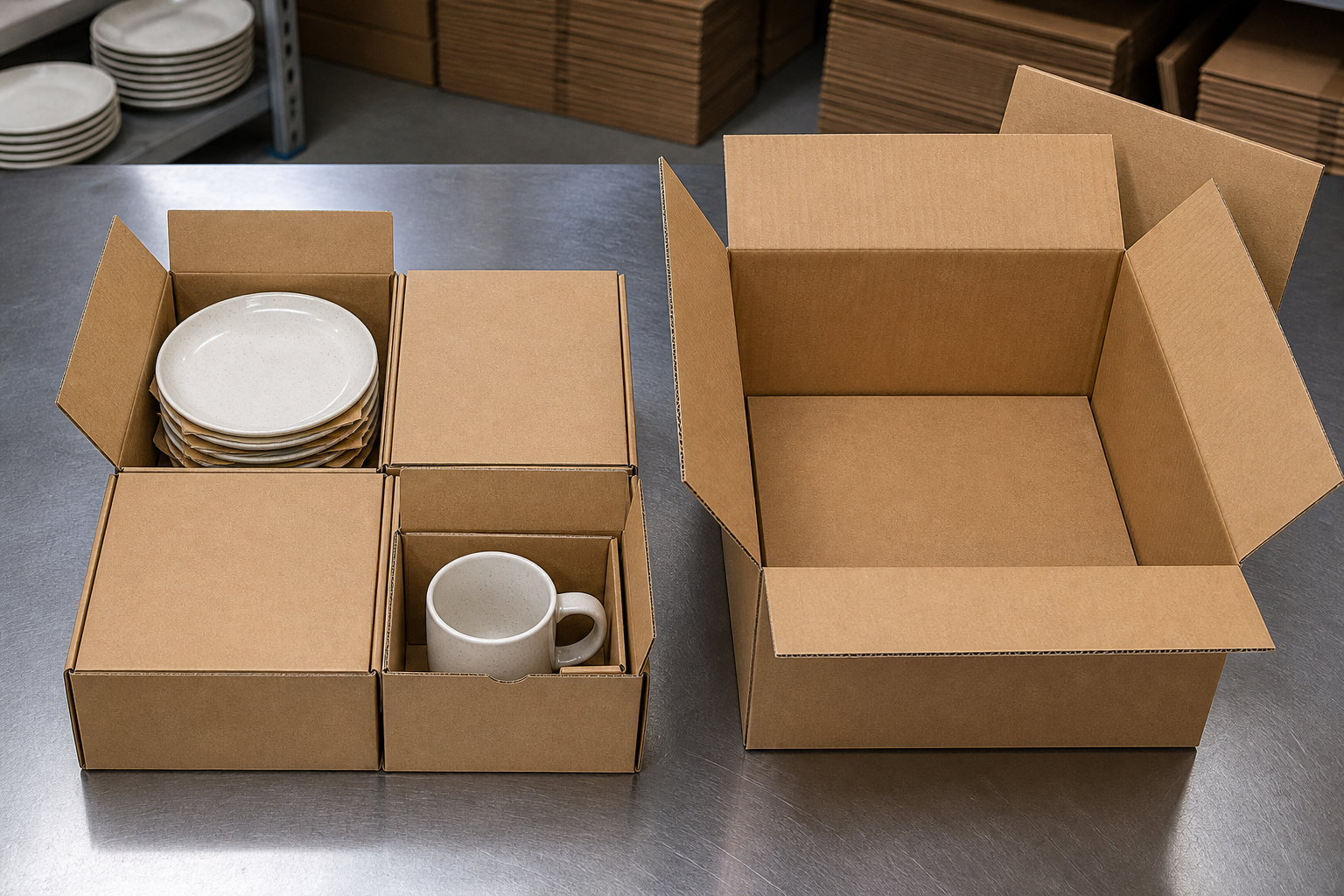
Protection begins at the ceramic surface.
Stop ceramic-to-ceramic contact
Plates and bowls should not knock against each other. Use separators or sleeves that stay in place during vibration. Check the fired dimensions of several production pieces, not only one ideal sample. Ceramic shrinkage creates normal size variation, so a divider that is perfect for one plate may be too tight or loose for another.
Pressure on a foot ring or uneven rim can concentrate impact. I prefer support spread across stable areas with space for cushioning.
Protect the weak points
Rims, handles, knobs, and thin projecting edges deserve special attention. A mug handle should not carry the weight of the mug or touch the outer wall. A plate rim should not sit directly against a hard corner. Lids need control so they cannot jump and strike the vessel.
Check the product shape before choosing an insert. Plates, bowls, and handled mugs transfer shock differently.
Control movement inside the pack
After closing the sample pack, lift and gently move it. A clear rattle or shifting mass is a warning. Do not crush the product tightly; keep every piece in position while cushioning impact. Loose void fill is not a full design because it can move and leave a corner unsupported.
Use This Parcel Packaging Test Plan
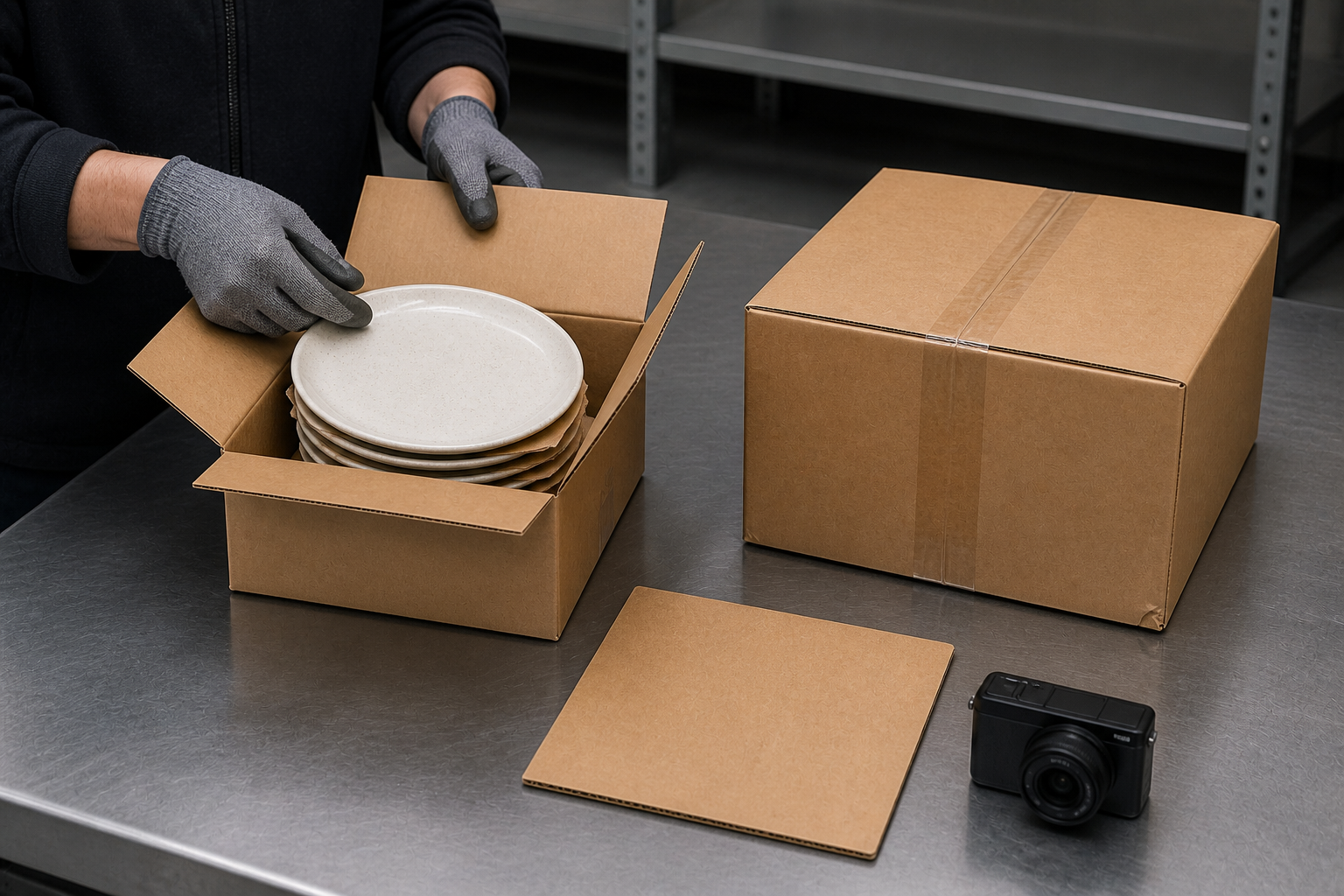
A useful test plan connects each risk to a decision. Do not approve packaging because one sample survived one drop.
| Parcel Risk | Pack Control to Review | Practical Test or Evidence | Approval Question |
|---|---|---|---|
| Corner or edge drop | Outer-box strength, corner space, cushioning geometry | Agreed drop sequence on a production-representative packed unit | Did any piece chip, crack, move, or press through the insert? |
| Repeated handling and vibration | Separators, sleeves, fit, closure | Distribution simulation or controlled vibration plus inspection | Is there rubbing, glaze marking, divider collapse, or piece contact? |
| Heavy parcel stacked above | Carton grade, insert load path, headspace | Compression assessment using actual packed weight and route needs | Does the pack deform and transfer load onto rims or handles? |
| Moisture or weak sealing | Board choice, tape, label, closure | Conditioning appropriate to the route and a sealed-pack review | Does the carton soften, open, or lose label readability? |
| Mixed-SKU order | Modular insert and void control | Trial packs for likely one-, two-, and mixed-item baskets | Can warehouse staff pack each combination consistently? |
| Customer return | Reclosable structure and simple instructions | Open, remove, repack, and resend trial | Can a customer rebuild the protection without special tools? |
The ISTA testing overview explains why packaged-product testing should reflect distribution hazards. A laboratory or packaging specialist can help choose a suitable procedure for the pack, weight, route, and sales channel. A test name alone is not proof: check the tested product, pack version, conditioning, sequence, result, photos, and report date.
Run the Test With Samples
Testing should use the intended clay body, shape, glaze, decoration, and fired dimensions. A plain sample can miss risks caused by a decal, rough foot, or reactive glaze surface. Inserts, board, tape, sleeves, and carton size should match the proposed production pack.
For a collection, test the heaviest set, the most delicate shape, a handled item, and likely mixed orders. If one insert serves several SKUs, test the loosest and tightest fit.
After testing, do not record only “pass.” Open the carton in order and photograph each layer. Note crushed corners, glaze rub, shifted dividers, chips, cracks, and packaging marks. Small movement clues often show where the next failure will begin.
Diagnose Damage Instead of Adding More Material
When a test fails, the answer is not always more foam or a larger box. First locate the break and trace the force path.
- A chipped rim may point to direct rim contact or too little edge clearance.
- A broken mug handle may mean the handle touched an insert or carried load.
- A plate cracked through the center may have been bent by poor support or stack pressure.
- Repeated scuffing may come from vibration and surface contact, not a hard drop.
- A crushed outer corner with intact ceramics may show that the cushioning did its job.
Change one main variable at a time, then retest. Changing the board, insert, gap, product count, and tape together makes it hard to learn which control worked.
Make the Pack Easy to Repeat in a Warehouse
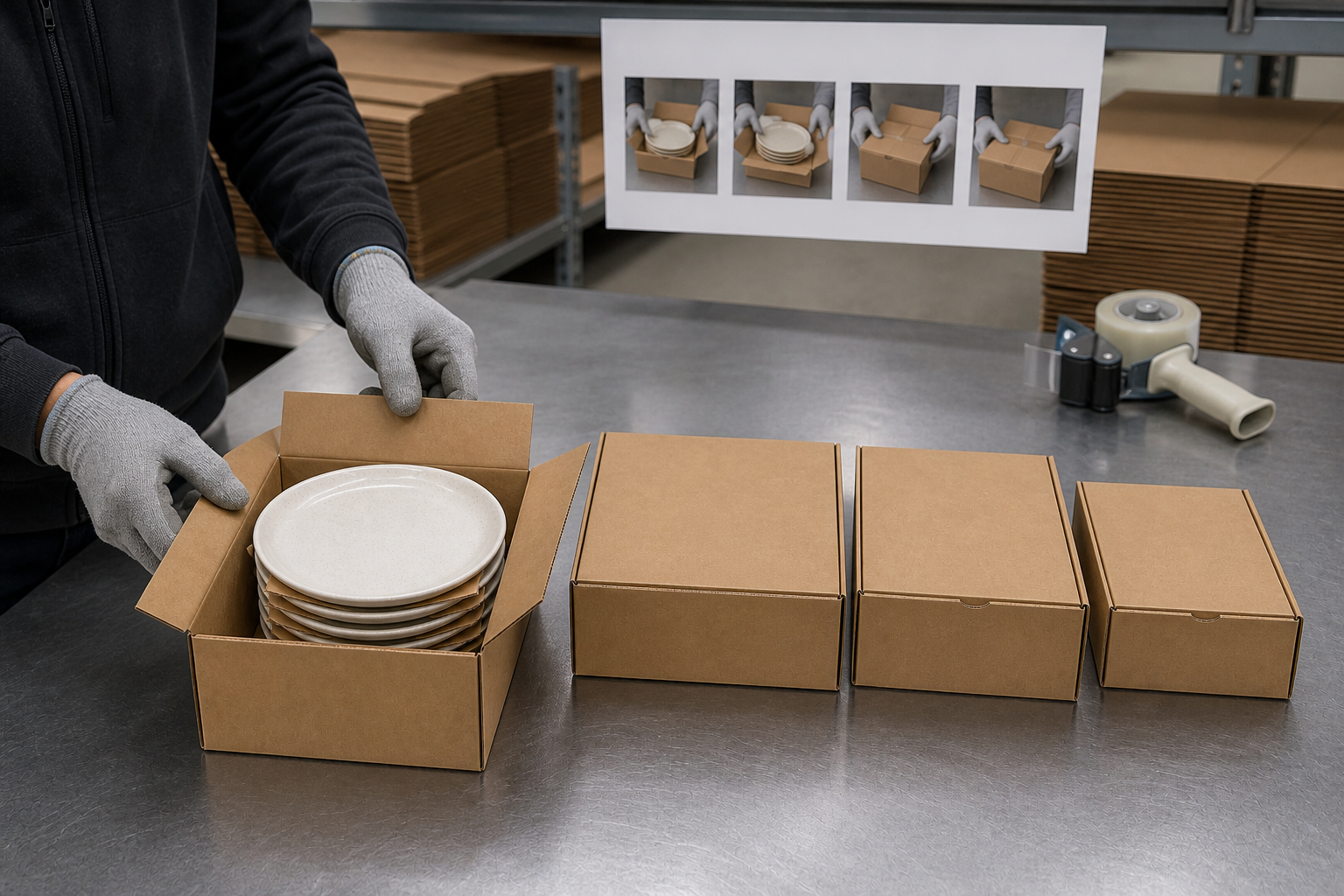
The best prototype still fails if packers assemble it three different ways. Create a standard with photos of every layer, part names, orientation, quantities, closure, and label position.
Run a trial with someone who did not design the pack. Watch for reversible inserts, unclear fold lines, or space filled differently each time. A good result is repeatable without the designer beside the table.
Also confirm packed weight and dimensions. Parcel charges often use actual or dimensional weight, so unnecessary space can increase freight cost on every order. The carrier’s published UPS packaging guidelines and FedEx packing guidance provide useful general handling principles, but your ceramic pack still needs product-specific validation.
Balance Protection, Unboxing, and Material Use
Customers see the pack before they see the glaze. Clean arrangement and easy opening matter, but branding should not weaken protection. A thin gift box may need a separate shipping carton, and a ribbon should not replace a closure.
Use material where it solves a known risk. Ask suppliers for board and cushioning specifications, recycled-content evidence where claimed, disposal instructions, and clear identification of mixed materials. The FTC Green Guides are a useful U.S. reference when reviewing environmental marketing claims. Avoid broad words such as “eco-friendly” unless the claim is specific and supportable.
A short insert can explain care, glaze variation, and what to do if an item arrives damaged. Keep it simple.
Learn From Returns With a Damage Code
Returns are packaging data if the team records them well. Ask customer service and the warehouse to use a small set of damage codes, such as chipped rim, broken handle, cracked body, crushed carton, wet carton, product movement, or wrong pack-out.
For each case, keep the SKU, order configuration, carton size, pack version, route where available, and inside/outside photos. Review patterns by pack version. One delivery proves little; a pattern by corner, SKU, warehouse, or order combination gives a stronger direction.
My Advice as a Manufacturer
Freeze a “golden pack” just as you freeze a golden ceramic sample. Keep the approved box, inserts, sleeves, tape method, labels, pack-out photos, packed weight, dimensions, and test record together under one version number.
Before changing board grade, insert supplier, piece arrangement, carton size, or product shape, ask whether the change affects the test evidence. My simple advice is: make the pack easy to build, hard to build wrongly, and strong enough for the real parcel route—not an ideal trip across the meeting table.
Questions Buyers Often Ask
Is a retail gift box enough for online shipping?
Often it is not. A gift box may support display and unboxing but lack the strength, closure, clearance, or cushioning needed for parcel delivery. Test it as part of the full shipping system, including any outer carton.
How much space should sit between the ceramic and outer box?
There is no safe universal number. It depends on product geometry, weight, cushioning material, carton strength, and route. Agree on a tested pack structure rather than copying a gap from another product.
Can we claim packaging is recyclable?
Only when the claim is accurate for the material and the markets where it is sold. Check coatings, laminates, adhesives, local collection limits, and the evidence behind the wording. Use clear, qualified language where needed.
What should a packaging test report include?
It should identify the product and pack version, sample quantity, packed weight and dimensions, conditioning, test method and sequence, acceptance criteria, results, damage observations, and photos. The report should match the final proposed structure.
Conclusion
Reliable ecommerce dinnerware packaging starts with the parcel journey, protects the ceramic’s real weak points, controls movement, survives a suitable test plan, and can be packed the same way every day. It also gives customers a clear unboxing and gives your team useful damage data after launch.
If you are developing a DTC ceramic line, send FENN your SKUs, likely order combinations, target markets, fulfillment route, current pack drawing, and damage concerns. We can help review the ceramic shapes and packaging structure before you lock the production pack.
Review Your DTC Dinnerware Packaging
Share your ceramic SKUs, likely order combinations, fulfillment route, current pack drawing, and damage concerns with FENN for a practical packaging review.