
Short Answer
Good fast casual dinnerware should separate easily from a stack, hold the menu portion without awkward handling, wash clean in the restaurant’s equipment, and remain easy to replace. I would compare fired ceramic samples during a busy service cycle, then judge purchase price against recorded losses and useful servings. Ask for product-specific test evidence before accepting durability or food-contact claims.
A bowl can look lovely on an empty counter and become a small nuisance by lunchtime. It catches the bowl beneath it. The serving spoon knocks its rim. Staff need two hands where they expected to use one.
I am Kitty, and when I review ceramics for a busy restaurant, I look for these little interruptions. Across many daily turns, they matter. My starting question is simple: what does this bowl ask your team to do every time they use it?
Compare Fast Casual Dinnerware by the Cost of a Useful Serving
Cost per use is the cost assigned to each completed serving, using a clearly stated cost boundary and a measured or assumed service life. It is a planning tool, not a durability certificate.
Here is an illustrative comparison. These are invented planning figures, not FENN prices or promised lifetimes. Both bowls must first meet the same food-contact, menu, and handling requirements.
| Planning input | Bowl A | Bowl B |
|---|---|---|
| Landed purchase cost per bowl | $4.00 | $5.20 |
| Assumed useful servings before removal | 200 | 320 |
| Purchase cost per serving | $0.020 | $0.01625 |
| Purchase cost allocated to 10,000 servings | $200.00 | $162.50 |
Divide landed cost by useful servings. On these assumptions, Bowl B costs more to buy but less to use. To match Bowl A’s purchase cost per serving, Bowl B needs 260 useful servings: $5.20 divided by $0.020.
That break-even number is more useful than a supplier saying “very durable.” Can a trial support the longer life, and can you afford the opening stock?
This comparison excludes washing, labor, storage, and financing. Add those separately if they differ. Do not count the purchase cost again as a replacement charge within the same calculation. Nor should you treat these lifetime allocations as the cash budget for your first order.
A short pilot will not establish a full lifetime. If most bowls are still working at the end, record that fact and keep a range of possible outcomes. Do not turn a week without chips into a claim of years of service.
Follow One Bowl Through the Lunch Queue
I like to compare two candidate shapes on the same menu station. Keep the portion, utensils, staff task, and observation period as similar as possible. The point is to find handling differences, not to stage a perfect photograph.
First, Take It From the Stack
Stackable restaurant bowls need room to separate as well as a stable base. A deep nesting shape may save shelf height yet wedge when its dimensions vary slightly.
Ask the restaurant bowl supplier to state the height of an agreed stack, not just the height of one bowl. Try several fired pieces together. Note sticking, rocking, and the grip staff need to lift the top piece without touching its food-contact surface.
From a factory point of view, fired diameter, wall angle, foot-ring shape, and shrinkage variation all affect this fit. A drawing alone cannot show the full result. I want approved dimensions and tolerances linked to a real stack of samples.
Next, Fill It at Normal Speed
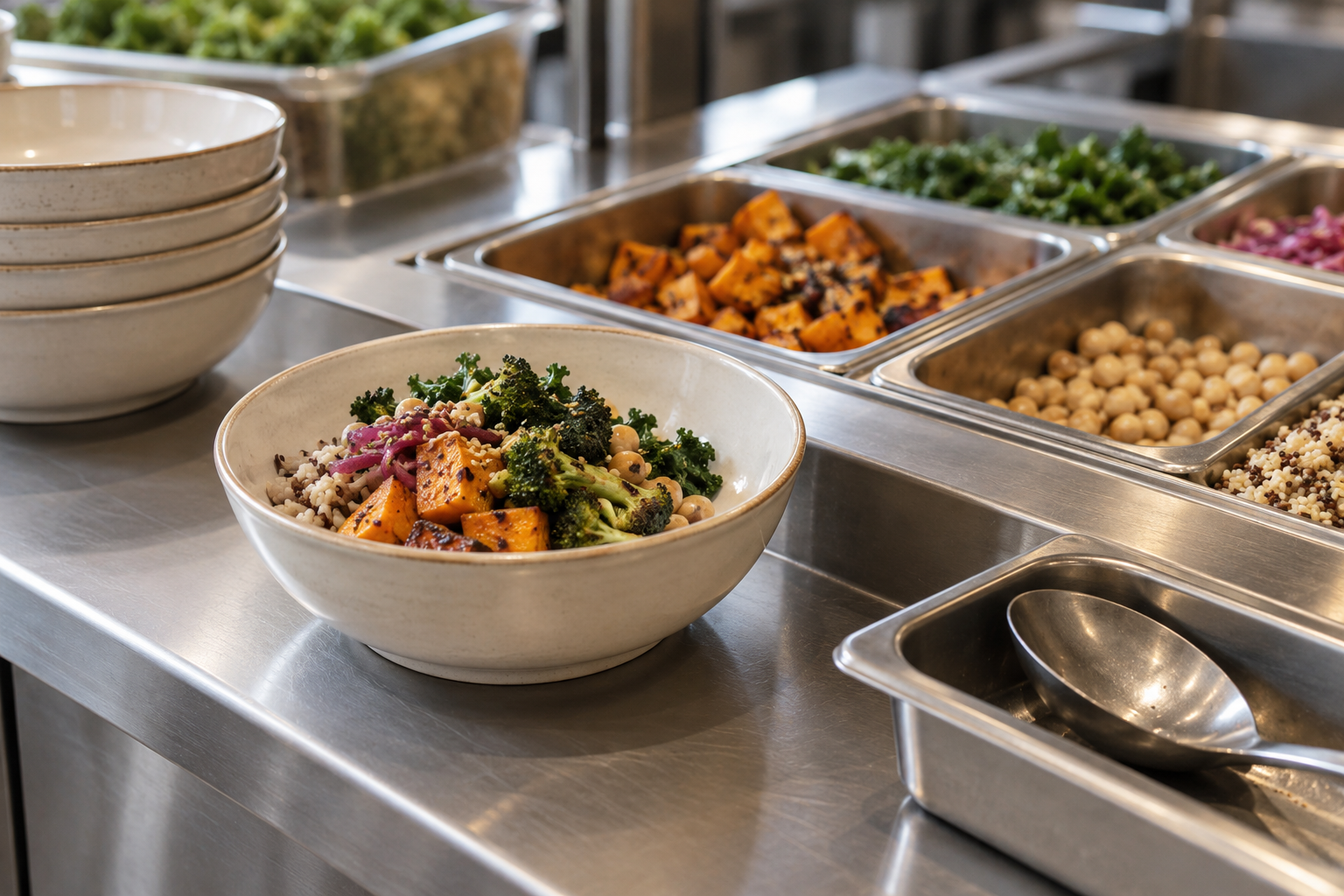
Use the actual rice, salad, noodles, or other menu portion. Water capacity does not tell you how a mound of food sits under the serving spoon.
Watch where the spoon meets the rim and whether toppings spill during normal carrying. A wide opening can make filling easier, but extra width may take space from the next order on the counter. A taller bowl can hold the portion yet feel awkward on a tray.
The useful judgment is whether staff can fill and hand over the bowl comfortably with the planned portion. If they must slow down or change their grip, record the reason before asking for a larger size.
Then, Watch the Return Point
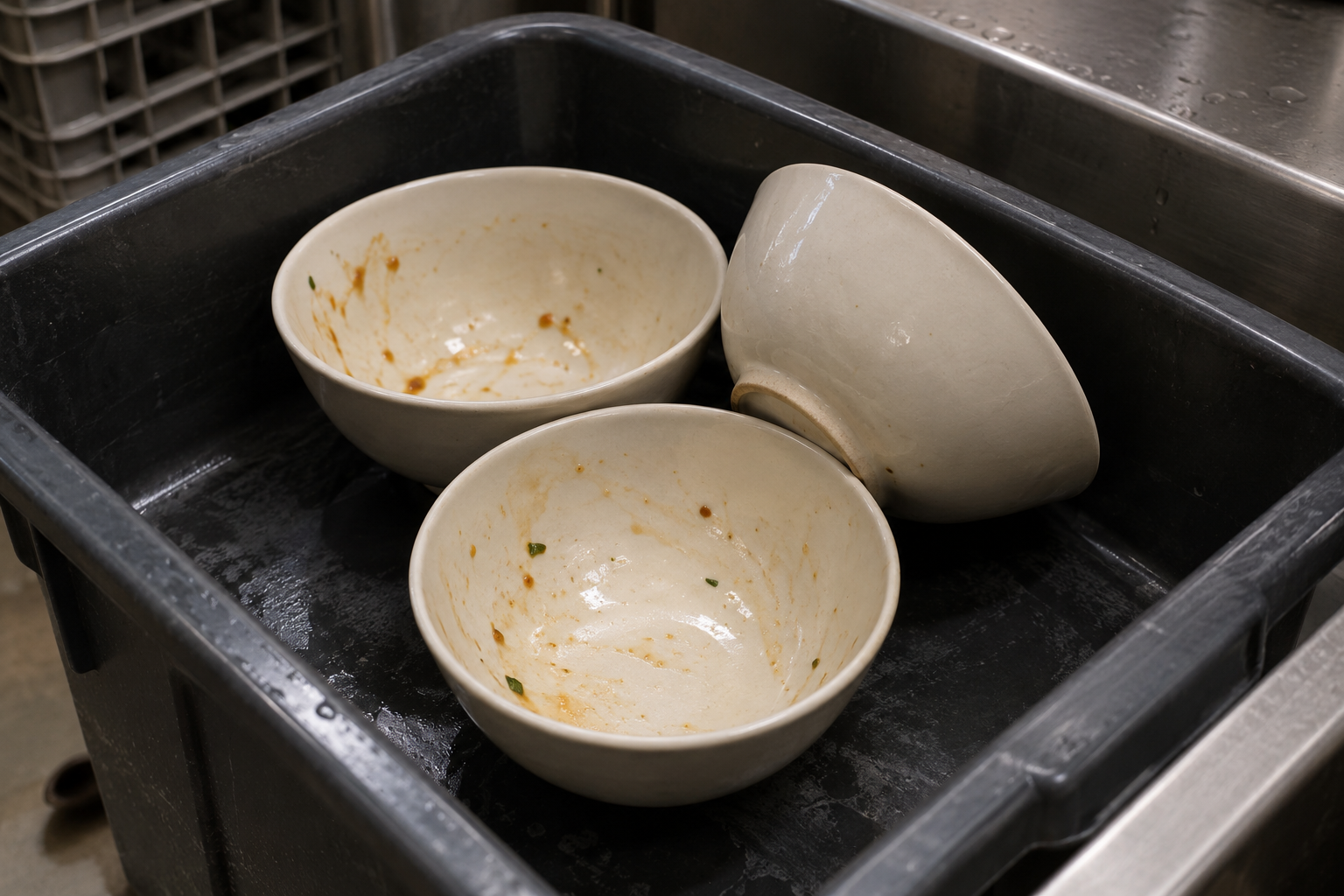
The return station is where I look for avoidable ceramic-to-ceramic contact. A tall pile inside a bus tub can put rims against hard foot rings. Heavy bowls can also make a full tub difficult to handle.
Observe normal work without deliberately dropping or striking pieces. Record where contact occurs, then discuss both the bowl design and the handling method. A thicker rim may help a particular design, but added thickness is not proof of chip resistance. Rim profile, body quality, firing, and contact geometry work together.
For durable ceramic bowls for restaurants, I ask for the chip-test method, sample identity, number of pieces, and results. Results from unlike methods should not be ranked as if they were the same test.
Let Washing Costs Challenge the Cheap-Bowl Assumption
A low unit price loses some appeal if the shape fits fewer pieces in a rack or needs frequent rewashing. Count the bowls that fit with suitable spacing; do not force extra pieces into contact to improve the number.
The ENERGY STAR commercial dishwasher guidance gives useful equipment context, including different machine and sanitation types. Its equipment criteria do not certify a ceramic bowl or predict your cost per bowl.
Run samples under the site’s actual approved wash procedure. Record the machine, detergent, cycle conditions, loading arrangement, and inspection points. Ask the supplier which conditions its dishwasher claim covers. A domestic dishwasher statement alone does not establish performance in your commercial routine.
After the agreed cycles, check for glaze change, persistent marks, rough areas, and fine cracking. Glaze thickness, body-glaze fit, and decoration method can affect the result. A change of glaze or decoration may therefore need a new review, even when the shape stays the same.
Include drying and storage in the trial. Follow the site’s hygiene procedure, and allow proper air drying before storage. Saving shelf space is not a reason to pack wet bowls into tight stacks.
For US operations, the FDA Food Code is a model used by jurisdictions to develop food-service rules. Check the rules adopted where the restaurant operates; the model itself is not a product approval.
Keep a Loss Ledger That Leads to a Decision
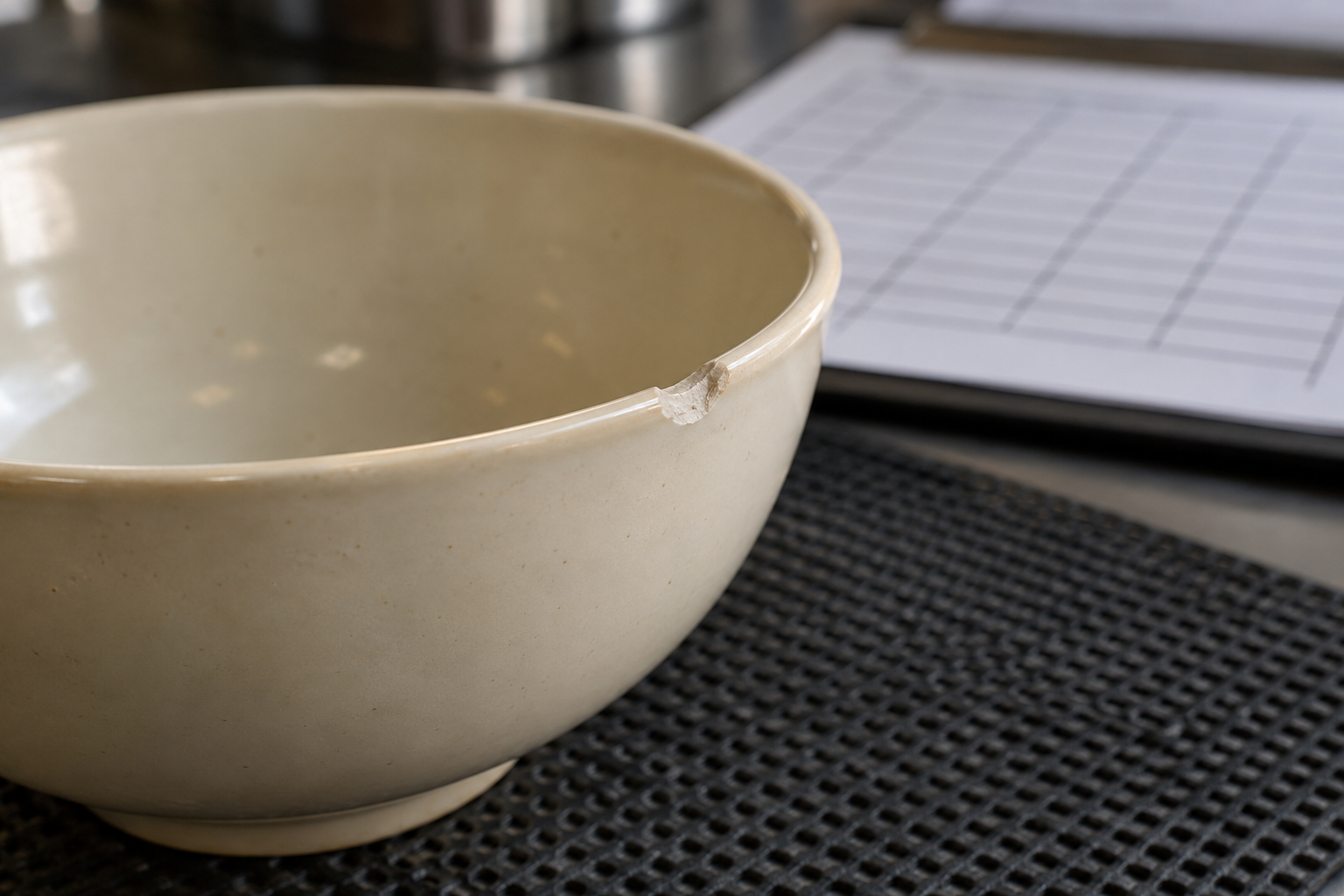
One total labeled “breakage” hides too much. A bowl removed for a chip needs a different response from one that disappeared into takeaway service.
Use this simple record for each candidate over the same observation window:
- Opening usable quantity and any additions.
- Completed servings using that bowl type.
- Pieces removed for chips, cracks, surface damage, or other specified reasons.
- Missing pieces recorded separately from damage.
- Closing usable quantity and the location of each observed problem.
- Rewash events and handling delays recorded separately from removals.
Reconcile the stock: opening quantity plus additions, minus removals and missing pieces, should equal closing usable quantity. Investigate a mismatch before calculating a loss rate.
For example, 12 damaged pieces over 6,000 servings equals two damaged pieces per 1,000 servings. If another six pieces are missing, record one missing piece per 1,000 servings separately. These are example calculations, not acceptable-loss targets.
Do not score safety against price. Hold a candidate if product identity or required compliance evidence is unresolved, or if the trial reveals cracking, unstable stacking, or an unworkable cleaning problem. Among suitable candidates, compare handling and cost using your own priorities.
Food-contact evidence belongs outside the loss ledger. FDA guidance on lead in food and foodwares explains why pottery can require attention to lead release. Ask a qualified lab to confirm the applicable lead and cadmium testing for your destination and product. Reports should identify the relevant body, glaze, decoration, item type, method, and results; an unrelated white plate report is not enough for a decorated bowl.
Make the Replacement Order as Simple as the First Order
A multi-site chain needs a bowl that can be reordered without restarting the project. Before launch, agree the SKU, fired dimensions, glaze reference, permitted variation, pack quantity, reorder minimum, and expected lead time in writing.
Keep a retained sample and test incoming replacements with existing stock. Small changes in the foot ring or fired profile can change nesting. A replacement that looks close enough in a photograph may still interrupt the lunch line.
For the first range, I usually prefer fewer core shapes with clear menu jobs. Add a second bowl when a different portion or service task justifies it. Extra colors and shapes bring more stock decisions, even when they share a factory.
My Advice as a Manufacturer
I would rather hear “the bowl catches when we lift the seventh piece” than “please improve quality.” The first comment gives the factory something it can measure and correct.
Start with actual fired samples. Agree how you will judge stacking, rim contact, cleaning, and replacements. Then connect every revision to that record. If the body, glaze, or shape changes, ask which previous checks remain valid and which must be repeated.
Questions Buyers Often Ask
Is porcelain always the best material for fast-casual service?
No. I would compare the finished shape, weight, rim performance, glaze, and test evidence. A material name alone does not establish service life or handling quality.
How many dishwasher cycles should we request?
Agree the method, conditions, inspection points, and pass criteria with the supplier or testing lab. There is no single cycle count that proves suitability for every commercial kitchen.
Should we choose the bowl with the lowest pilot loss rate?
Only after checking comparable exposure and the causes of loss. A small trial can be noisy, and a bowl used less often has had fewer chances to fail. Keep observing when the difference is uncertain.
Can we use one bowl across all locations?
Possibly, but check the smallest shelf, relevant wash racks, menu portions, and return arrangements across the sites. Approving one flagship kitchen does not confirm every location fits.
Choose for the Next Busy Lunch
The best fast casual dinnerware for your business earns its place through easy handling, sound evidence, and predictable replacement. I would pay attention to the full trip from clean shelf to return station, then use the numbers to test the buying decision.
You can also find related sourcing guidance in our FENN Resources.