
Short Answer
A UK ceramic dinnerware importer should define whether goods will be sold in Great Britain, Northern Ireland, or both; match food-contact evidence to the finished ware; and agree who handles import records and product information. Ordinary ceramic plates, bowls, and mugs do not need UKCA marking simply because they are sold in the UK. Check the applicable product rules before printing any conformity mark.
For a UK sourcing brief, I would start with a plain question: where will these pieces actually be sold?
“UK market” sounds clear. But it may mean a shop in England, a distributor in Belfast, or an online store delivering to both. The ceramic shape may stay the same while the document review changes.
I would rather settle that detail over the first sample discussion than discover it when the boxes are printed. Here are five assumptions I would question before approving an overseas order.
Five Assumptions a UK Ceramic Dinnerware Importer Should Check
| Assumption | What changes the answer | Useful buyer action |
|---|---|---|
| Every UK product needs UKCA | The product category and applicable marking rules | Ask which rule requires the proposed mark. |
| One UK destination covers every sale | GB and NI can follow different regulatory arrangements | List final sales territories and the shipping route. |
| An EU report is either useless or automatically enough | The tested article, methods and applicable requirements | Ask for a written review of what can be reused. |
| A delivered quote transfers all responsibility | The agreed import arrangements and each business’s legal role | Name who declares, pays, keeps records and handles queries. |
| The retail box contains everything anyone needs | Loose sales, replacement pieces and retailer systems | Review information at the actual point of sale. |
My test for a useful supplier answer is simple: can the answer be tied to a particular product, market and document? “We export everywhere” does not answer those questions.
Assumption 1: Every Plate Needs a UKCA Mark

UKCA tableware is a confusing search phrase. UKCA is not a general food-safe stamp for ordinary ceramic dinnerware.
The government’s UKCA and CE marking guidance explains that conformity marking is required only where the relevant sector rules call for it. Applied to ordinary, unpowered ceramic plates, bowls and mugs, the practical conclusion is that UK sale alone does not create a UKCA requirement.
I would not add the logo to a plate base just to make the product look more official. Ask the person requesting it to identify the product regulation first.
Scope matters. A ceramic mug supplied with an electric heating device needs a separate review of that device and the whole offer. A toy tea set is another different question. Do not transfer an answer about ordinary dinnerware to those products.
For a normal dinnerware order, ask for relevant food-contact evidence and product identification. A decorative mark cannot replace either.
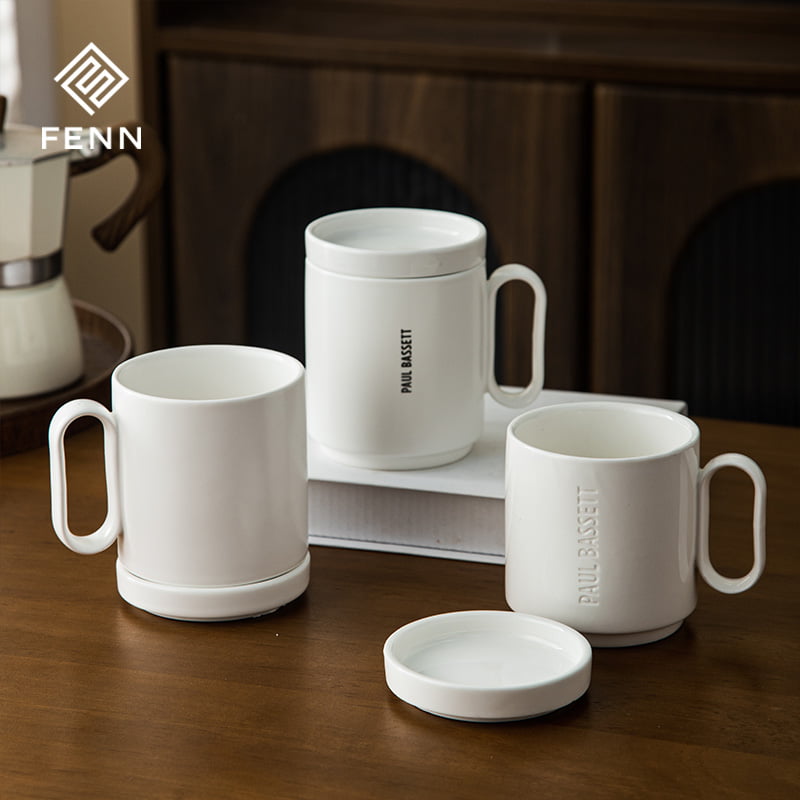
Our Porcelain Mug with Lid product photographs give a useful visual reference: a white cup with an oval handle and a matching shallow piece. I would identify the supplied ceramic articles first. The coffee maker in the styled photograph is a separate object, not evidence that an electrical appliance belongs in the mug order. Ask the supplier to list exactly what the quote includes.
Assumption 2: Great Britain and Northern Ireland Are One Approval Route

Great Britain means England, Scotland and Wales. Northern Ireland is part of the UK, but relevant EU food-contact rules can apply there under the Windsor Framework. A warehouse address in England does not, by itself, describe every market your online store serves.
The FSA’s guidance on GB and NI food-contact differences gives a concrete example through BPA rules for certain materials. It is not a blanket BPA-testing instruction for every ceramic plate. It shows why a buyer should check destination and material scope together.
For example, a ceramic storage mug might include a plastic lid and a separate seal. I would give the reviewer the complete component list. A report for the fired ceramic body does not explain the lid material.
Ask your compliance adviser or laboratory to confirm the current requirements for the relevant nations and components. Ask the broker separately about the actual movement of goods. These are connected tasks, but they are different tasks.
A useful answer names the markets covered and any exclusions. “Suitable for Europe” is too broad to approve packaging.
The FENN photograph shows the matching shallow piece holding food beside the cup. If your offered lid is also intended as a small dish, include that use in the review instead of describing it only as a cover. This photograph does not establish a plastic or silicone component; the mixed-material mug above is a hypothetical example, and the actual bill of materials must decide the review.
Assumption 3: An EU Test Report Is Either Useless or Enough
I would avoid both extremes. A change in destination does not automatically make good laboratory data worthless. Equally, an EU heading on a report does not settle a UK product file.
Ask the laboratory to compare the existing evidence with the requirements for your finished article and intended market. The FSA food-contact regulations overview provides a starting point for England, Wales and Northern Ireland. It is an older overview, so ask the reviewer to check current amendments and the relevant Scottish rules where needed.
From a factory point of view, product identity deserves just as much attention as the report title. I would check the body, glaze, decoration, food-contact surfaces and firing route against the approved sample.
Consider a cream mug that later gains a coloured interior. It may use the same mould, yet the food-contact surface has changed. A professional supplier should flag that change for review instead of quietly attaching the old report.
Three records serve different jobs:
- Test report: what was tested, how it was tested and the results.
- Food-contact declaration of compliance: the responsible business’s statement against applicable requirements, identifying the covered articles.
- Production and batch records: the connection between the approved configuration and the supplied goods.
Ask for the applicable ceramic declaration and its supporting evidence. Do not confuse it with a UKCA declaration of conformity template. Have the responsible reviewer confirm the required wording and supply-chain arrangements.
The best response is a clear explanation of coverage, gaps and any additional testing. A new date typed onto an unrelated report is no improvement.
Assumption 4: A Delivered Price Makes the Import File Someone Else’s Job
A quote can cover transport without explaining who will act as importer, submit declarations or retain records. I like the purchase order to make those responsibilities visible before the shipment is booked.
The government’s import goods into the UK guide covers the main preparation steps, including registration, declarations, classification and taxes. The exact route needs confirmation for your transaction.
Ask who will handle customs clearance, whose relevant EORI will be used, what the quoted price includes, and who will answer a query after arrival. Compare the reply with the written delivery terms. Do not assume that paying a freight charge removes your product obligations.
Ceramic material descriptions also matter. The HMRC ceramic classification guide distinguishes ceramic materials and product uses. Give your broker an accurate material specification and product description, rather than asking them to classify a photograph labelled “dinner set.”
I would ask the supplier to confirm whether the body is porcelain or another ceramic material and identify every item in a mixed set. The broker should check the current classification, origin treatment and any applicable trade remedies. An attractive glaze name is not a customs description.
Assumption 5: The Box Solves Every Information Requirement
Picture a retailer opening a six-mug pack and selling the mugs separately. If all useful identification stays on a discarded outer carton, the shop may struggle to connect a customer complaint with the original delivery.
I prefer to review the sale unit before signing off artwork. Is the customer buying one mug, a pair or a complete dinner set? Can a replacement piece still be traced after the original packaging is gone?
Have the responsible UK business approve the required names, contact information, identification and use instructions, including where they must appear. The supplier can prepare printing files, but should not guess the final legal wording or borrow it from another customer’s pack.
Then check retailer needs separately: barcodes, item names, pack quantities, capacity descriptions and care copy. These may be commercial listing requirements rather than universal legal rules.
Keep performance claims separate too. Food-contact evidence does not prove microwave or dishwasher performance. If a metallic decoration is added, revisit the intended-use claims before reusing the plain version’s artwork.
The FENN group photograph shows plain, printed and raised-letter versions of a white mug. I would give each ordered version a clear item code and connect it to its approved artwork and evidence review. The photograph is a way to explain variant identity, not a claim that those versions have identical materials, testing or UK approval.
Try This With a Two-Destination Mug Order
Here is a hypothetical example. A brand orders a ceramic mug with a removable lid for shops in England and a distributor in Northern Ireland.
I would keep one controlled manufacturing specification for the unchanged product, with separate destination reviews attached. The ceramic, lid and seal each need clear material identification. The reviewer records which existing evidence supports each market and what remains open.
The commercial team then checks the shipping arrangements and agrees the approved information for each sale unit. If both markets can use the same artwork, record that decision. If they need different versions, give the versions clear codes.
This avoids paying for duplicate work without assuming every requirement is identical. It also gives the factory something practical to follow: the right component specification and the right artwork version for each order line.
My Advice as a Manufacturer
I like a short, accurate file more than a large folder nobody can explain.
When you assess a ceramic dinnerware UK supplier or an overseas factory, notice how they handle an unanswered question. A careful partner identifies the gap, supplies the manufacturing facts and agrees who will confirm the answer. That is more useful than promising one certificate for every market.
Before bulk production, freeze the approved body, glaze, decoration and accessories. If any of those change, reopen the affected review. That small habit helps keep the paperwork connected to what leaves the kiln.
Questions Buyers Often Ask
Do ordinary ceramic mugs need UKCA marking?
Not merely because they are sold in the UK. Check the applicable category; electrical accessories or toy products require their own assessment. UKCA is not a substitute for food-contact evidence.
Can I reuse a report prepared for EU buyers?
Possibly. Ask a qualified reviewer to check the tested product, methods and requirements against your destination. Reuse needs a documented basis, not just a familiar report heading.
Must every colour be tested separately?
Do not decide from appearance alone. Ask the laboratory whether grouping is justified for the specific glazes, decorations and articles. Keep the written rationale and control later changes.
Can one packaging design cover GB and NI?
It may, if it meets the applicable requirements and retailer needs for both. Confirm that before printing; one shared design should be an approved decision, not an assumption.
Bring the Market Details to the Sample Discussion
For a UK ceramic dinnerware importer, the useful starting point is the finished product and its sales route. Settle those details early, then build the evidence and product information around them.
Contact FENN with your GB and NI destinations, SKU list, accessories, decoration plan and existing reports. I can help organise the manufacturing information for your market review. Our FENN Resources hub also has practical guides on sampling, quality and packaging.