
Short Answer
Source branded ceramic tableware by working backward from the date gifts must be received. Define the gift set, quantity, logo method, destination, packaging, and approval owner before requesting a quote. Ask for a fired decorated sample, a complete packed sample, and a dated production plan. A dispatch date alone does not protect your event deadline.
I like corporate gifts that people keep using after the event. A comfortable mug or a useful small plate can do that beautifully. But when I review a gift project, my first question is usually about the calendar. The ceramic piece may be straightforward; three approval teams and five delivery addresses can make the project much harder.
Copy This Branded Ceramic Tableware Project Brief
Send this short brief to each supplier so their answers cover the same job.
- Occasion and recipient: [staff welcome / client gift / event; intended adult user].
- Gift contents: [pieces per set, dimensions, usable capacity where relevant].
- Quantity: [complete gift sets, plus separately agreed spare pieces and boxes].
- Design route: [existing shape and glaze / new glaze / new shape].
- Artwork: [approved file version, colors, dimensions, placement, rights holder].
- Use and care: [food use, washing expectations, any heating claims to review].
- Destination: [country, receiving address, onward delivery route].
- Dates: [event date, required receipt date, receiving window, approval deadlines].
- Packaging: [set layout, gift box, card, transport protection, language versions].
- Budget: [currency and allowance per delivered set; list included costs].
- Approval owners: [brand, purchasing, product review, final release contact].
- Fallback: [which design details can change if the schedule slips].
My quick judgment rule: a useful supplier reply identifies assumptions, missing decisions, and the next approval date. “Yes, no problem” tells me very little unless it comes with those details.
For example, “500 gifts for December” is incomplete. A stronger brief says, “500 two-piece sets received at our warehouse before the event, one approved artwork version, one named release contact, with onward parcel delivery.” Add the actual dates and destination before asking for a firm schedule.
Put the Receipt Date at the Top of the Page
An event date, a warehouse receipt date, and a factory-ready date are different promises. I want all three visible. If a venue only accepts goods during a short booking window, early delivery may also cause trouble.
Build the schedule backward. Allow time for receiving checks and distribution, transport and clearance, final inspection and packing, production, and sample approval. Ask the supplier which steps can overlap and which depend on a signed decision. Printed boxes can sometimes be prepared alongside ceramics, but their fit still needs confirmation with the actual fired pieces.
Here is a planning example, not a FENN lead-time promise. Suppose the agreed allowances are seven calendar days for receiving and distribution, 28 for freight and clearance, 35 for production and packing, and 14 for sampling and approvals.
| Milestone counted back from gift day | Illustrative timing | What must be confirmed |
|---|---|---|
| Gifts ready for recipients | Day 0 | Local distribution finished |
| Goods received at the nominated warehouse | Day -7 | Receiving slot and checking team booked |
| Shipment leaves the agreed origin point | Day -35 | Transport plan and documents ready |
| Production release | Day -70 | Samples, artwork, quantity, and pack approved |
| Sampling begins | Day -84 | Complete brief and usable artwork received |
Those allowances total 84 days. They do not include a separate contingency or a failed sample round. Replace every allowance with project-specific information, confirm whether days mean working or calendar days, and add an explicit buffer. A freight estimate is not a guaranteed arrival date.
A professional schedule also names the consequence of a late approval: a revised receipt date, a simpler design, or a priced alternative transport plan. “We will catch up later” is not a schedule.
Give Marketing a Fired Sample to Approve
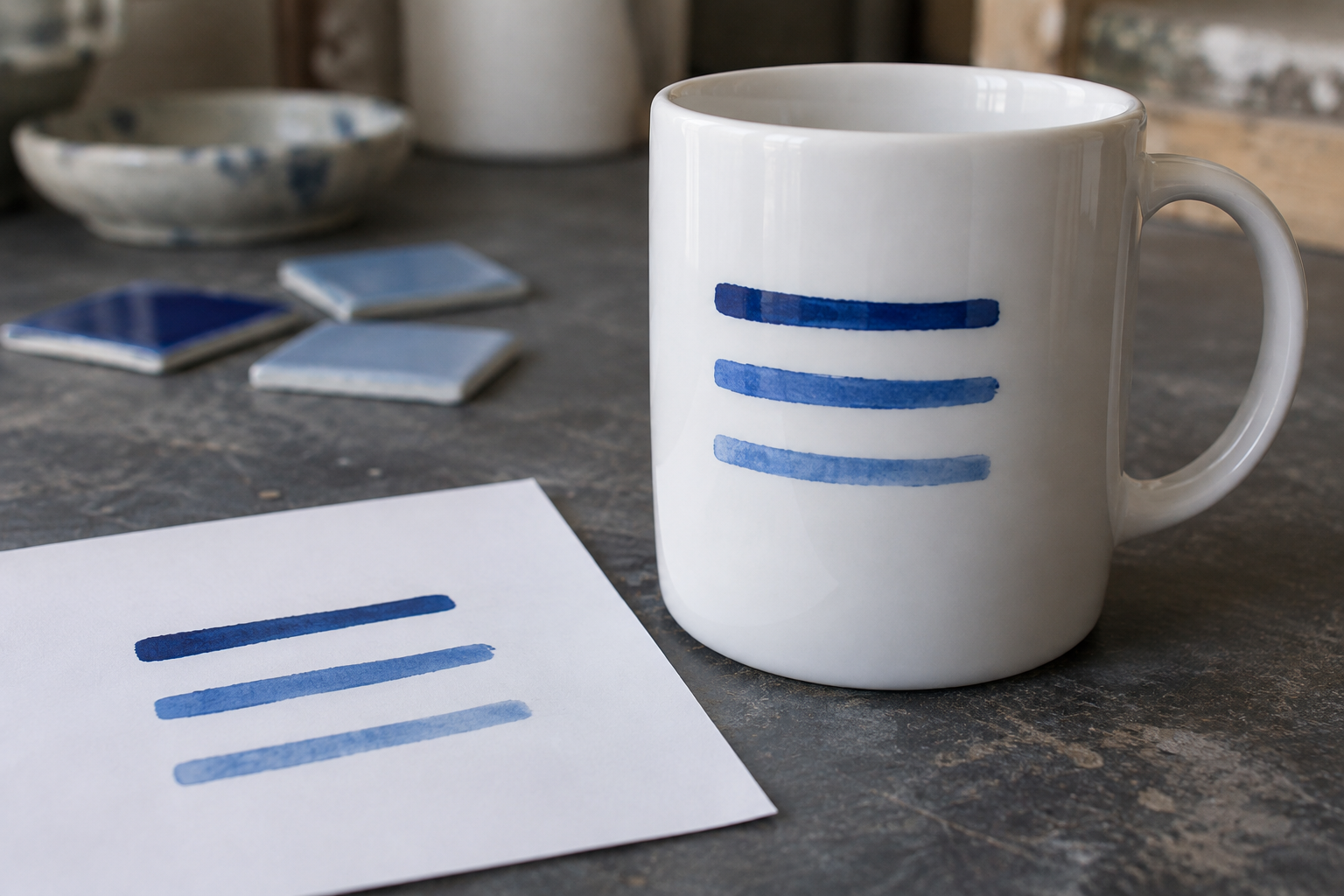
The artwork file controls the design; the fired sample shows what that design looks like on ceramic. I ask buyers to approve both.
A flat screen proof cannot show how a mark looks around a curved mug or over a glaze that varies slightly. Ceramic decoration may change during firing. Fine lines, small lettering, and exact color expectations need review on the selected body and glaze, using the proposed decoration process.
Ask the supplier to name the process rather than simply writing “logo printing.” Is the mark under the glaze, in the glaze, or applied over a fired glaze with a further firing? What supporting evidence covers the proposed use and care claims? The method name alone does not answer those questions.
For corporate gift ceramic plates, decide whether the mark belongs on the underside, the rim, or the eating surface. An underside mark can keep the front quiet, but its position still needs a drawing that relates it to the foot ring. Do not assume one placement is automatically exempt from review.
I prefer a signed sample reference with the artwork version, size, placement, decoration process, and agreed appearance range. If a brand color cannot be matched closely enough, discuss a simpler mark or printed sleeve before releasing production.
Keep artwork permission in the brief too. WIPO trademark guidance is useful background; it does not confirm permission for your particular project. Ask the company commissioning the gifts to confirm which marks may be reproduced and who can approve changes. An agency’s draft file is not the same as final brand approval.
Count Complete Gifts Before Comparing Unit Prices
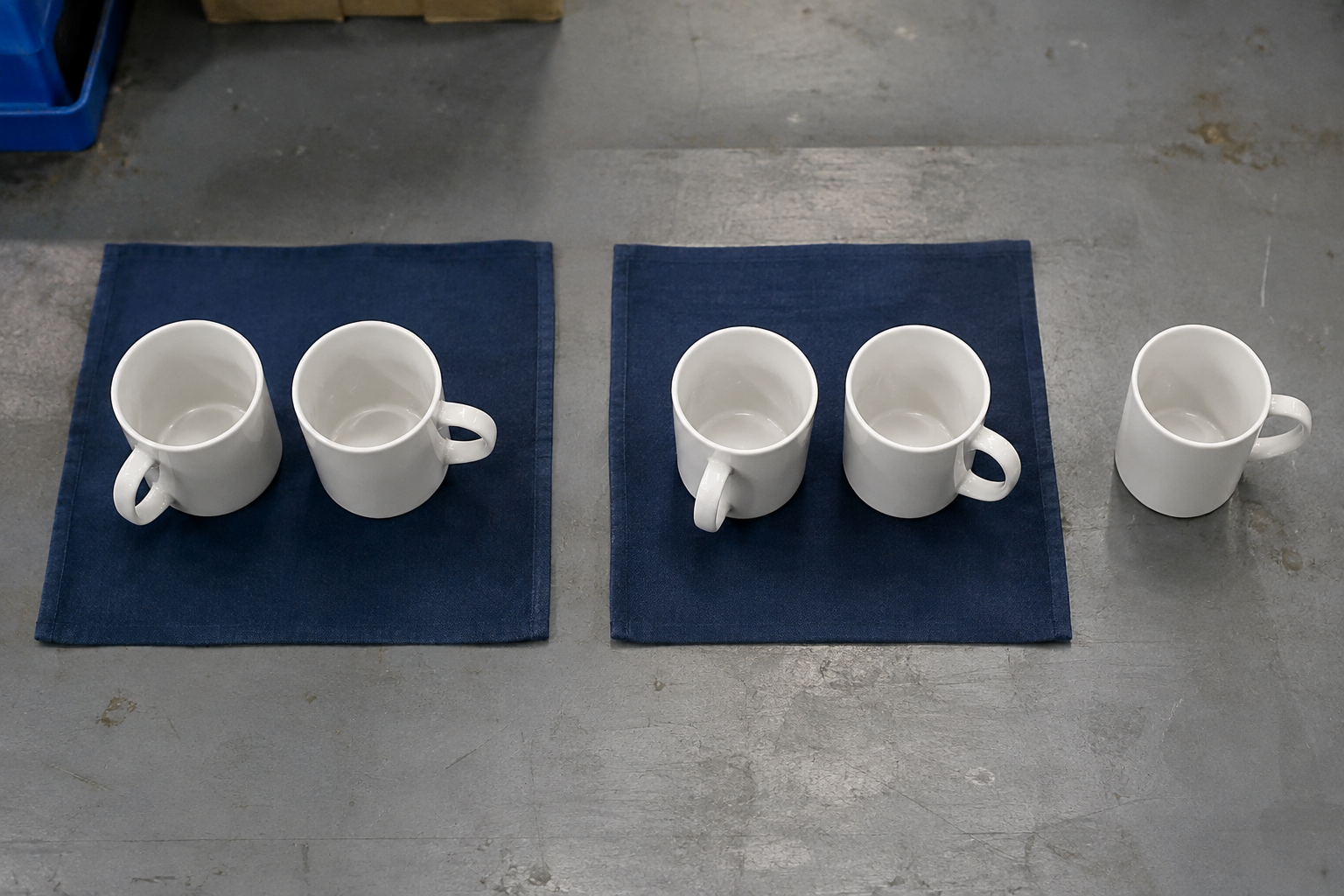
A quote for 600 mugs is not a quote for 600 two-mug gifts. It sounds obvious until purchasing, marketing, and the packing team use different units.
Take an illustrative order for 300 two-mug sets. The gift allocation requires 600 mugs. If the buyer separately chooses 12 spare mugs, the ceramic total becomes 612. That does not automatically mean 306 gift boxes: the buyer must decide whether spares are packed as gifts or held as replacement pieces.
Give each destination its own set count, card version, and receiving contact. Check that the destination totals equal the approved order. If individual names are added, agree how the final list is checked and frozen before printing. A late name correction can affect one item while holding up an entire packing batch.
Ask for minimum quantities by component: ceramic shape, glaze, decoration, printed box, and card. An existing mold can reduce development work, but it does not guarantee immediate stock or remove decoration and packaging setup costs.
Then compare the same delivered scope. Include sampling, decoration setup, packaging, inspection, freight, and any destination charges allocated to the buyer. Have the supplier state the delivery term and named place. Otherwise, the cheapest unit price may simply leave more work outside the quote.
Approve the Gift as a Usable Product
A gift mug is still something the recipient may drink from. I would not let a tight event schedule push product suitability into a final paperwork exercise.
Define the intended use and destination early. Ask a qualified laboratory or compliance adviser what evidence is needed for the finished body, glaze, and decoration. FDA guidance on lead in food and foodwares is a useful US starting point, not a certificate for an individual product or a complete market checklist.
When reviewing a report, match the sample description and photographs to the ordered item. Check the decoration, test scope, result, and identity of the issuing laboratory. A report for an undecorated white mug should not be accepted without assessing whether it covers the final decorated version.
Agree care wording from supporting evidence. Do not transfer a dishwasher or microwave claim from a plain item to a newly decorated one without review. The card and box should tell the same care story.
Name the Person Who Receives the Cartons

Delivery to one company warehouse and delivery to hundreds of homes are different projects. I ask where the factory’s packing responsibility ends and who prepares any onward parcels.
Approve one complete packed set, including the card and the transport protection around the gift box. Ask for packing instructions that someone at the receiving warehouse can follow. A decorative sleeve is presentation, not proof of shipping protection.
Use the ISTA test procedure guide as a starting point for a discussion with the packaging specialist. The appropriate evaluation depends on the actual shipping route and packed configuration. A test report should identify the pack version and contents; it should not be treated as a promise that every delivery will arrive undamaged.
For an event, confirm unloading access, receiving hours, storage space, and who checks the goods. Hold replacement stock where it can reach the event in time. Spares sitting overseas may offer little help on the morning gifts are handed out.
My Advice as a Manufacturer
I would put one person in charge of collecting approvals, even when several teams need to comment. Give that person a short release record covering the product, artwork, packed sample, quantity split, and required receipt date.
When time becomes tight, simplify the part that has not been approved. An existing shape with restrained decoration may be more practical than a new mold and special glaze. Keep the product checks and ask for a revised plan. A rushed promise is less useful than a clear choice.
Questions Buyers Often Ask
What is the minimum order for custom ceramic gifts?
It depends on the selected shape, glaze, decoration, and packaging. Ask for the minimum for each component and the cost of a simpler alternative. One headline MOQ may hide a higher minimum for printed boxes.
Can we approve a photo instead of receiving a sample?
Photos help check layout, but they cannot fully show fired color, handling, or pack fit. I prefer physical approval for a new design. If the project uses an already approved item, document exactly what stays the same and what needs fresh review.
Should every recipient’s name go on the ceramic?
Only if the schedule and checking process support it. A personalized card may be easier to correct. Ask how names, quantities, and replacement pieces will be matched before choosing individual ceramic decoration.
How many spare gifts should we order?
There is no useful universal percentage. Consider attendance uncertainty, shipment history, replacement time, and whether extra pieces can form complete sets. State the spare allocation separately and decide where it will be held.
Bring the Brief Before the Deadline
Good branded ceramic tableware starts with a usable object and a realistic handover plan. I want the recipient to enjoy the gift, and the buyer to know exactly what has been approved.
You can also use the FENN Resources hub to prepare your sampling and packaging questions.