Short Answer
A retail dinnerware supplier should provide more than approved samples. Before listing a line, the retailer needs one controlled launch package covering SKU data, dimensions, materials, care and safety claims, food-contact evidence, barcodes, unit and master-carton details, product images, replacement rules, and reorder timing. Check every field against the finished product and packaging before stock leaves the factory. Missing data can delay a listing even when the dinnerware itself is ready.
When a buyer tells me, “The plates are approved, so we can launch,” I usually ask to see the product-data file. In my experience, that question finds the real gap. A beautiful ceramic line can still sit in a warehouse because a barcode will not scan, a carton size is wrong, or a product page uses a claim nobody has checked.
Retail readiness is the bridge between a good ceramic product and a product that can actually be received, listed, sold, replaced, and reordered.
Build One Retail Launch Package
I prefer one shared package with clear version numbers instead of details spread across emails. The file can be a workbook plus folders for reports, artwork, and images. Each SKU should have one row, including every color and pack configuration.
Use this copy-ready index:
1. SKU master: retailer SKU, supplier code, product name, color, set contents, material, finish, country of origin, and sales unit.
2. Measurements: fired dimensions, capacity method where relevant, net weight, and practical tolerance notes.
3. Claims and care: dishwasher, microwave, freezer, oven, food-contact, handmade, and sustainability wording that has been approved for the actual item.
4. Compliance file: reports, tested sample description, laboratory details, dates, target market, and any declarations requested by the retailer.
5. Packaging data: unit pack, inner pack, master carton, materials, labels, inserts, gross weight, carton dimensions, and pack quantity.
6. Item identification: barcode number, barcode artwork, placement, quiet space, print contrast, and scan check.
7. Content assets: clean product images, scale and detail views, set-content image, packaging image, glaze-variation reference, and care copy.
8. Supply plan: MOQ, order multiple, lead-time assumptions, first ship window, reorder rhythm, retained sample, and change-control contact.
The strongest package has an owner and a date. “Latest version” written in an email subject is not version control.
Use a Five-Gate Retail Readiness Check
This is the decision tool I use to keep small missing details from becoming launch delays.
| Gate | Buyer Must Be Able to Confirm | Useful Proof | Stop Sign |
|---|---|---|---|
| 1. Product identity | Every SKU, color, size, and set content is unambiguous | Approved SKU master and physical sample | Supplier code and retailer code are mixed or duplicated |
| 2. Claims and compliance | Claims match the finished body, glaze, decoration, and market | Item-specific reports and approved claim sheet | A plain white sample report is used for a new decorated item |
| 3. Pack and barcode | The right item can be scanned, handled, and received | Printed pack sample, scan record, carton specification | Barcode is only checked on a screen or carton count conflicts |
| 4. Listing content | Customer-facing facts and images match the product | Final copy sheet and named image folder | Capacity, color, or set contents differ between files |
| 5. Supply continuity | Buyer knows how the line will be replenished | Reorder plan, retained standard, change notice process | No owner for repeat-order color or packaging changes |
Do not average these gates into one score. A line with four green gates and one red barcode gate is not ready.
Make the SKU Master the Single Source of Truth
The SKU master should feed the purchase order, packaging artwork, warehouse setup, product page, and reorder file. If each team types the same details again, small differences appear.
For ceramic dinnerware, record measurements after firing. Clay shrinks, and catalog dimensions may be rounded. State whether a bowl diameter is measured at the widest point and whether mug capacity means brimful capacity or a working fill. For sets, list every piece and quantity rather than writing only “16-piece set.”
Names also need control. “Cream,” “ivory,” and “warm white” may describe one glaze to different people. Use one customer-facing color name and connect it to an approved physical sample or controlled color range.
My judgment standard is simple: a person who has never seen the collection should be able to identify the correct item and pack from the SKU master alone.
Approve Claims Before Writing the Product Page
Retail copy often moves faster than testing. That is risky. Words such as dishwasher safe, microwave safe, oven safe, lead free, non-toxic, or sustainable should not be added because they sound normal for dinnerware.
The claim review must match the finished clay body, glaze, decoration, food-contact area, and intended market. The official FDA guidance on lead in foodwares is a useful U.S. starting point. For EU sales, the European Commission food contact materials overview explains the wider legal framework, while the applicable ceramic rules and buyer requirements should be confirmed for the current item and market.
Look beyond the report result. Check the tested article description, colors, decoration, method, lab, date, and market scope. Ask whether later production changes could affect the evidence. A generic “food safe” letter without a clear connection to the ordered SKU is weak support.
Care wording should also match real use tests. If metallic decoration makes a piece unsuitable for microwave use, that restriction must be consistent on the product page, packaging, and insert.
Test the Barcode on the Real Packaging
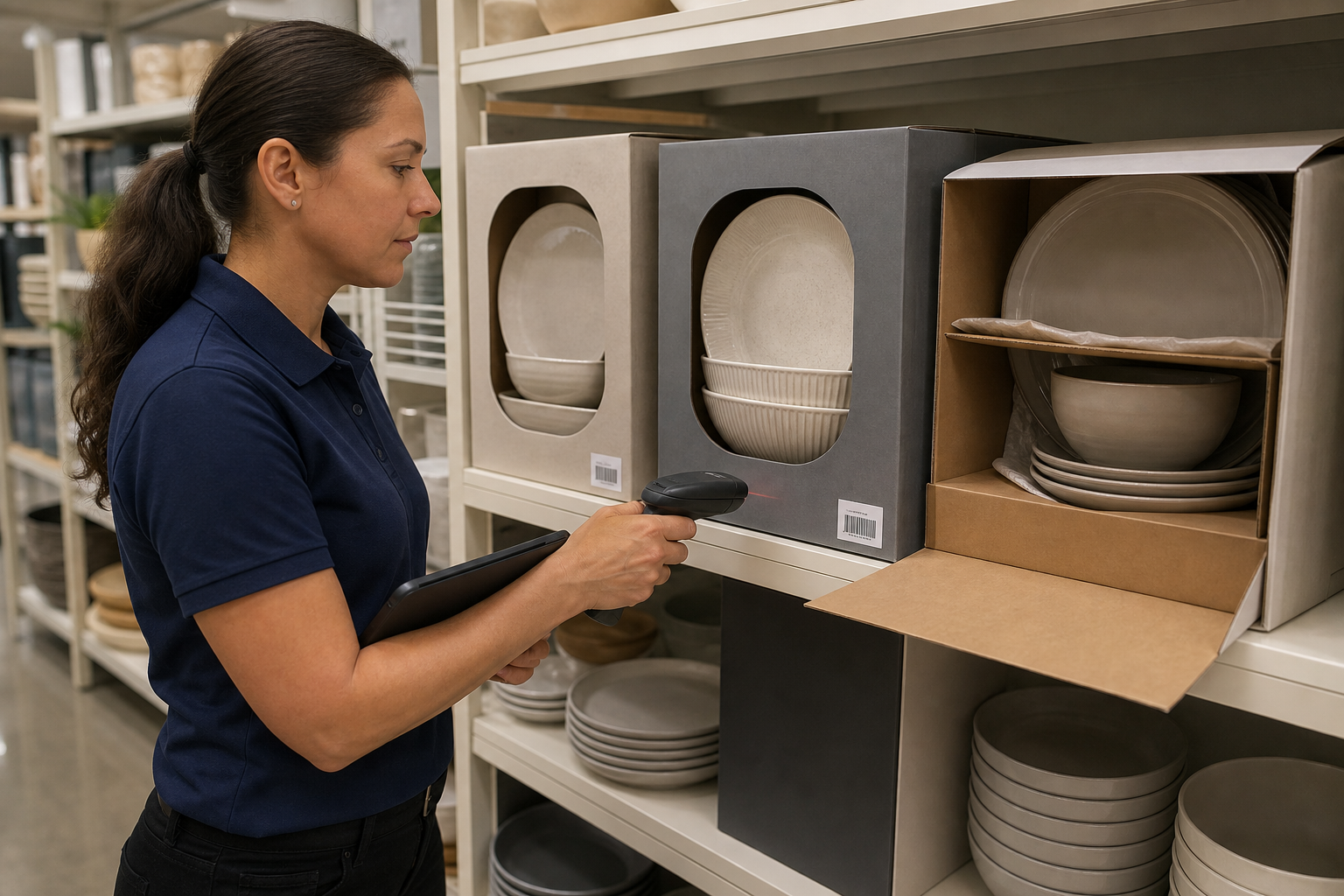
Barcode readiness is not just receiving a number. The barcode must identify the correct sales unit and print clearly at a workable size and location. GS1 barcode guidance is a high-trust place to understand identification and barcode quality principles.
Print the final artwork on the real packaging material. Then scan it with more than one device and check it after normal packing and handling. Curves, glossy coatings, folds, seams, low contrast, and nearby graphics can reduce scan quality.
Confirm whether a single piece, boxed set, inner pack, and master carton need different identifiers. Keep barcode ownership clear; do not let a supplier reuse a number from another customer or configuration.
Check Packaging Data With a Packed Carton
A spreadsheet estimate is not enough for ceramic dinnerware for retailers. Pack a production-representative unit and master carton, then weigh and measure them. Confirm piece count, dividers, cushioning, labels, orientation, sealing, and carton marks.
Gross weight matters to freight, warehouse handling, and retailer limits. Carton dimensions affect pallet plans and storage. An error repeated across hundreds of cartons becomes expensive quickly.
I also ask the team to perform a pack-out audit: open a finished carton, compare every item and label with the purchase order and SKU master, then repack it using the written method. Where distribution risk justifies it, agree on suitable packaging evaluation with a qualified test provider; the ISTA testing overview offers useful context on distribution-testing approaches.
Give Content Teams Images They Can Actually Use
A retail listing needs more than one styled photograph. Prepare a named image set for each SKU:
- clean front or three-quarter product view;
- top view and side profile where shape matters;
- close-up of glaze, rim, foot, or decoration;
- clear set-contents image;
- scale or capacity reference;
- packaging and label view;
- approved variation range for reactive or handmade-look finishes.
Images must show the sale item accurately. Do not hide natural glaze variation in all marketing images and reveal it only after customer complaints. A useful variation image helps merchandising, customer service, and returns teams explain what is normal.
Match file names to the retailer SKU. A folder called “final new final 2” is a small joke in the office and a serious problem during a launch.
Plan Reorders Before the First Listing
Retailers need to know whether a broken plate can be replaced, whether a set will remain active, and how quickly stock can return. Agree on MOQ, order multiple, lead-time assumptions, safety-stock responsibilities, and the date when packaging or artwork files become locked.
The retail dinnerware supplier should retain approved product and packaging standards. For ceramics, this may include a physical golden sample, acceptable glaze-range samples, fired dimensions, weight guidance, decoration artwork, carton specification, and inspection photos.
Require notice before changes to the body, glaze, decal, mold, firing route, packaging material, or pack quantity. A change that looks small to production can affect listing copy, barcode setup, color consistency, testing scope, or warehouse data.
My Advice as a Manufacturer
Hold one short “listing gate” meeting before shipment. Put product development, compliance, packaging, e-commerce, logistics, and purchasing around the same file. Review one real SKU from start to finish, then check that the same controls cover the rest.
My simple advice is to make the physical pack prove the data, and make the data prove the listing. If a detail cannot be traced from approved sample to carton to product page, close that gap before launch.
Questions Buyers Often Ask
What should a retailer request first from a ceramic dinnerware supplier?
Request the SKU master, approved samples, claim and compliance file, packaging specification, barcode plan, image list, and reorder terms. Set owners and due dates for missing fields.
Does every color need separate product data?
Yes. Each color should have a clear SKU or variant identity, image set, glaze reference, and applicable evidence. Testing scope may vary by glaze or decoration, so confirm it rather than assuming one report covers all colors.
When should barcodes be tested?
Test after the number and placement are approved, again on printed packaging material, and finally on packed production-representative units. Check each sales and logistics level that uses a barcode.
What is the difference between a golden sample and a listing sample?
A golden sample controls product approval for production and reorders. A listing sample may be used for photography, copy, or retailer review. They should agree, but their roles and custody should be recorded.
How can retailers reduce errors across many SKUs?
Use one controlled SKU master, fixed naming rules, required fields, version history, and a gate owner. Pilot the process on one SKU before copying it across the line.
Conclusion
Retail-ready dinnerware needs controlled product data, supportable claims, working barcodes, verified packaging, accurate images, and a practical reorder plan. A reliable retail dinnerware supplier should help connect the approved ceramic item to every field the retailer needs to receive and sell it.
If you are preparing a ceramic line for retail, send FENN your retailer data template, target market, SKU plan, packaging rules, and launch date. We can help organize the sample, product, pack, and repeat-order details into a clearer launch package.