
Short Answer
The best buffet, banquet, and catering dinnerware is not simply the toughest or the prettiest. It should stack safely, feel manageable during fast service, fit the menu and service equipment, and remain easy to replace piece by piece. I ask buyers to test fired samples on a real trolley, table, wash route, and serving setup before approving a range.
When a buyer asks me for “hotel quality,” I ask one question back: where will the plate work hardest? A plate carried to a seated banquet, a bowl used at a buffet, and a platter passed through a catering kitchen may look related, but they meet different handling risks.
Start With the Service Moment, Not the Catalog Page
Foodservice ceramic tableware has to work when people are busy. In a buffet, guests lift and return pieces repeatedly. In a banquet, staff may carry tall stacks across a large room. In off-site catering, pieces meet transport crates, temporary tables, and a quick pack-down.
That is why I would not choose from one hero photograph or one plate sample. Put the likely service moment at the center of the decision.
| Service scenario | What I would prioritize | What to test on the fired sample | Early warning sign |
|---|---|---|---|
| Self-service buffet | Stable stacks, easy grip, clear food presentation | Lift the top piece with one hand; check nesting and stack separation | Pieces stick together or the rim is hard to catch |
| Seated banquet | Controlled weight, stack height, clean place setting | Carry a realistic stack and set a full place with the planned charger | A good-looking plate makes the setting too wide or heavy |
| Off-site catering | Practical packing, shape compatibility, quick sorting | Load the actual carrier or crate and unpack a small service trial | An unusual shape wastes space or is slow to identify |
| Shared multipurpose range | Repeatable dimensions, replacement continuity, flexible pieces | Test plates, bowls, cups, and platters together on the same table | Each piece looks nice alone but does not work as a family |
I find this route map much more useful than asking for the “most durable” option. Durability matters, of course, but the form of the piece decides how people will handle it.
Build the Core Range Around Handling
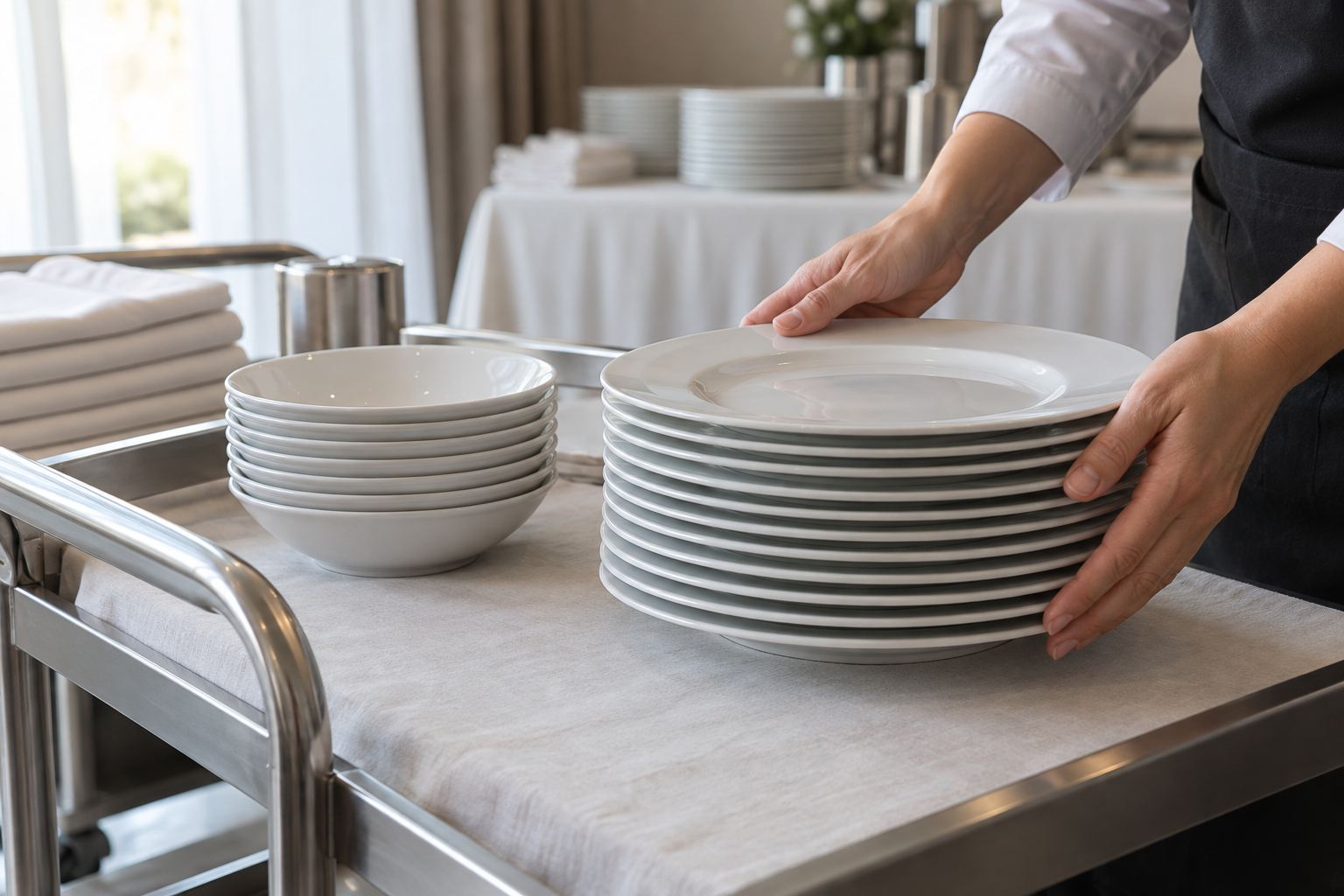
For a buffet dinnerware supplier, I would first define the core pieces that staff and guests will touch most often. Usually this is a dinner plate, side plate, bowl or coupe bowl, cup, and one or two serving forms. Add specialty pieces only after the core works.
Look at the rim as a working edge, not just a design line. A very thin edge may suit a refined presentation, yet it can be less forgiving when plates touch during clearing or stacking. A broad rim can protect the food area and help a server hold the plate, but it also adds diameter and may reduce usable table space. There is no universal best rim. Ask the factory to show the actual fired profile and let the operating team handle it.
Weight needs the same practical view. A heavier plate can feel solid, but a stack multiplied by many covers can tire a server. A very light plate may be welcome for carrying, yet it still needs an appropriate body, profile, and firing control for the intended service. I would ask for the weight of each finished piece and then run a lift test with a real stack. Do not judge weight from one empty plate held for two seconds.
Stackability is also more than “can these plates nest?” Check how many pieces make a stable stack, the total stack height, whether the foot marks the glaze below it, and whether plates separate cleanly. A stack that leans or locks together will slow service long before anyone starts talking about decoration.
Give Buffet and Banquet Pieces Different Jobs
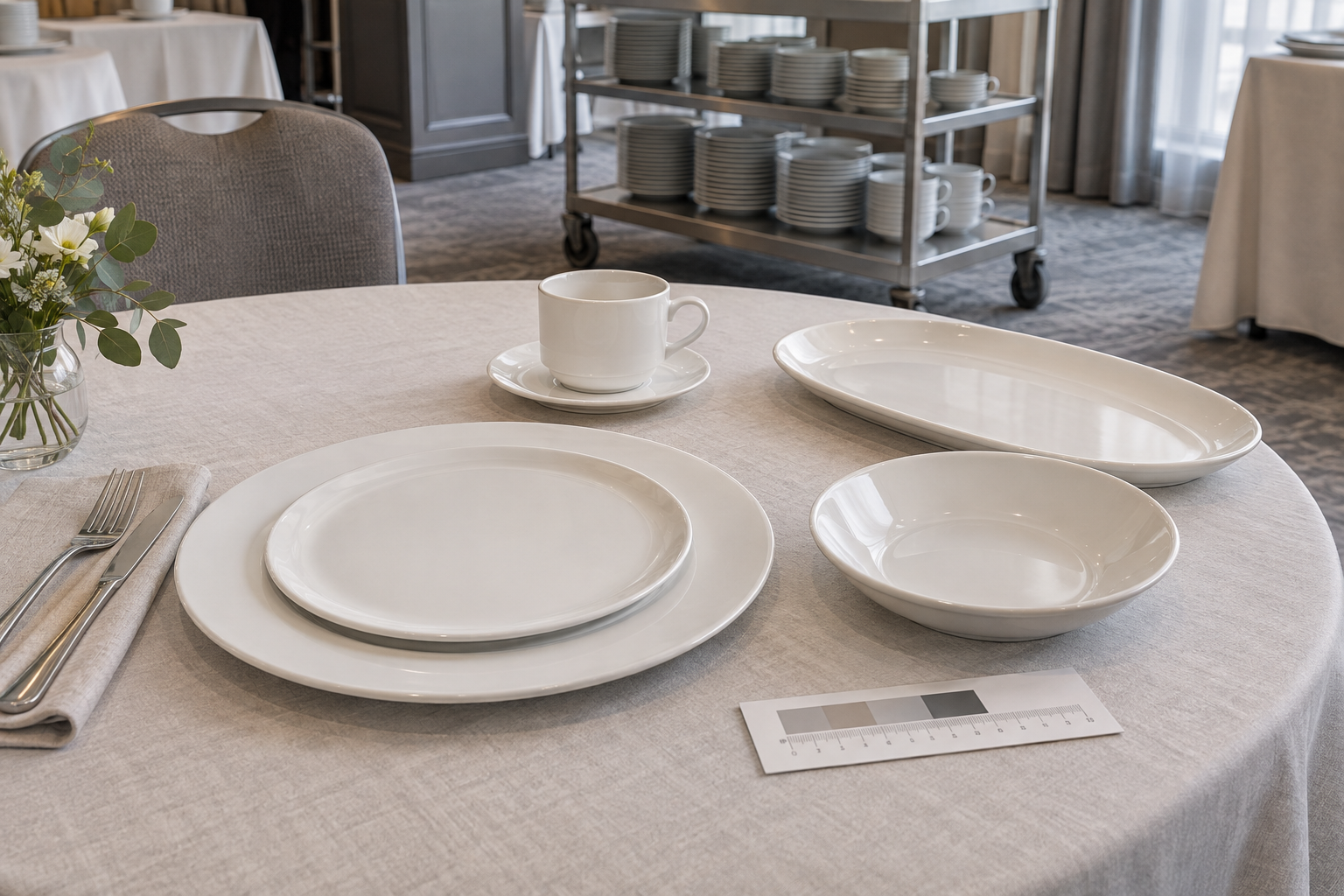
Buffet service often needs shapes that guide portioning and look orderly when the station is replenished. A shallow bowl may help with sauced food; a broad plate may work better for mixed selections. Check the actual serving utensils. A spoon resting across a narrow bowl or a ladle hitting a fragile-looking rim is a useful early signal.
Banquet ceramic plates need to work with the whole setting. I would place the charger, dinner plate, bowl, cup, cutlery, menu card, and any shared item on the intended table size. A 1 or 2 cm difference can matter when many settings run along one table. The buyer should also confirm clearance for plate covers, service trays, and stack carts where they are used.
For catering dinnerware, sorting is a quiet but important job. Similar-looking bowls in two sizes can create confusion during packing and clearing. A sensible range gives each piece a clear role and makes spare stock easy to count. If a signature organic shape is important to the brand, test it in the actual carrier before you lock it into every SKU.
Ask for Proof That Matches the Claim
Food-contact compliance, dishwasher suitability, and microwave suitability are separate topics. Do not let a general statement about one stand in for all the others.
For products sold into the United States, ask what evidence supports any food-contact claim for the finished construction and intended market. The FDA explains its consumer guidance on lead in food and foodwares. For the EU, the European Commission’s food-contact materials overview is a useful starting point for understanding the regulatory context. These pages do not approve a specific plate; the supplier’s relevant test documents and product details still matter.
If the range has metallic decoration, a reactive glaze, an unusually dark color, or different body materials across the family, name those variants in your request. I would not assume one report or care claim covers every finish without checking its scope.
For service operations, the FDA Food Code is useful context for foodservice practices, but it is not a ceramic product specification. Keep the evidence question simple: what exactly was tested, which finished product does it represent, and what claim does it support?
Run a One-Hour Service Trial Before Bulk Approval
My favourite hospitality review is not a meeting. It is a short trial with the actual pieces.
1. Place the fired samples on the intended table or buffet counter.
2. Stack, lift, carry, clear, and reload them using the normal tray, trolley, or carrier.
3. Serve a representative menu item and see whether utensils, portion size, and rim space work.
4. Send the pieces through the expected wash and dry flow if the operation can do so safely.
5. Check the pieces again for handling marks, unstable stacking, confusing sort points, and fit problems.
6. Write down the exact sample version, glaze, dimensions, weight, and any change agreed.
This is not a substitute for a formal durability or compliance test. It is a practical use check. It often catches a problem that a showroom review misses: a cup handle that slows clearing, a platter that will not fit the carrier, or a stack that becomes awkward after eight pieces.
If a project needs packaging or transport validation, talk with the relevant packaging specialist about a test that matches the true distribution route. ISTA’s test procedure directory helps buyers begin that conversation. A test result only has meaning when the product, pack-out, and route are comparable.
Plan Replacement Before the First Event
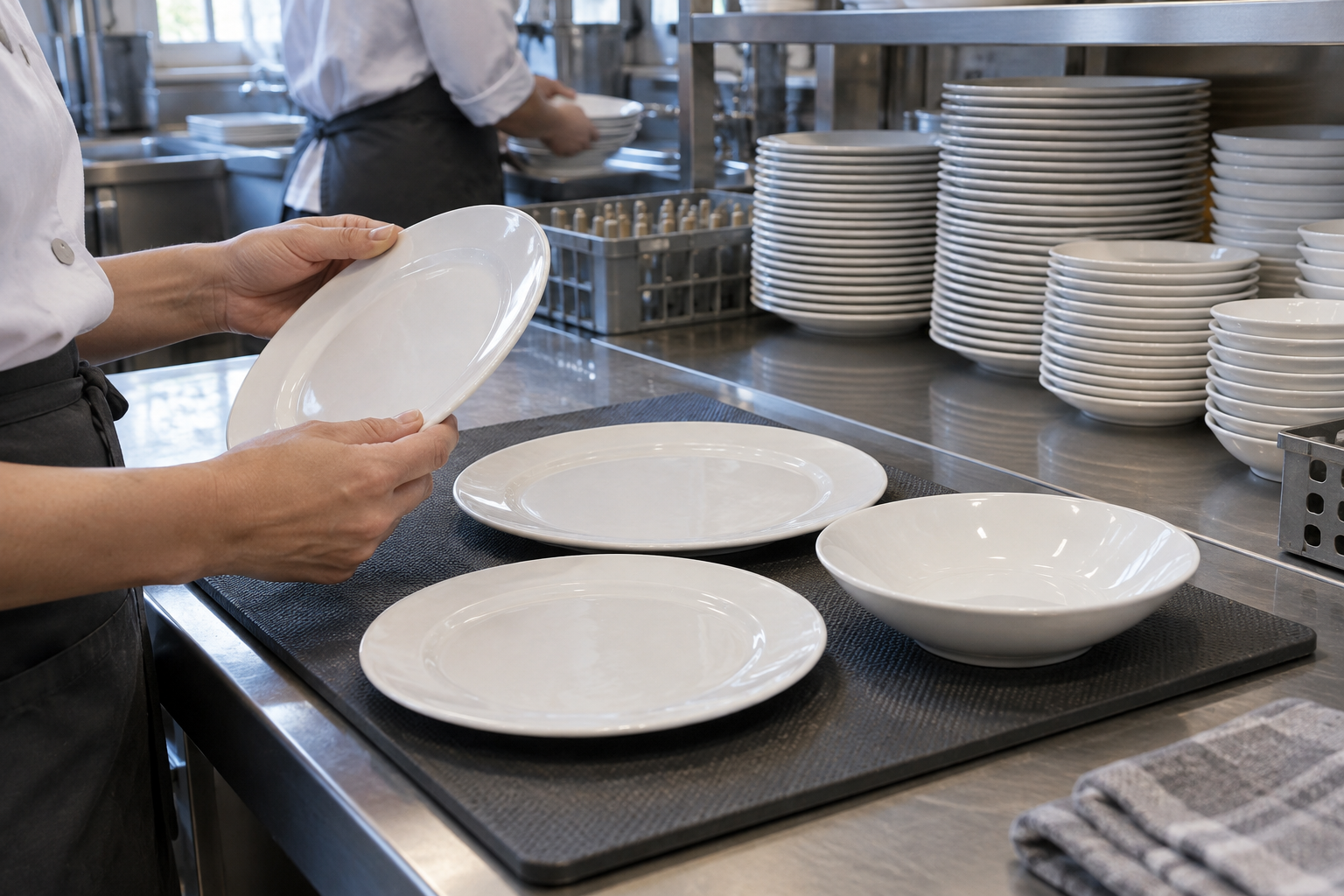
Hospitality ranges rarely stay perfect forever. A good replacement plan is not an admission of weak quality. It is normal operating control.
Keep a simple record for every approved piece: SKU, finished dimensions, weight, body and glaze description, decoration position, sample date, and photographs in normal lighting. Retain an approved reference sample where possible. If the range will be reordered over several years, agree how the supplier will identify the approved version and how changes will be communicated.
Ask practical questions early. Can a buyer reorder a single core SKU? Is there a minimum for replacement pieces? How will the factory compare a repeat glaze run with the approved reference? Which older pieces are most likely to be kept in the range? A supplier who answers with a clear control method is giving you something more useful than a vague promise of consistency.
My Advice as a Manufacturer
I would choose a calm, workable core range before chasing too many special shapes. The right dinnerware should make service feel easier while still carrying the look of the venue or brand.
Bring the chef, banquet manager, stewarding team, and purchasing person into the sample review if you can. Each one notices something different. The chef sees portion and plating space. The manager sees table rhythm. The stewarding team sees stacks and wash flow. Purchasing sees repeat-order risk. One shared trial gives the factory a much clearer brief.
Questions Buyers Often Ask
Is porcelain always better for banquet dinnerware?
Not automatically. The suitable body depends on the desired appearance, finished weight, shape, intended use, and the supplier’s process control. Compare actual fired samples in the service setting rather than buying a material label alone.
How many pieces should we stack in a test?
Use the highest stack a staff member is likely to lift or move in normal work, then observe stability, comfort, and separation. Record the stack count in the approval notes; do not rely on a single low stack for a busy operation.
Can one range serve buffet, banquet, and off-site catering?
Often, a focused core range can. Test the exact pieces in all three settings. You may find that a core plate and bowl work everywhere, while serving platters or cups need a separate solution.
How do we manage replacement pieces when glaze varies naturally?
Agree the acceptable appearance range from fired samples, keep a retained reference, and ask for a documented repeat-order review. Natural variation should be defined and controlled; it should not be used to hide an avoidable mismatch.
Conclusion
The right buffet dinnerware supplier helps you choose a range that works in the hands of guests and staff, not only under studio lights. Match the piece to the service moment, test fired samples through a real workflow, and record the core details needed for repeat orders and replacements.