
Short Answer
Choose a fine dining dinnerware supplier that can turn your menu and kitchen limits into repeatable fired samples. Check usable plating space, a clean carrying grip, fit in your racks, surface cleaning, and replacement consistency. Ask for product-specific food-contact evidence and written heat-use limits. Approve the plate with your chef and service team before committing to bulk production.
I love a plate with personality. But when I review one for a restaurant, I also want to know where the server’s fingers go. That small detail can decide whether a beautiful shape earns its place in service.
My starting point is a shared sample brief. The chef brings the dish; the buyer brings the budget and order plan; the kitchen team brings the awkward questions. Those questions save work later.
Copy This Brief for Your Fine Dining Dinnerware Supplier
Use one sheet for each shape. Fill it before ordering samples, then add observations from the fired pieces. A blank is useful: it shows what still needs a decision.
| Brief field | What to record before sampling | What to record after trying the sample |
|---|---|---|
| Dish and portion | Course, portion, sauce, garnish, cutlery | Photo of the actual portion; any food touching the grip area |
| Working surface | Needed flat or curved area; rim use | Usable space on the fired plate; spoon and knife access |
| Service route | Pass layout, carrying method, table space | Grip, loaded balance, clearance beside neighboring dishes |
| Equipment fit | Rack model, shelf opening, warming equipment | Fit on the actual equipment; any contact or obstruction |
| Finish | Color range, gloss, texture, decoration position | Cleaning result, cutlery marks, appearance under dining-room light |
| Supply record | Sample ID, intended market, opening quantity | Approved version, agreed variation, repeat-order terms |
My acceptance rule: each field needs an observation and an owner. “Looks good” is not enough for equipment fit. “Chef tried sample A in rack B; rim touched divider” gives the supplier something useful to change.
This sheet is a development tool, not a food-safety certificate or a laboratory test. Keep those records alongside it.
Fill the Menu Fields Before Choosing the Silhouette
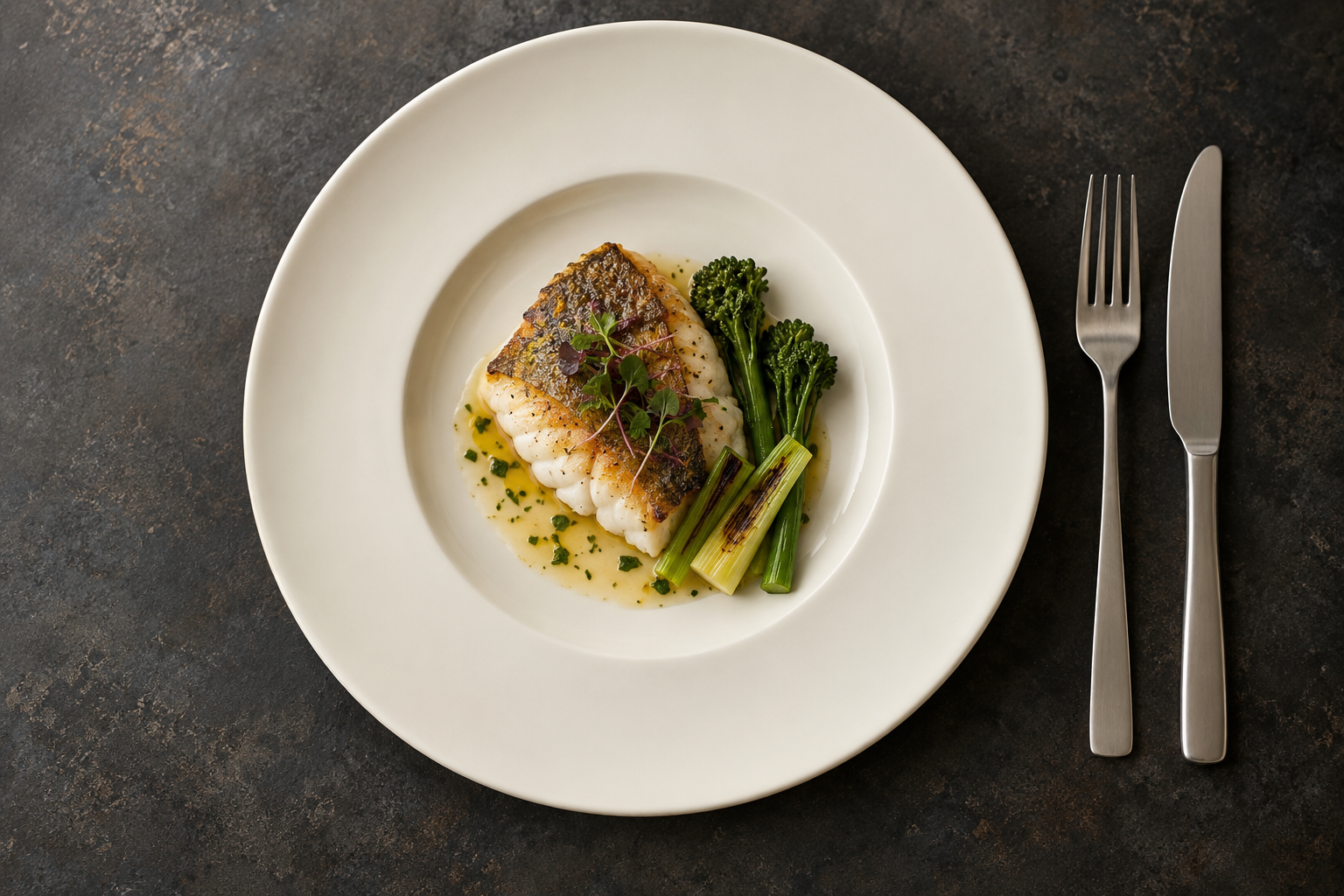
Imagine a tasting-menu course with a small piece of fish, sauce, and a crisp garnish. A wide rim may frame it beautifully. Yet the center might be too small to keep the garnish dry. A flatter plate could give the chef more room without increasing the outside diameter.
I call this the usable plating area: the part of the fired surface that supports the intended food arrangement and cutlery movement. It is not automatically the same as the plate’s overall size.
Try the real portion on the sample. Then ask someone to eat it with the intended fork, knife, or spoon. Does sauce collect where a spoon can reach it? Does the knife rock on a ridge? Does the last bite become difficult to lift?
For restaurant plating plates, this is a better check than approving an empty product photo. Photograph the accepted portion from above and at the guest’s eye level. Keep both images with the sample ID.
Consider orientation, too. An irregular shape may require the chef to turn every plate before plating. If that adds an extra movement at the pass, decide whether the visual effect earns that effort. Try several pieces together so small shape differences are visible.
Turn Kitchen Limits Into Dimensions the Factory Can Use
“Make it elegant and light” leaves too much room for guessing. I would rather receive an outside footprint, a working-area sketch, a preferred weight range, and the location where the server expects to grip it.
These are proposed targets until the factory checks feasibility. Ask which dimensions can be held after firing and how they will be measured. Clay shrinks during production, and broad or uneven forms can distort. A mold drawing alone does not settle the final shape.
For custom restaurant plates, ask the supplier to identify the difficult areas before tooling approval. A very thin rim, a broad unsupported center, or a sharp change in thickness deserves a clear explanation of the risk and proposed control.
The foot ring matters here. It affects how the plate sits and where it contacts the next piece when stacked. Check the underside for rough areas, then place the sample on a flat surface and on the actual table. Record rocking rather than hiding it with a cloth.
Name the Actual Rack and Warming Equipment
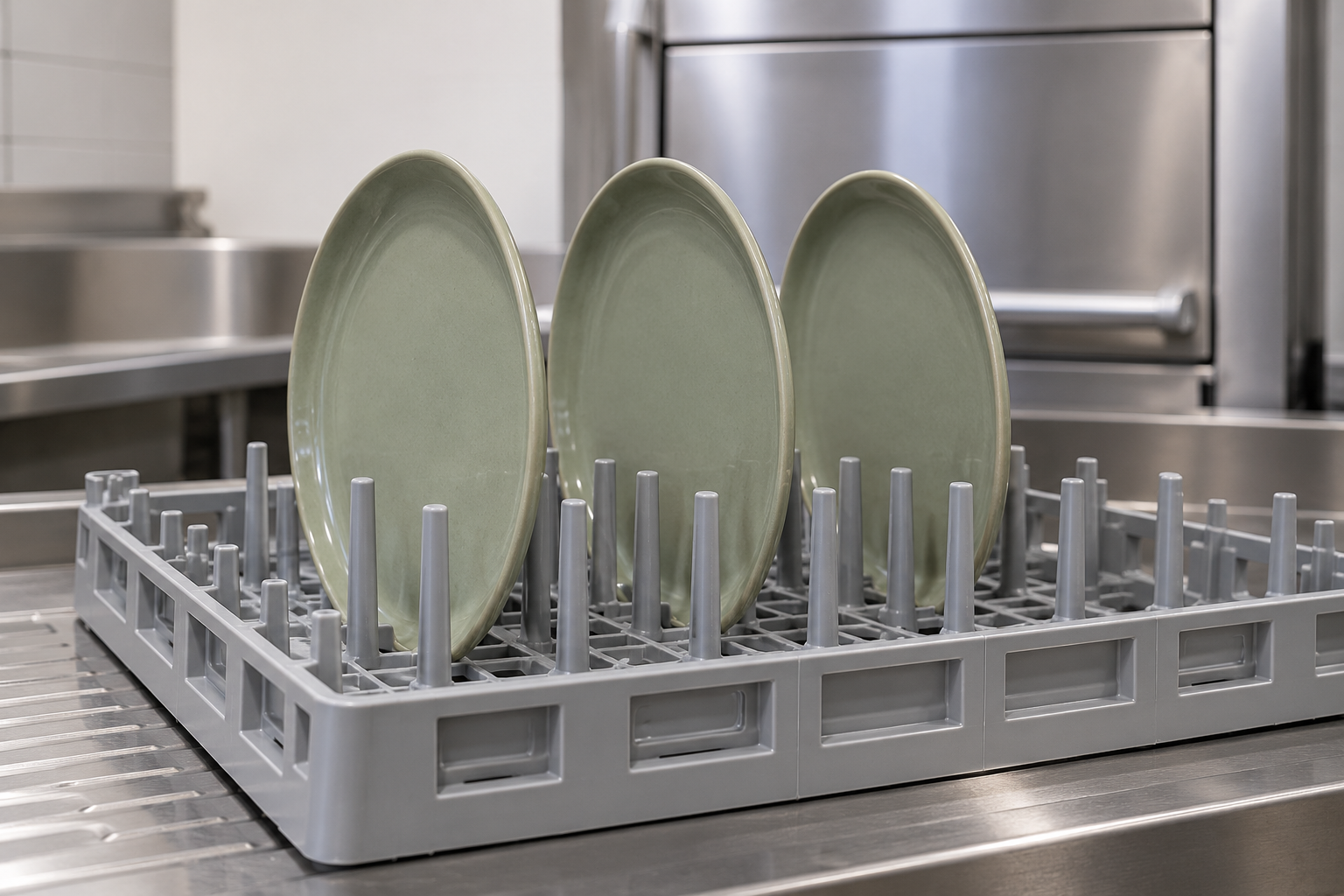
Use the rack or shelf that the restaurant will actually use. An oval plate can fit through the opening but sit badly between the rack dividers. Check normal loading without forcing pieces into place. Record the contact points and usable rack arrangement.
For warming, send the supplier the equipment type and intended operating conditions. Request written limits backed by suitable evidence for that product. Do not assume a microwave-safe claim covers an oven, salamander, or direct flame. Avoid sudden hot-to-cold trials invented in the kitchen; arrange thermal evaluation with qualified support.
A Sample Rejection Should Read Like a Useful Revision Note
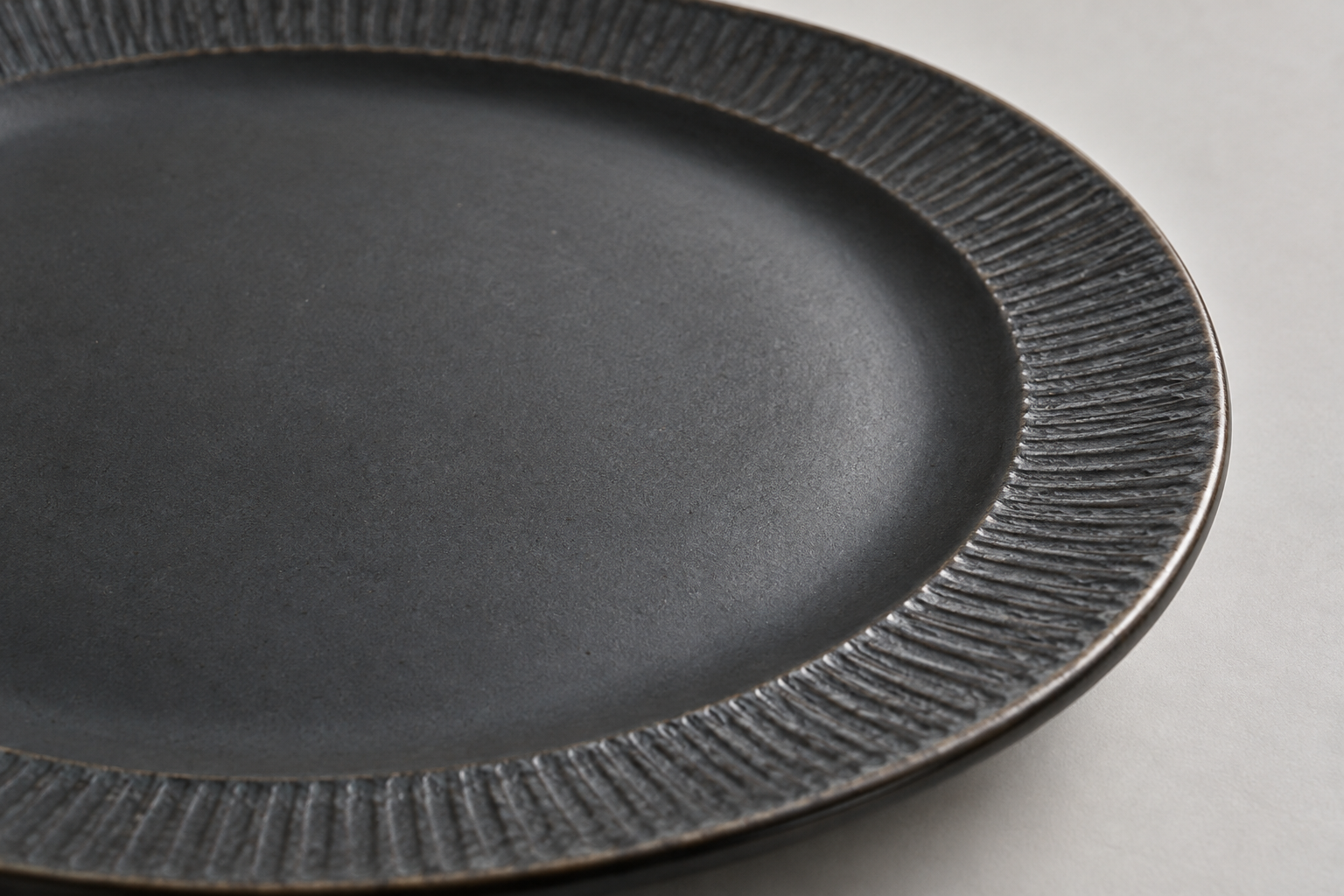
Here is an illustrative development example, not a report from a FENN customer.
Weak feedback: “The dark plate is difficult to use. Please improve it.”
Useful feedback: “On sample D2, the rough band crosses the area where we wipe sauce. After our normal wash, residue remains in that band. Please quote a smooth food-contact center while keeping the textured outer rim. Send revised fired samples with the same portion shown in our reference photo.”
Now the supplier can discuss a specific change. It may be possible to adjust the texture, glaze application, or boundary between surfaces. Ask what else changes: color, cost, lead time, and testing scope may need review.
I prefer changing one main feature at a time. If shape, body, glaze, and decoration all change together, it becomes difficult to tell which change solved the problem. Give every revision its own ID and keep the previous sample for comparison.
Let the Wash Team Finish the Brief
The chef sees the clean plate first. The wash team sees it after sauce, cutlery, stacking, and a busy service. Both views belong in the approval record.
Run a trial using the restaurant’s normal washing process within the supplier’s confirmed use limits. Record the machine or method, detergent, loading, and number of cycles. Check for trapped residue, surface changes, decoration wear, and rough contact points. A short kitchen trial can reveal a problem; it cannot prove years of durability.
A matte glaze may show metal marks from cutlery. Photograph what you see and establish whether it is removable transfer or actual surface damage before changing the acceptance standard. Do not accept “all matte plates do that” as a complete answer.
For US restaurant operations, the FDA Food Code is a useful model reference. Check the rules adopted in the restaurant’s own jurisdiction with the responsible team. It is not a product approval certificate.
Close the Brief With Evidence and a Repeat-Order Plan
Keep the sample review separate from food-contact evidence. The FDA’s guidance on lead in food and foodwares explains why appearance alone cannot answer a lead question. Ask the supplier for relevant release-test documentation and have the laboratory confirm the scope needed for your destination and product configuration.
For EU projects, use the European Commission’s food-contact materials guidance as the starting point for the applicable framework and material-specific requirements. A successful kitchen trial does not replace compliance documentation.
Match reports to identifiable samples, body, glaze, decoration, and intended use. If the tested item differs, ask the laboratory whether that evidence covers your design. Do not fill the gap with a supplier logo or a generic “food safe” statement.
Then agree how the restaurant will reorder individual shapes. Record the minimum quantity by shape and finish, expected production timing, and any notice required for changes. Keep an approved fired sample and an agreed shade range. A dramatic reactive finish needs more than one perfect reference photograph.
My Advice as a Manufacturer
I would spend the first sample budget on the hardest-working plate and the most unusual shape. Those pieces tend to expose the practical limits of a range early.
Keep the signature details that help the dish. Simplify details that make carrying, washing, or replacement needlessly difficult. A smooth center with a distinctive rim may be a useful compromise, but let the sample prove it.
I also want the final approval to name who checked plating, service, washing, and purchasing. A supplier can then work from one agreed revision instead of several conflicting comments.
Questions Buyers Often Ask
Does fine dining always require a new mold?
No. An existing shape with a suitable glaze may serve the menu well. Consider new tooling when the required working area, profile, or identity cannot be achieved with available forms.
Is a heavier plate better for fine dining?
Not automatically. Try the loaded piece using the restaurant’s carrying method. Weight should support stable handling and the desired feel without creating an avoidable burden across service.
Can we approve the whole collection from one sample?
I would not. Each shape can behave differently during firing, stacking, and washing. Review the key sizes and finishes, and ask the laboratory how the compliance sample plan should cover the range.
What if the chef loves a plate that does not fit the rack?
Pause approval. Compare a revised shape with a practical equipment change, including cost and staff handling. Do not leave the wash team to solve the mismatch after delivery.
Make the Sample Brief Your Approval Record
A fine dining dinnerware supplier should help turn the chef’s idea into a plate the whole team can use. The finished brief should show what worked, what changed, and which evidence supports approval.
You can also browse our buyer resources while preparing the brief.