
Short Answer
Ceramic dinnerware carton marks should identify the order, item, color, pack quantity, batch, and destination clearly. Add weights, carton numbers, handling symbols, and the barcodes your receiving team requires. Before printing, ask the supplier for a full-size label proof on the actual carton and check it against the packing list and warehouse item records.
I like to imagine the person opening the shipment before I approve its labels. They may never have seen the collection. They need to tell a sand dinner plate from a sand side plate without opening every box. A beautiful glaze cannot help them if both cartons simply say “ceramic plate.”
Carton marks are the printed information and symbols used to identify and handle an outer shipping carton. They may be printed directly on the box or applied as labels.
My quick judgment test is simple: can someone unfamiliar with the order identify the contents, count the correct selling units, and find the matching packing-list line? If not, I would revise the artwork.
Copy This Ceramic Dinnerware Carton Marks Brief
This is a working brief, not a universal legal label. Fill it in with your supplier and receiving team. Ask your importer or broker to confirm market-specific marking requirements separately.
| Field to approve | What to write in the brief | My acceptance check |
|---|---|---|
| Order and destination | PO number, buyer reference, receiving location | Matches this shipment, not the previous order |
| Product identity | Buyer SKU, shape, nominal size, color code and name | One description maps to one approved item record |
| Pack quantity | Pieces per inner, inners per carton, selling units per carton | Units are named; the multiplication is correct |
| Batch reference | Agreed lot code and linked packing record | Supplier can trace the code back to production records |
| Shipment count | Carton number and agreed numbering scope | Numbers reconcile with the final packing list |
| Physical data | Net/gross weight and outer dimensions, with units, where requested | Values come from the approved filled pack |
| Barcode fields | Required identifier, code type, data owner and label template | Receiver confirms what each scan must return |
| Handling and artwork | Needed symbols, print faces, label location, file revision | Marks remain visible after sealing and pallet preparation |
Keep the editable data sheet and the approved artwork together. A PDF tells the printer how the label looks. The data sheet tells the packing team which information changes between items and shipments. You need both.
Tell the Warehouse What “One” Means
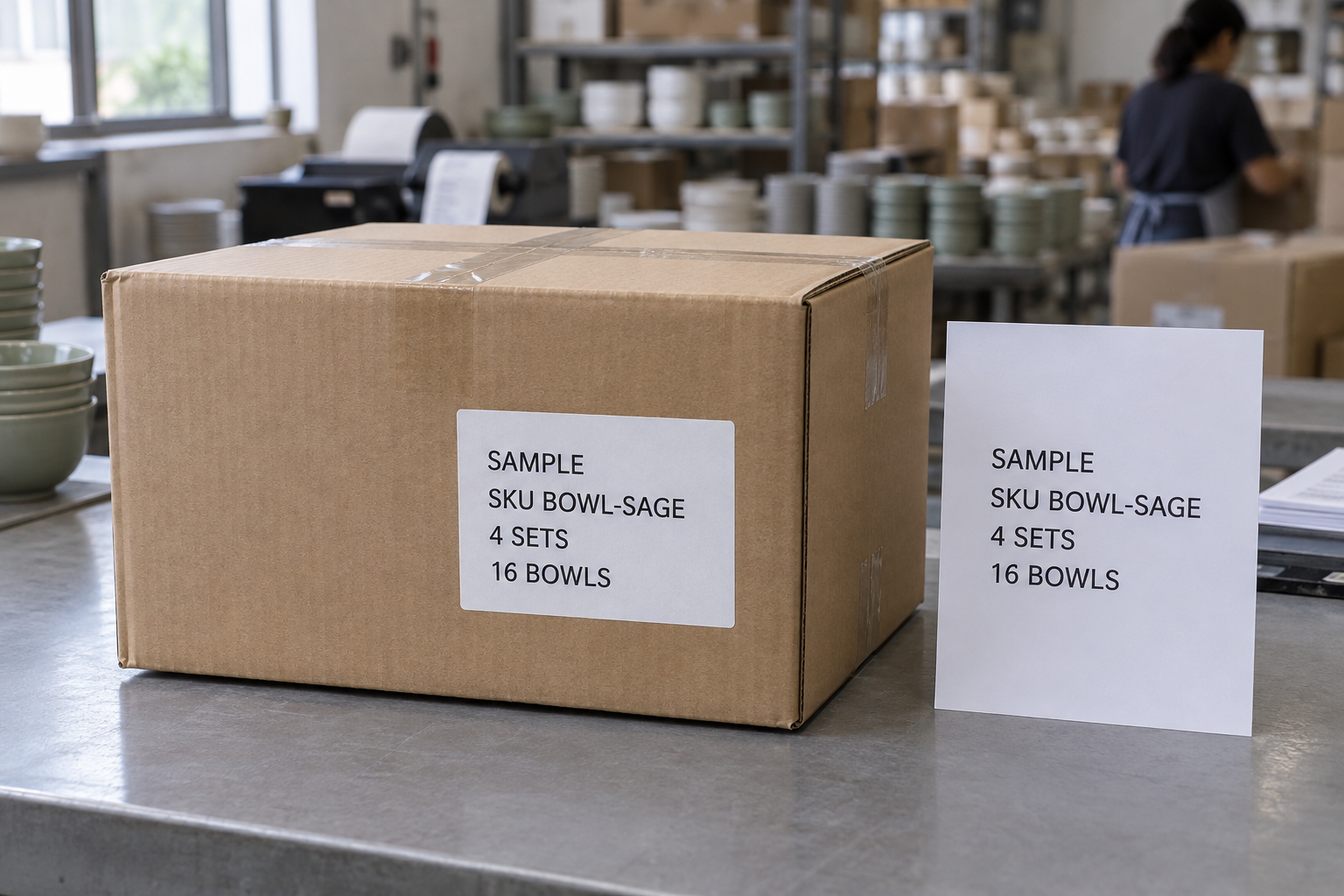
Here is an imaginary order: 240 four-piece bowl sets, packed four sets per master carton. That means 60 master cartons, with 16 bowls in each carton. “QTY: 16” is not enough. The warehouse might receive 16 sets instead of four.
I would write “4 sets × 4 bowls = 16 bowls” in the pack description, with the set SKU beside it. The inventory record should use the same selling unit. This example explains counting only; it is not a recommended pack size for every bowl.
For open-stock plates, the unit may instead be one plate. Keep that difference visible. A carton holding 12 single plates is not automatically a 12-piece retail set.
Color also needs a stable name and code. “Green” may cover several glazes, while a supplier’s glaze recipe code may mean nothing to your warehouse. Link the buyer’s color code to the approved sample reference in the packing instructions.
For reactive glaze, I would not create a new SKU for every natural shade variation. Agree the accepted range first. If packing groups are needed to keep sets visually balanced, record how those groups connect to the batch. A label can preserve that information; it cannot make mismatched pieces acceptable.
Decide Which Code Belongs on Which Package
I keep three questions separate: what is the item, which production lot is it from, and which physical shipping unit is moving?
A SKU is your item reference. A GTIN identifies a trade item. An SSCC identifies a particular logistics unit, such as a pallet or case. The GS1 Logistic Label Guideline explains how those identifiers support logistics labeling. A repeated item code does not provide unique shipment-unit identification.
Do not ask the factory to invent a barcode number because the artwork has an empty box. Ask the buyer’s data owner or logistics team to supply and approve the required identifier and format. Have the receiver confirm the packaging level it represents.
For tableware shipping labels, a useful supplier reply includes a field map: which value goes into each barcode, where that value comes from, and which receiving record it should match. “We can print any barcode” does not answer those questions.
If the retailer requires a shipment notice before delivery, agree who sends it and when. Check that the final cartons match that notice after any last-minute quantity change. Printing a correct label against an outdated shipment record still creates a receiving problem.
Try This Receiving Exercise Before Printing Everything
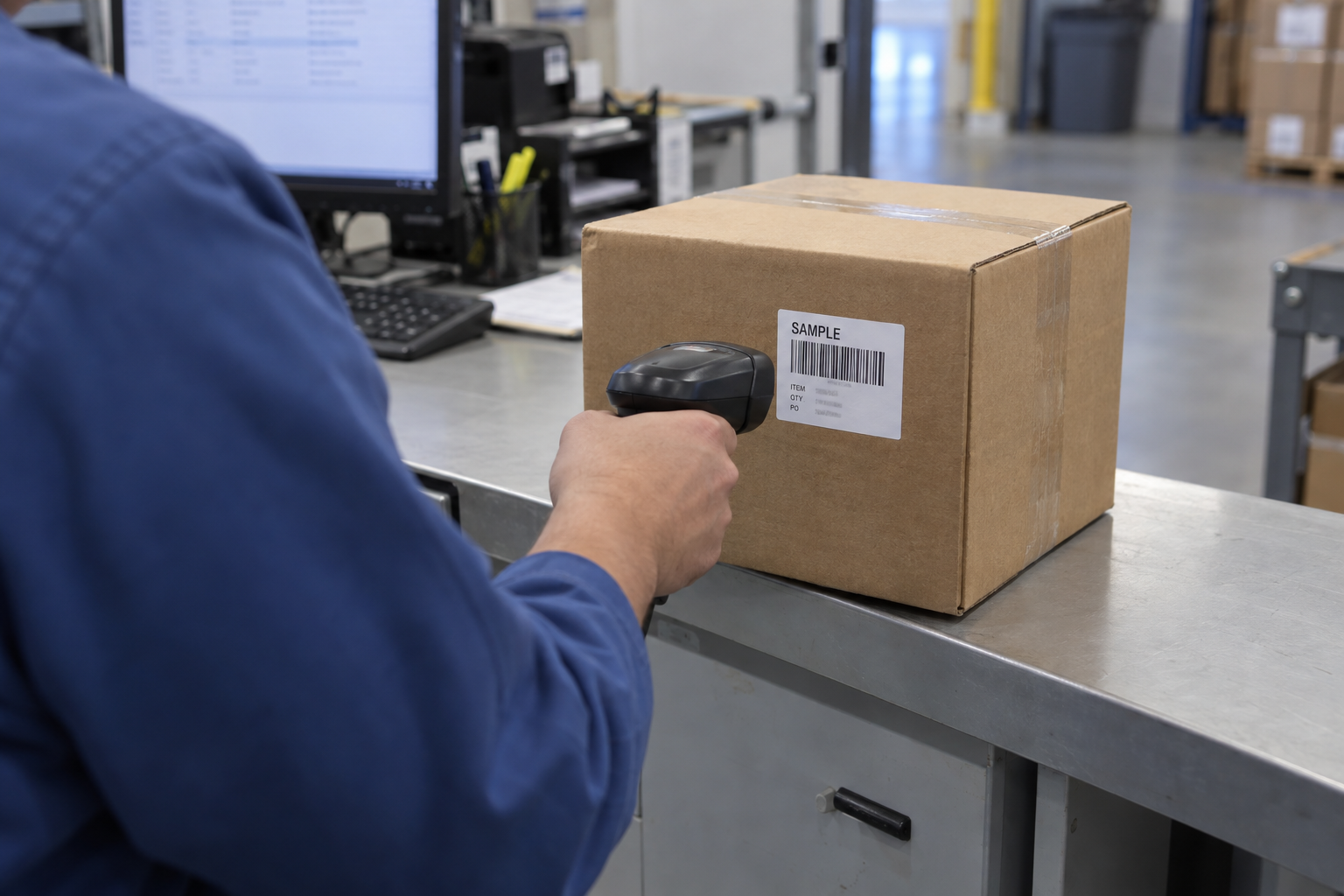
Put one packed carton, its proposed import carton label, and the relevant packing-list line in front of a colleague who did not prepare them. Ask them to receive the carton as if it had just arrived.
First, have them name the exact item and selling quantity. Then ask them to find the batch and destination. Finally, scan the printed label using the intended receiving setup, or send a physical proof to the receiving team if that setup is overseas.
A successful scan is useful, but it is not the same as a formal barcode quality check. GS1 barcode verification guidance addresses print quality and encoded data integrity. If the customer specifies a verification grade, request the relevant report instead of a phone photo showing that one scan worked.
Check the proof on the real carton surface. Rough corrugated board, weak printing, wrinkles, and tape glare can make a neat screen design harder to read. Keep the barcode and its required clear space away from folds, seams, straps, and tape. Use the agreed template for exact size and position.
I also ask for one photo after the carton is sealed and one showing the outward-facing labels on the prepared load. This catches a very ordinary mistake: the right label placed where nobody can reach or see it.
Give Exceptions Their Own Instructions
The standard carton is usually easy. The final partial carton is where people start guessing.
Write a short exception rule into the packing brief:
- Partial carton: show the actual quantity and list it separately; do not leave the standard quantity visible.
- Mixed-SKU carton: use an agreed mixed-carton label and a contents record listing each SKU and quantity.
- Repacked carton: update its contents record and any affected identifiers through the agreed system before release.
- Changed destination: replace obsolete routing information and reconcile the shipment records.
For example, if rejected bowls leave only three sets in the last carton, do not keep the four-set label and hope the warehouse notices. Update the quantity, carton weight where relevant, packing list, and shipment notice together.
Batch marks deserve similar care. A packing date is not automatically a firing date or production lot. From a factory point of view, the code is useful only when it leads back to meaningful records. Ask the supplier to demonstrate that link on one example before shipment.
Use Handling Symbols With a Purpose
Fragile, keep-dry, or orientation marks should reflect how the approved pack needs to be handled. ISO 780 handling symbols provide a shared reference for distribution packaging. Choose relevant symbols rather than filling every empty corner with them.
I would not approve a stacking-limit mark just because it looks familiar. The limit needs support from the packaging and load plan. Ceramic rim contact, unsupported handles, and movement between pieces still need physical protection. A fragile symbol does not replace separators or a suitable carton.
Keep operational labels separate from the review of origin, importer, and product marking. Ask the responsible importer to approve the required wording and placement for the destination. Do not assume that information printed on the master carton settles every marking question for the pieces inside.
My Advice as a Manufacturer

I prefer to approve one complete label package: the data sheet, artwork revision, filled-carton photos, and receiving check. It is much easier to correct one proof than to peel labels off an entire shipment.
Give one person control of the released file. At the packing table, clear away old labels when the SKU changes and compare the first new carton with the approved record. That small habit matters when two plate sizes use almost identical brown boxes.
Questions Buyers Often Ask
Does every dinnerware carton need an SSCC?
Not every customer asks for the same system. Confirm whether each carton, each pallet, or both need a logistics identifier. Where SSCCs are used, different logistics units need their own identities; one shared number is not an item code.
Can I reuse the artwork for a repeat order?
Yes, as a controlled layout. Recheck the PO, batch, destination, pack quantity, and variable identifiers. Never treat last season’s completed label as ready for the next shipment.
Should labels show exact fired dimensions for every plate?
Usually the item description uses the approved nominal size. Keep measurement methods and tolerances in the product specification. Label wording should match the buyer’s item record, not change with normal firing variation.
Is direct carton printing better than stickers?
Either can work. Direct printing suits stable information; labels can carry changing data. Judge the actual print, adhesion where relevant, readability, and receiver requirements before choosing.
Conclusion
Good ceramic dinnerware carton marks make the packed order easy to identify and receive. Start with clear units, controlled item data, and traceable batches. Then approve the printed proof on the package that will actually ship.
You can also explore our dinnerware buyer resources while preparing the shipment.