
Short Answer
A ceramic dinnerware factory audit should look beyond certificate logos. Buyers should verify certificate scope, factory name and address, product category, food-contact test reports, traceability, QC documents, social audit records, and inspection evidence before trusting a supplier.
I have seen many buyers feel safe after receiving a PDF with a nice logo. I understand why. When you are far from the factory, certificates feel like proof. But in real ceramic production, a certificate is only the start. It does not prove that your matte plate, colored bowl, or decal mug is safe and consistent.
Quick Definition
A factory certificate shows that a supplier has been reviewed against a standard. A test report shows how a product performed under a specific test. An audit record shows what was checked at the factory. For dinnerware buyers, all three can matter, but they must match the product and factory.
Best Criteria: What Should a Buyer Verify First?

Before you compare suppliers, use this simple order:
| Evidence Type | What It Can Prove | What To Check | Red Flag |
|---|---|---|---|
| Business and factory evidence | The supplier is real and controls production | Factory name, address, production site, export history | Certificate belongs to another company |
| Quality system certificate | The factory has a process system | Scope, expiry date, issuing body, site address | Scope says general trading only |
| Food-contact test report | The dinnerware meets a test condition | Same body, glaze, decoration, item type, market | Report is for a different product |
| Social or retailer audit | The factory passed buyer or platform review | Audit date, site, corrective actions | Only shows a badge, no report detail |
| QC and inspection records | The order can be controlled in production | Defect standards, AQL plan, final inspection photos | “We check quality” with no checklist |
This is the heart of ceramic supplier certification review: the document should match the factory, the product, the market, and the order.
Why Ceramic Dinnerware Needs Product-Specific Evidence
Ceramic dinnerware looks simple on a table. In the factory, clay body, glaze formula, firing temperature, decoration method, rim design, and packaging structure all affect the final product.
A quality certificate is useful, but it does not replace a food-contact test report for your decorated mug. It also does not tell you whether the matte glaze will mark, whether the rim is strong enough, or whether the gift box can survive shipping. From a factory point of view, the best evidence is layered: factory documents, product test reports, and order-level QC records together.
When a buyer asks me if one certificate is enough, I ask back: “Enough for what?” Enough to start a conversation, maybe. Enough to approve bulk production, no.
Certificates That Are Useful, But Not Enough Alone
Quality Management Certificates
A quality management certificate, such as one based on ISO 9001 quality management principles, can show that the factory has written processes. But I would still check the scope. Does it include ceramic tableware manufacturing? Is the address the same factory that will make your order? Is the certificate current? If the supplier only sends a cropped image or a certificate with no scope page, I would ask for the full document.
Social Audit or Retailer Audit Evidence
Some buyers need social audit evidence, especially if they sell to larger retailers. This may include buyer audits, platform audits, or programs such as amfori BSCI. These audits can help check management systems, worker conditions, working hours, and corrective actions. But they do not replace product testing or ceramic QC. Social audit evidence is one layer; it does not prove your glaze, decal, rim, and carton are right.
Food-Contact Compliance Documents
For dinnerware compliance, product-specific test reports are more important than general statements like “food safe.” For the U.S. market, buyers often discuss FDA guidance on lead in foodware. For the EU market, European Commission food contact materials guidance is a useful starting point. The test report should match your product: same factory, material, glaze or decoration, item type, and market.
What a Useful Test Report Should Show
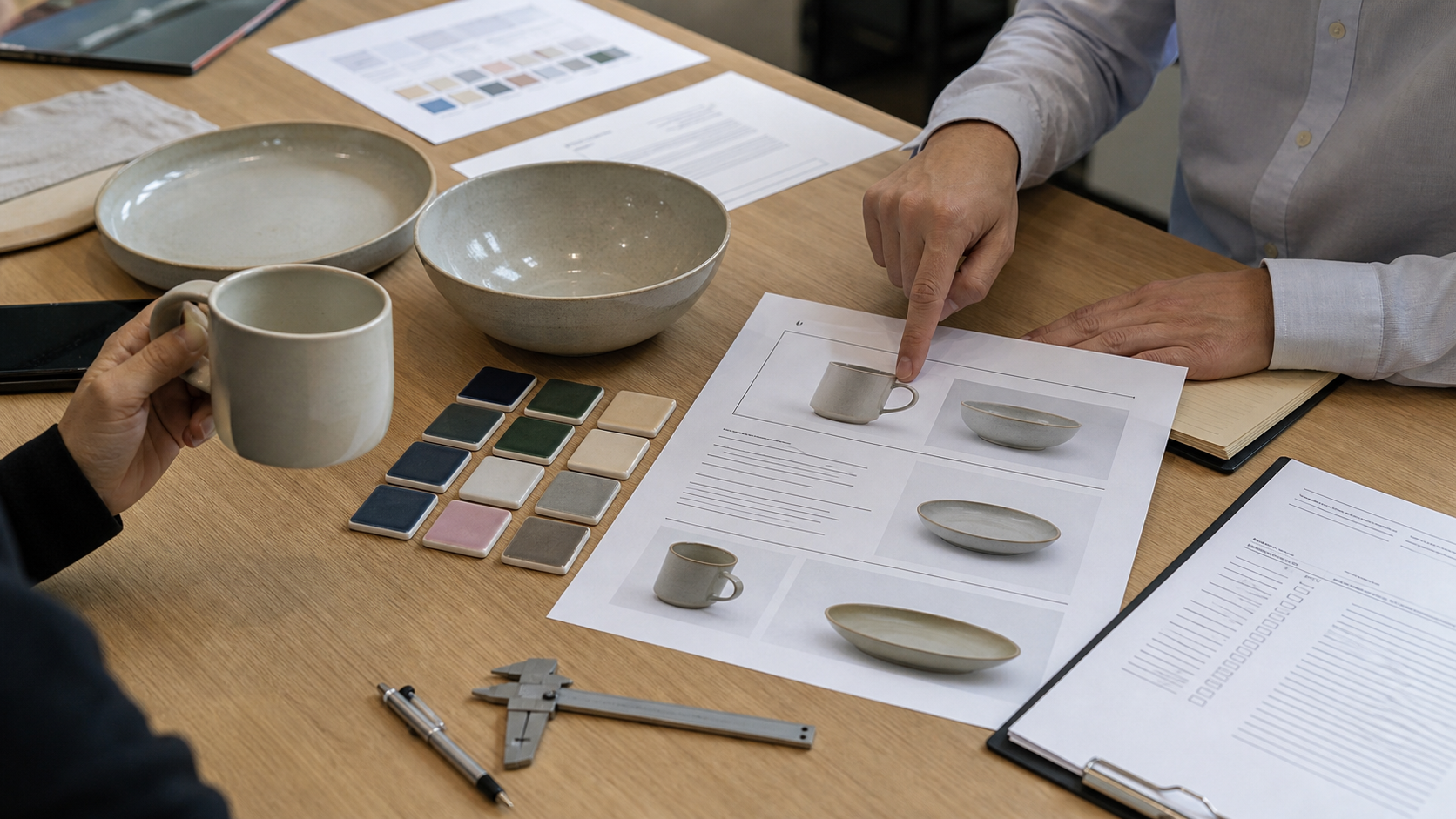
When we review documents with buyers, I check the boring details first. A useful ceramic dinnerware test report should show:
- Supplier or manufacturer name.
- Product description and item type.
- Material, glaze, decoration, or color description where possible.
- Test standard or method.
- Test result and limit.
- Laboratory name.
- Report date.
- Photos or sample description that match the item.
If your order includes several items, one report may not cover everything. A plate, deep bowl, mug, and decorated rim item may have different contact areas and risk points.
How To Judge Audit Evidence Like a Professional Buyer
Here is the question I ask in my mind: can this document survive a real problem? If a shipment has a compliance question, can the report show the tested product? If a repeat order has color variation, can the factory show master samples and records? I would ask for:
- Incoming material or glaze batch control records.
- Master sample or golden sample process.
- In-process inspection points before firing, after glazing, after decoration, and before packing.
- Defect classification for critical, major, and minor defects.
- Final inspection method, often discussed with AQL rules.
- Packaging specifications for inner protection, master carton, and pallet loading.
- Traceability for repeat orders and material changes.
You do not always need all of these before the first sample. Before bulk production, the supplier should explain these controls clearly.
Supplier Audit Checklist for Ceramic Dinnerware Buyers
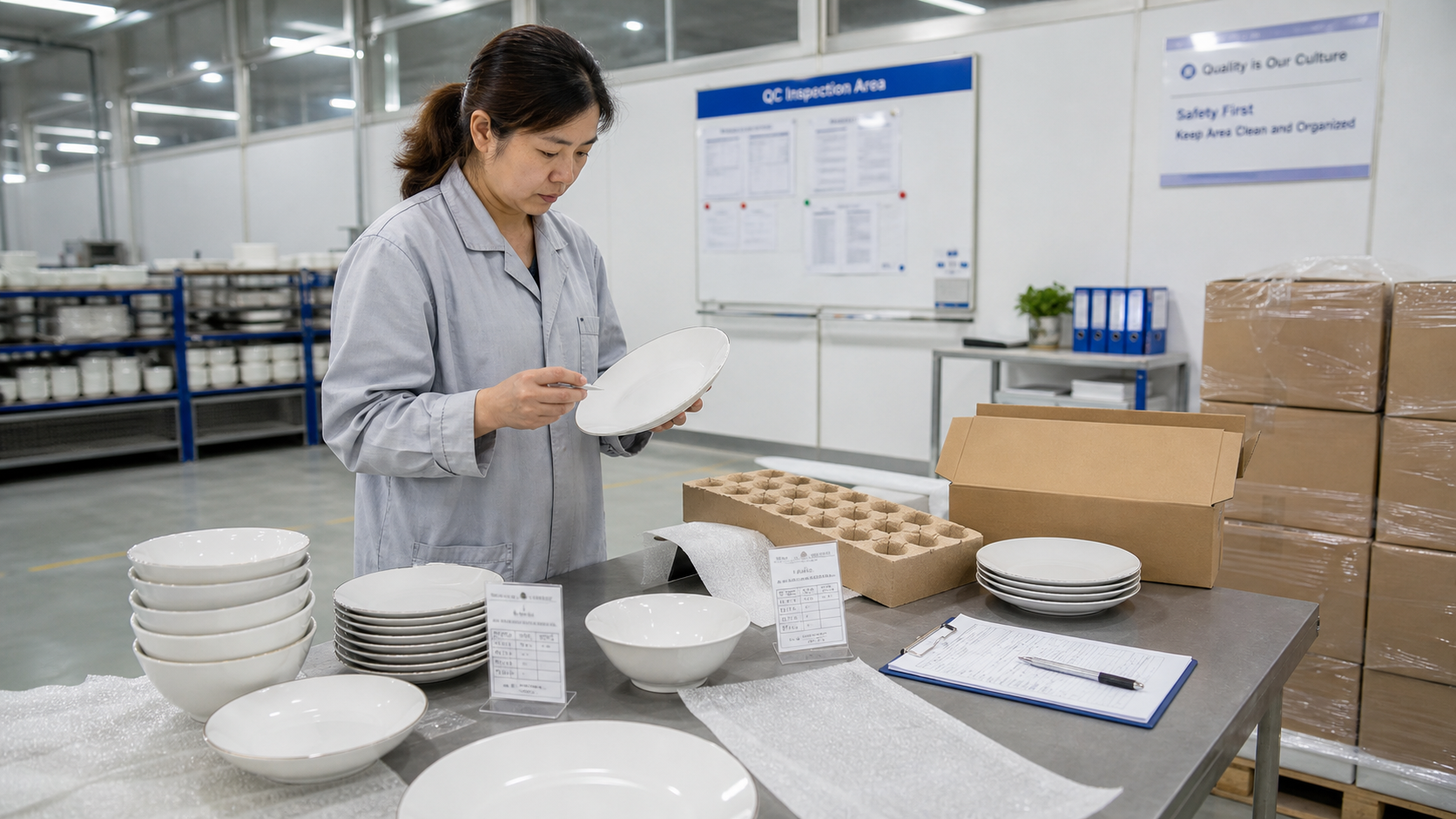
Use this checklist before you approve a new supplier or first production order. If the supplier cannot answer clearly, pause and ask for evidence before paying the deposit.
| Audit Area | Questions To Ask | Strong Evidence |
|---|---|---|
| Factory identity | Who owns production and where will the order be made? | Business license, factory address, site photos, matching certificate address |
| Product scope | Have you made similar ceramic dinnerware before? | Similar samples, production photos, export packing examples |
| Food-contact compliance | Which documents fit my target market? | Product-specific test reports and clear test scope |
| Quality control | How do you define defects before production? | QC checklist, defect photos, AQL discussion, inspection report sample |
| Sample control | What becomes the master sample? | Signed sample, color range board, retained sample record |
| Glaze and decoration | What are the risk points in this design? | Notes on glaze flow, decal position, rim contact, firing variation |
| Packaging | How do you reduce breakage in export shipping? | Inner protection plan, carton specs, drop-test option, pallet plan |
| Repeat orders | How do you keep future orders consistent? | Retained samples, batch records, change-control communication |
Warning Signs I Take Seriously
I become careful when a supplier answers every document question with only “yes, no problem.” A professional ceramic supplier should explain limits. Reactive glaze has a natural color range. Matte finish may need cutlery-mark testing. Metallic decoration may affect microwave claims. Thin rims need strength review. Other warning signs include:
- Test reports without product photos or clear sample descriptions.
- Certificates under a different company name with no explanation.
- Expired documents.
- Audit badges shown without scope or date.
- A factory that refuses to discuss defect standards before production.
- “Food safe” claims with no market-specific support.
- No retained sample process for repeat orders.
My Advice as a Manufacturer
My advice is to respect certificates, but never stop there. A certificate can help you build trust. A ceramic dinnerware test report can help you check safety and compliance. A factory audit can help you understand production control. The safer buying decision comes when all evidence points to the same story.
In my factory experience, the best suppliers are not afraid of detailed questions. They can explain what they have, what it proves, and what should be tested for your market. For a private-label brand, this honest explanation is more valuable than unrelated certificates.
Questions Buyers Often Ask
Is an ISO certificate enough to choose a ceramic supplier?
No. It can be helpful, but it is not enough by itself. You still need product-specific test reports, sample approval standards, QC records, and packaging review for your dinnerware order.
Do all ceramic dinnerware items need the same compliance documents?
Not always. Requirements can depend on market, item type, use, decoration, food-contact area, retailer rules, and local regulations. Do not assume one old report covers every SKU.
It depends on your sales channel. Larger retailers may require it. Either way, still verify factory identity, QC process, compliance documents, and order control.
Conclusion
A ceramic dinnerware factory audit is not about collecting certificate logos. It is about proving that the supplier can make your product responsibly, test it correctly, inspect it clearly, pack it safely, and repeat it later.
If you are reviewing a ceramic supplier certification package, send FENN your target market, item list, glaze or decoration plan, and the documents you received. I can help you see which evidence is useful, which parts need checking, and what questions to ask before bulk production.