
Short Answer
Custom ceramic dinnerware lead time depends on shape readiness, mold work, glaze development, sampling rounds, food-contact testing, packaging approval, production capacity, inspection, and export booking. A buyer can shorten the schedule by approving a clear brief, using existing shapes where possible, freezing artwork early, and leaving time for realistic ceramic sampling timeline checks.
When a buyer asks me, “Kitty, how many weeks do we need?”, I do not answer with only one number. Clay shrinks. Glaze changes in the kiln. A gift box may pass artwork review but fail a packing test. The fastest project is not the one that skips checks. It is the one with clear decision gates.
Definition Box: What Lead Time Means in Custom Dinnerware
Custom ceramic dinnerware lead time is the total time from approved buyer brief to finished goods ready for shipment. It may include design review, sampling, mold making, glaze testing, compliance documents, bulk production, final inspection, packaging, and export handover.
When you compare suppliers, ask whether their lead time starts from your first email, from deposit payment, from approved sample, or from final artwork approval. These are very different answers.
The Timeline Route Map I Use With Buyers
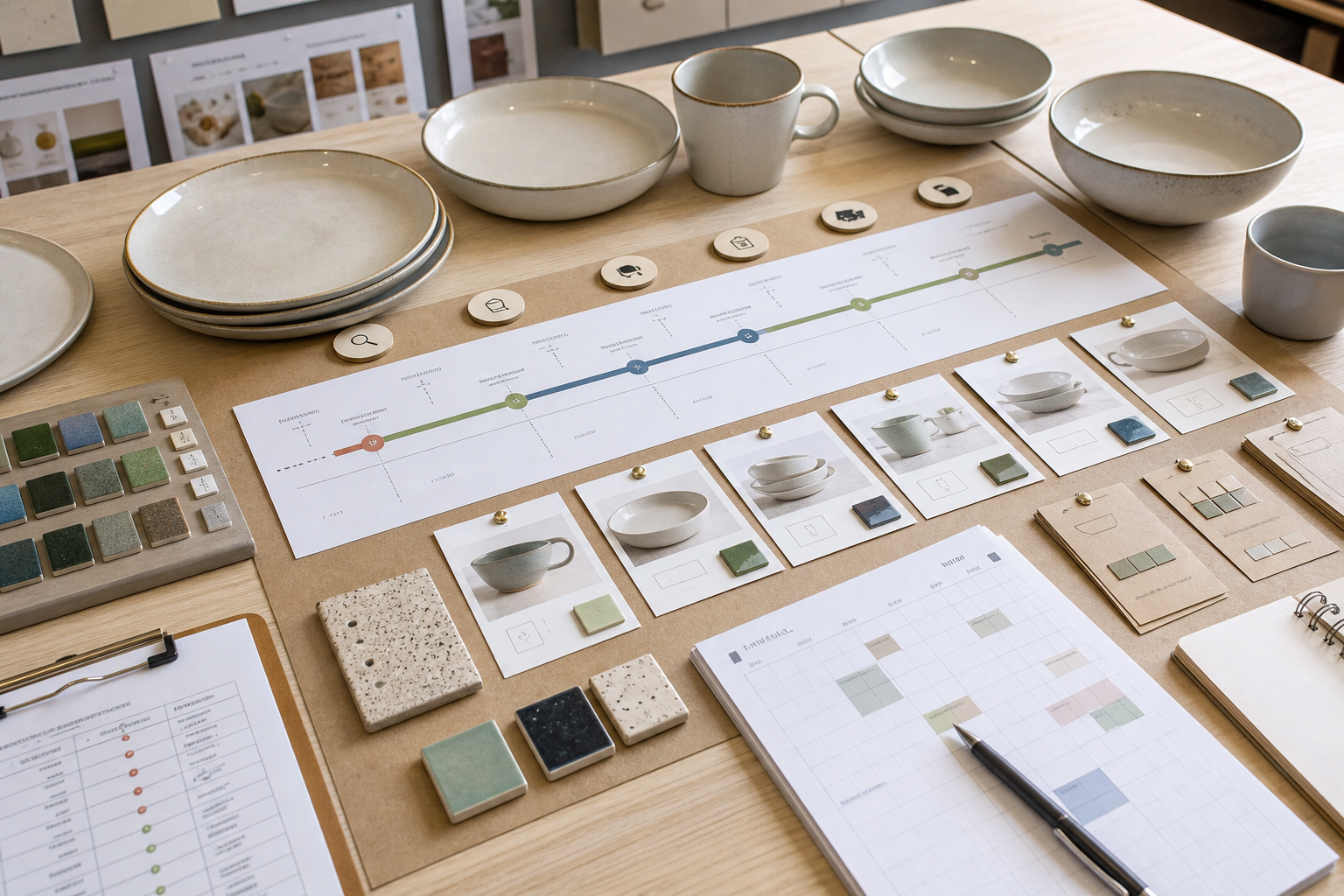
Here is a practical private label dinnerware timeline for a normal custom project. Exact timing changes by season, product complexity, and approval speed, but the sequence is usually similar.
| Stage | Buyer Decision Gate | What Can Delay It | How To Keep It Moving |
|---|---|---|---|
| Brief review | Final target market, product use, SKU list, price band | Vague references, unclear quantity, missing market | Send shape, size, glaze, logo, packaging, and compliance needs together. |
| Shape route | Existing mold or new mold | Unique silhouette, unclear dimensions, stackability issues | Use existing shapes for speed, or approve drawings before mold work starts. |
| Glaze and decoration | Color, finish, logo, decal, rim treatment | Too many colors, late artwork changes, metallic decoration | Limit first-round choices and freeze food-contact decoration zones. |
| First samples | Shape, weight, feel, color direction | Kiln variation, shrinkage, handle or rim adjustment | Give written feedback with photos and accept tolerance ranges. |
| Test and document plan | Food-contact, use claims, retailer file | Wrong report scope, late market change | Confirm test standard, item type, glaze, and decoration before bulk. |
| Packaging approval | Inner protection, gift box, carton mark | Artwork delay, carton MOQ, weak protection | Approve structure before final graphics if launch time is tight. |
| Bulk production | Approved sample and purchase order | Peak season, material wait, too many SKU splits | Lock specs and avoid changing glaze or artwork after production starts. |
| Inspection and shipment | Final QC, packing, booking | Defect sorting, carton corrections, booking space | Book inspection early and prepare export documents before goods finish. |
This route map helps avoid a common mistake: approving each part separately without seeing how one delay pushes the full OEM dinnerware production time.
Stage 1: Brief Review Saves More Time Than It Seems
A strong brief should include product type, size target, weight feeling, clay body preference, glaze finish, logo method, packaging format, selling market, order quantity, target price, and reference samples. If you only send a lifestyle photo and say “make something like this,” the supplier has to guess.
From a factory point of view, guessing is slow. My practical rule is this: if the supplier cannot quote and sample from the brief, the brief is not ready yet.
Stage 2: Existing Shapes Can Be Fast, New Molds Need Patience
Existing shapes are usually faster. If the shape already works in production, the buyer can spend time on glaze, decoration, packaging, and claim review.
New molds need more steps. The drawing must consider shrinkage, rim strength, foot ring, stacking, handle comfort, and firing stability. A wide flat plate may warp more easily than a smaller bowl. A thin rim may look elegant but need extra QC attention.
New shapes can make a brand more distinctive, but the schedule must respect mold trial, sample correction, and approval time. If a launch date is fixed, use new molds only where they truly matter.
Stage 3: Glaze Development Is Not Just Color Matching
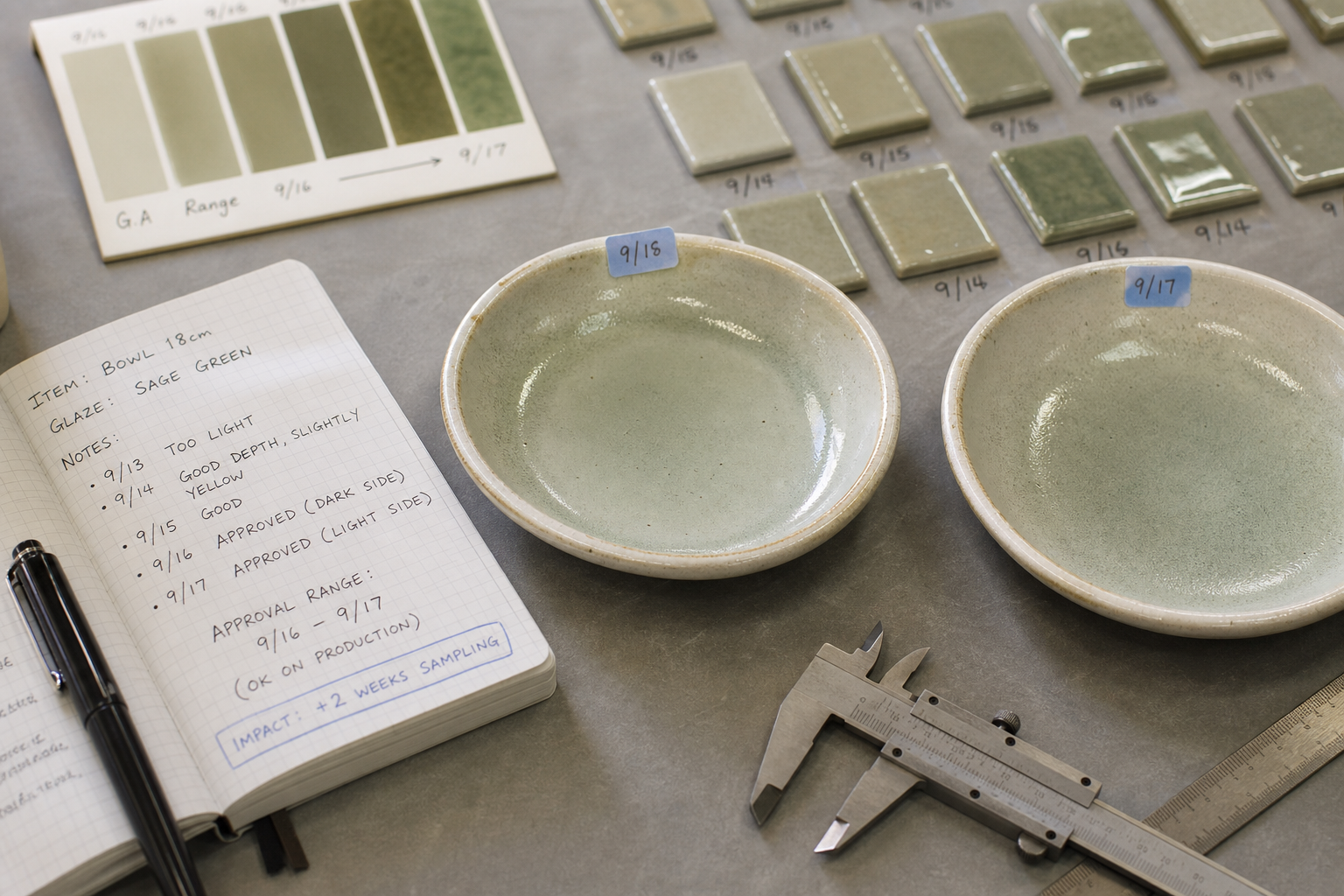
On a screen, one green may look simple. In the kiln, that green depends on glaze thickness, body color, firing curve, kiln position, and surface shape. Matte, speckled, reactive, and dark glazes may need more checking for cutlery marks, cleaning behavior, pinholes, and color range.
For faster approval, I ask buyers to choose a target range, not one impossible photo. Approve a master sample and define what is acceptable in bulk: slightly lighter, slightly darker, more speckle, less speckle, rim flow, or no rim flow.
If every natural ceramic variation becomes a rejection, the project will slow down.
Stage 4: Testing and Claims Should Not Wait Until the End
Food-contact testing, microwave claims, dishwasher claims, and retailer requirements should be planned before bulk production.
Official sources such as FDA lead guidance and European Commission food contact materials are useful starting points when buyers sell in the US or EU.
For technical quality systems, ISO quality management can also help teams ask better process-control questions. For packaging and transit planning, ASTM packaging standards are a useful high-trust reference direction.
The key is not to collect documents randomly. The report should match the real item, glaze, decoration, and market. If the buyer changes from a plain white mug to a metallic rim mug, the schedule may change too.
Stage 5: Packaging Can Quietly Control the Launch Date
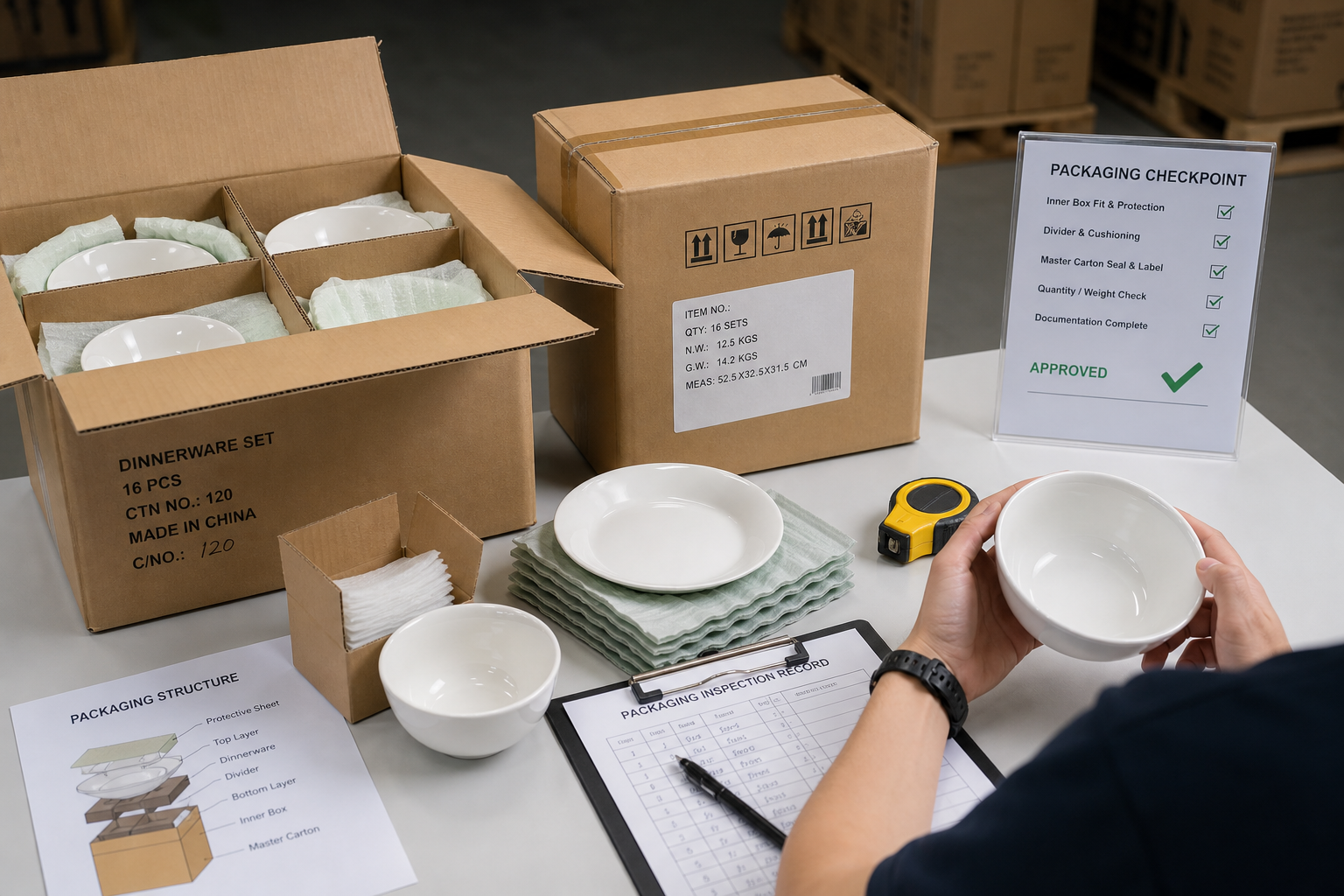
Many buyers focus on the ceramic sample and forget packaging until late. Then the box artwork, insert, barcode, carton mark, and protection structure become urgent. For export dinnerware, packaging is part of quality. A beautiful gift box still needs to survive movement.
If time is tight, I prefer to approve packaging in two layers. First approve the structure: how the items sit, how they are protected, how cartons stack. Then approve the printed artwork. This keeps the physical packing work moving while the brand team checks small design details.
For export planning, buyer teams can also use International Trade Administration export basics as a general reminder to prepare shipment documents, market requirements, and handover details early.
A Delay Diagnosis Tool for Buyers
When a project feels slow, use this table before blaming only the factory or only the buyer.
| Delay Symptom | Likely Cause | Buyer Control |
|---|---|---|
| Quote keeps changing | Specs, quantity, or packaging are not fixed | Freeze one RFQ version and mark later changes clearly. |
| Sample color is not approved | Target color is too narrow or glaze route is unstable | Approve a range board and ask for production-like samples. |
| Mold sample needs another round | Shape creates shrinkage, warping, stack, or handle issues | Decide whether the unique shape is worth the extra time. |
| Test report does not match | Sample, decoration, or market changed after testing plan | Confirm test scope before sending samples to the lab. |
| Packaging is late | Artwork, barcode, insert, or carton spec was not ready | Start packaging structure and artwork review during sampling. |
| Production slot moves | Approval arrived during peak season or after material planning | Reserve capacity after sample approval and avoid late SKU changes. |
| Shipment waits | Inspection, payment, documents, or booking are late | Prepare booking and document list before final packing finishes. |
This table turns a vague delay into a decision.
How Buyers Can Shorten Lead Time Without Increasing Risk
You can shorten a custom dinnerware development schedule, but the shortcut should be smart:
- Use existing shapes for the first launch if the deadline is firm.
- Reduce first-round glaze choices to one or two strong options.
- Freeze logo, decal, and rim decoration before testing.
- Approve a written tolerance range for color, weight, and minor handmade variation.
- Start packaging structure while samples are being reviewed.
- Confirm food-contact and use-claim requirements before bulk production.
- Avoid adding new SKUs after the production plan is made.
- Book inspection and shipment planning early.
The wrong shortcut is skipping sample approval, packaging checks, or claim evidence. That may look fast for a few weeks, then become expensive later.
My Advice as a Manufacturer
My advice is to build your launch date backward.
Start with the retail delivery date, then add time for freight, export booking, final inspection, packing, bulk production, packaging production, test reports, sample correction, and sample approval. If the number feels too tight, simplify the product before placing the order.
At FENN, I would rather tell a buyer early that the plan needs fewer SKUs, simpler glaze, or existing shapes than pretend every custom idea can fit any date.
If you are planning a private label dinnerware launch, send FENN your target launch date, SKU list, shape route, glaze ideas, decoration plan, selling market, and packaging concept. I can help map the project stages and show which decisions affect lead time most.
Questions Buyers Often Ask
When does the supplier’s lead time usually start?
Ask directly. Some suppliers count from deposit payment, some from approved sample, and some from final artwork or packaging approval. For custom ceramic dinnerware lead time, I prefer to record the start point in writing.
Can custom ceramic dinnerware be developed very quickly?
Sometimes, if the buyer uses existing shapes, stable glaze, simple decoration, ready packaging, and fast approvals. New molds, reactive glaze, special packaging, or late testing needs will add time.
What usually delays ceramic samples?
Common delays include unclear briefs, glaze color correction, shape shrinkage, handle comfort changes, decoration placement, and buyer feedback that arrives without clear approval rules.
Should testing happen before or after bulk production?
Plan testing before bulk production whenever the result affects claims, market access, or retailer approval. Do not wait until finished goods are packed to discover the report scope is wrong.
How can I compare lead times from different suppliers?
Compare the same start point, same product complexity, same packaging scope, same test requirements, and same shipment terms. A shorter number is not better if important stages are excluded.
Conclusion
Custom ceramic dinnerware lead time is controlled by decisions, not only by factory speed. A clear brief, realistic ceramic sampling timeline, early testing plan, packaging approval, and stable production specs help keep OEM dinnerware production time under control.
If your launch date matters, ask FENN to review the schedule before sampling begins. A simple timeline check can show where to simplify and where approval delays may appear.
Need help planning your custom dinnerware timeline?
Send FENN your target launch date, SKU list, shape route, glaze ideas, decoration plan, selling market, and packaging concept. I can help map the project stages and show which decisions affect lead time most before sampling begins.