Short Answer
A ceramic dinnerware RFQ should state the product specification, SKU quantities, target market, packaging, compliance and testing needs, delivery timing, and commercial terms. Attach drawings and finish references, then ask every supplier to separate product, tooling, samples, tests, packing, and freight. Accurate quotes come from shared assumptions, not from a low unit price alone.
When three factories give very different prices, I often look at the inquiry first. If it only says, “Please quote 10,000 ceramic plates,” each supplier fills the gaps. One may assume white stoneware in a bulk carton; another may include reactive glaze, retail boxes, and testing. Both quotes can be honest and impossible to compare.
My simple advice is to make the supplier answer the same question. The template below is the version I would want to receive over coffee before we start discussing price.
Copy This Ceramic Dinnerware RFQ Template

You can paste this into a document or spreadsheet. Use one row per SKU for product details and quantities.
Project information
- Brand or company:
- Contact person and decision role:
- Project name and RFQ revision/date:
- Sales market or countries:
- Target launch or required delivery date:
- Estimated first order and annual forecast:
- Existing product, adapted factory shape, or new custom shape:
Product specification by SKU
- SKU code and product name:
- Material or body type:
- Finished dimensions and weight target:
- Shape drawing, photo, or physical reference:
- Glaze color, surface, and acceptable variation:
- Decoration or logo method and placement:
- Intended use and performance claims:
- Order quantity by shape, color, and decoration:
Packing and logistics
- Selling unit: open stock, set, or gift set:
- Inner protection and retail box requirement:
- Master-carton quantity and marking:
- Barcode, label, insert, and printed artwork:
- Shipping route: parcel, pallet, or mixed distribution:
- Requested Incoterms rule, named place, and version:
- Destination port, city, or warehouse:
Compliance, quality, and approval
- Target-market food-contact requirements:
- Required laboratory reports or declarations:
- Who arranges and pays for testing:
- Inspection standard and acceptance limits:
- Sample stages and number of approval sets:
- Packaging test or buyer-specific protocol:
- Required traceability or retained references:
What the quotation must show
- Unit price by SKU and quantity tier:
- Product, retail pack, and export carton inclusions:
- Sample, model, mold, tooling, and setup charges:
- Testing, inspection, artwork, and barcode charges:
- MOQ by shape, glaze, decoration, and pack format:
- Sample timing, production lead time, and capacity assumptions:
- Payment terms, quote validity, currency, and tax basis:
- Exclusions, buyer-supplied items, and open questions:
If a field is not final, mark it “open” and ask for priced options. A visible uncertainty is safer than a silent assumption.
Define the Ceramic, Not Just the Product Name
“Dinner plate” is not a specification. A useful tableware request for quote identifies body, finished size, weight direction, profile, foot ring, rim, glaze, and decoration.
If porcelain or stoneware is undecided, ask for two named routes. Do not let suppliers choose different materials in one price column. Material can affect forming, firing, color, weight, edge feel, and glaze route.
Give finished fired dimensions and state which measurements are critical. Ceramic shrinks during drying and firing, so the supplier needs tolerances. A professional response flags a difficult flatness, stack, weight, or rim requirement before treating a custom mold as certain.
For color, a screen code is a direction, not a fired standard. Say whether a physical sample, fired tile, or approved range will control production. Name food-contact and non-food-contact decoration zones so the factory can review technique, firing, durability, and evidence.
Make Quantity Comparable at SKU Level
An order total can hide very small runs. Suppose your launch has two shapes, three colors, and two logo versions. That is not one 12,000-piece product. It may create several production and packing combinations.
List quantity by SKU and ask what controls MOQ: shape, glaze batch, decal sheet, retail-box print, or carton size. A vague “MOQ 1,000” is not enough if nobody knows whether it means per item, color, or design.
State whether the unit price means an accepted first-quality piece and how normal production loss is treated. Do not add a reject allowance to a price that already covers accepted goods.
Describe the Complete Pack You Want Priced
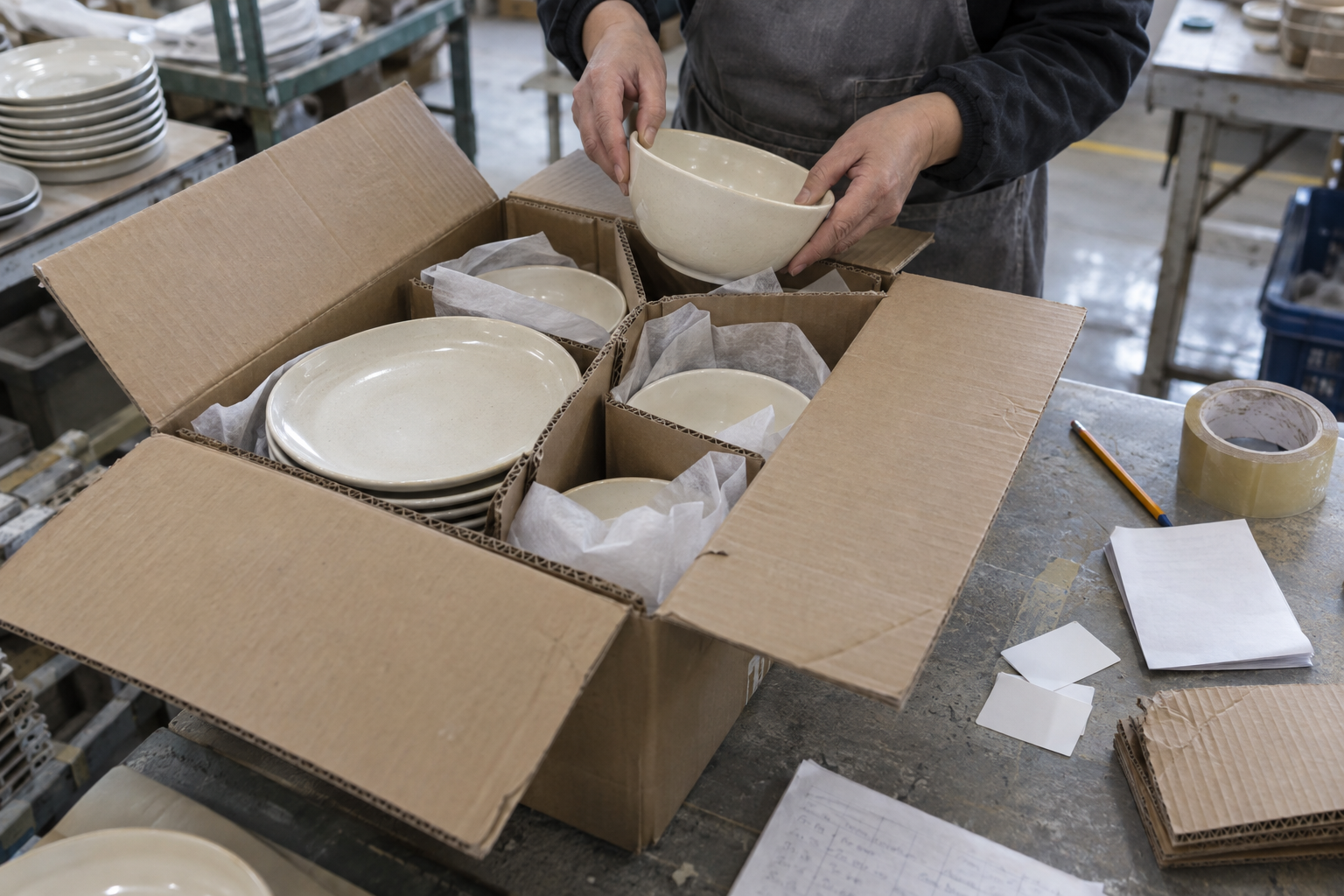
Packaging is part of product cost and risk. State the selling unit, separators, wrapping, retail box, master carton, labels, inserts, and pallet needs. If artwork is not ready, give print coverage, colors, finish, and estimated size.
Match the pack to the route. A palletized retail set faces different handling from individual parcel shipments. The ISTA test procedures page shows that procedures serve different distribution and development purposes. Ask a qualified provider to choose the plan; “pass drop test” is too vague.
Ask suppliers to quote the base product and named pack options separately. Then you can see whether a change comes from the ceramic, presentation, or transport protection.
State the Market Before Asking for Compliance Cost
“Food safe” is not a complete requirement. Tell the supplier where the product will be sold, how it will be used, which surfaces and decorations contact food, and which documents your importer or retailer expects.
For the United States, the FDA page on lead in food and foodwares is useful official background. For the European Union, the European Commission explains the framework for food-contact materials, including specific measures for ceramics. These links do not replace a product-specific compliance plan.
Ask a qualified laboratory or adviser to confirm test scope for the actual body, glaze, decoration, shape, use, and market. Identify who selects the lab, approves and pays for the plan, provides samples, and must be named on reports.
A strong response states which existing report may be relevant and what still needs testing. Unrelated certificates should not erase the testing line.
Put the Commercial Basis Beside the Unit Price
A unit price without a delivery basis is unfinished. State the currency and requested Incoterms rules, including the named place and version. The ICC explains that these rules allocate certain delivery obligations, risks, and costs; they do not replace the sales contract.
Ask which loading, transport, clearance, freight, insurance, duty, and destination costs are included. Do not compare an ex-factory price with a delivered price as if the difference were factory efficiency.
Keep one-time charges separate from repeat unit cost. Model making, molds, decals, samples, tests, and courier fees may have different ownership and repeat-order terms.
Use This Quote Comparability Gate

Before choosing a supplier, test whether each answer sits on the same base.
| Check | Comparable when | Hold the decision when |
|---|---|---|
| Product | Same material, size, finish, decoration, and quality basis | Supplier substituted a body or finish without pricing it as an option |
| Quantity | Same SKU mix and accepted-piece basis | MOQ or loss assumptions are unclear |
| Packing | Same selling unit, protection, printing, and carton scope | One quote excludes retail or export components |
| Compliance | Same market, product variants, reports, and testing responsibility | “Certified” is stated without matching scope |
| Timing | Sample and bulk timing start from the same approval points | Lead time ignores mold, artwork, testing, or peak capacity |
| Delivery | Same currency, Incoterms rule, named place, and included costs | Freight or destination charges are mixed into only one quote |
If a row is not comparable, ask for a revision. Do not “normalize” a missing assumption in your head and treat it as agreed.
Weak RFQ Versus Strong RFQ
Weak: “Quote 10,000 matte ceramic bowls with logo, best price, delivery to the US.”
Stronger: “Quote revision B for two bowl sizes in ivory matte stoneware, 5,000 accepted pieces per size, using attached fired finish reference and underside one-color logo artwork. Price each SKU with individual paper protection, six pieces per plain master carton, shipment to Long Beach under the requested named delivery basis. Show retail-box option, tooling, sample, testing, and inspection costs separately. Flag any open tolerance, compliance, MOQ, or timing assumption.”
The stronger version still needs drawings and a compliance plan, but it gives the factory a controlled start and asks it to expose what is missing.
My Advice as a Manufacturer
Send the same core RFQ to every shortlisted supplier and protect the revision number. Keep supplier improvements as named alternatives, not quiet changes to the base quote.
After written review, hold a short clarification call and issue a clean RFQ revision. The final quotation should not depend on somebody remembering a chat.
The lowest number is only useful when it buys the product you intended. A good supplier makes its assumptions easy to see.
Questions Buyers Often Ask
Should I include a target price?
Yes, if it is a realistic target tied to quantity, packing, quality, and delivery basis. It helps the supplier suggest suitable routes. Do not use one target for several different scopes.
Can I send an RFQ before the design is final?
Yes. Label open items and request options or a budget range. Treat the result as an early estimate until samples, specifications, and commercial assumptions are confirmed.
Do I need exact annual volume?
No, but give an honest forecast range and the firm first-order quantity by SKU. Ask suppliers to quote quantity tiers rather than treating a hopeful forecast as a purchase commitment.
How many suppliers should receive the RFQ?
Use a shortlist you can review properly. Still judge technical answers, communication, sampling, capacity, quality control, and evidence.
When is a quotation ready for approval?
When the product revision, SKU quantities, packing, compliance scope, timing, delivery basis, charges, exclusions, and validity are clear enough to place into the purchase agreement without guessing.
Conclusion
A complete ceramic dinnerware RFQ turns a product idea into one shared quotation question. Define the ceramic, list SKU quantities, describe the pack, name the market, separate charges, and fix the commercial basis. Then use the comparability gate before you treat any unit price as the best price.
If you are preparing a new range, send FENN your completed OEM dinnerware quote template, drawings, quantity plan, target market, and packing direction. I can help identify the open points before the quotation moves into sampling.