
Short Answer
Organic shape ceramic dinnerware can be controlled in bulk when the irregularity is designed, not accidental. Define which curves may vary, which points must stay stable, and how pieces must sit, stack, pack, and match as a set. Approve several fired samples—not one perfect plate—then inspect production against measurable functional limits and a photographed visual range.
I like organic forms because they make a table feel human. But I have seen a handmade-looking rim excuse rocking plates and uneven sets.
My simple rule is this: freedom belongs in the visible outline; control belongs wherever the product touches food, tables, other pieces, packaging, and the customer’s hand.
First Diagnose What “Irregular” Means
When a buyer says, “We want an irregular plate,” I first ask what should create that feeling. It may be an asymmetric outline, a gently moving rim, a hand-cut edge, a soft oval, or small differences between pieces. These are not the same production job.
An organic shape is planned. A warped shape moved away from the approved design during drying or firing. The two can look similar in one photograph.
Use the plate on a flat surface. Rotate it. Stack it. Put it beside five more pieces. If the design still looks intentional and works normally, the variation may be acceptable. If each test gives a different problem, “handmade look” is hiding weak control.
Use a Shape Tolerance Map, Not One Diameter
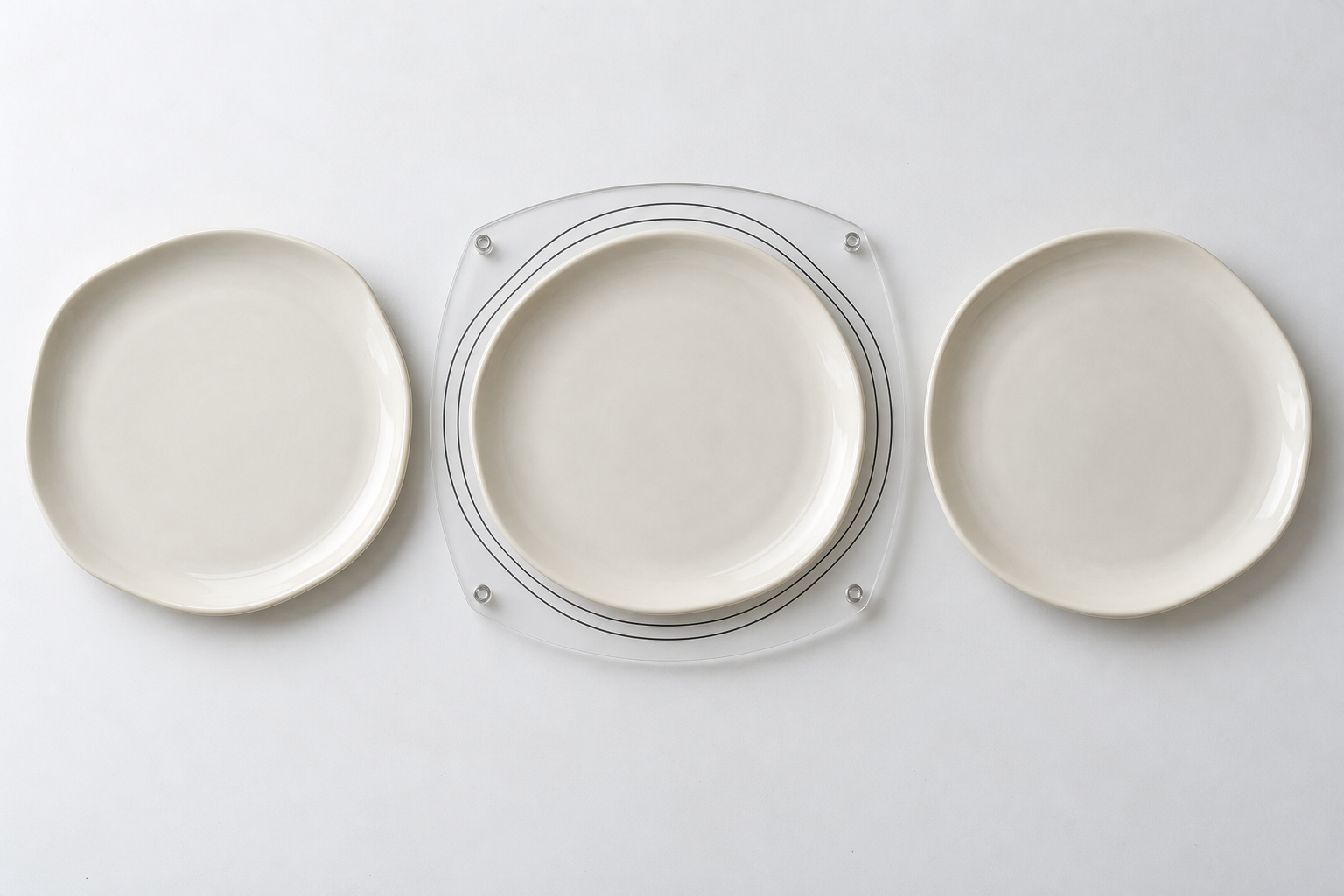
A single diameter cannot describe an asymmetric plate. I prefer a simple top-view drawing that separates creative zones from functional zones.
| Control Zone | What May Vary | What Must Stay Controlled | Practical Approval Method |
|---|---|---|---|
| Outer silhouette | Gentle waves, lobe depth, asymmetric rhythm | No sharp peaks, collapsed areas, or sudden flat spots | Overlay top-view photos against the approved outline range |
| Food well | Minor visual movement | Useful area, drainage, cutlery comfort, easy cleaning | Test with real food and normal utensils |
| Rim | Soft height movement if intended | No uncomfortable high point, weak thin point, or sauce run-off | Side-view gauge plus hand and service test |
| Foot ring | Very little variation | Stable table contact, safe glaze clearance, no rocking | Flat-surface rotation and feeler check |
| Stack contact | Hidden local contact differences | Stable nesting, acceptable lean, easy separation | Multi-piece stack test with rotation |
| Pack contact | None unless designed into the insert | No edge pressure or loose movement | Trial pack using production-style dividers or inner boxes |
This is the heart of a useful ceramic plate shape tolerance. The supplier should be able to show which reference points are measured, what tool is used, and whether the limit is based on fired pieces. “We will control it carefully” is not a control plan.
Symptom 1: The Plate Looks Organic but Rocks on the Table
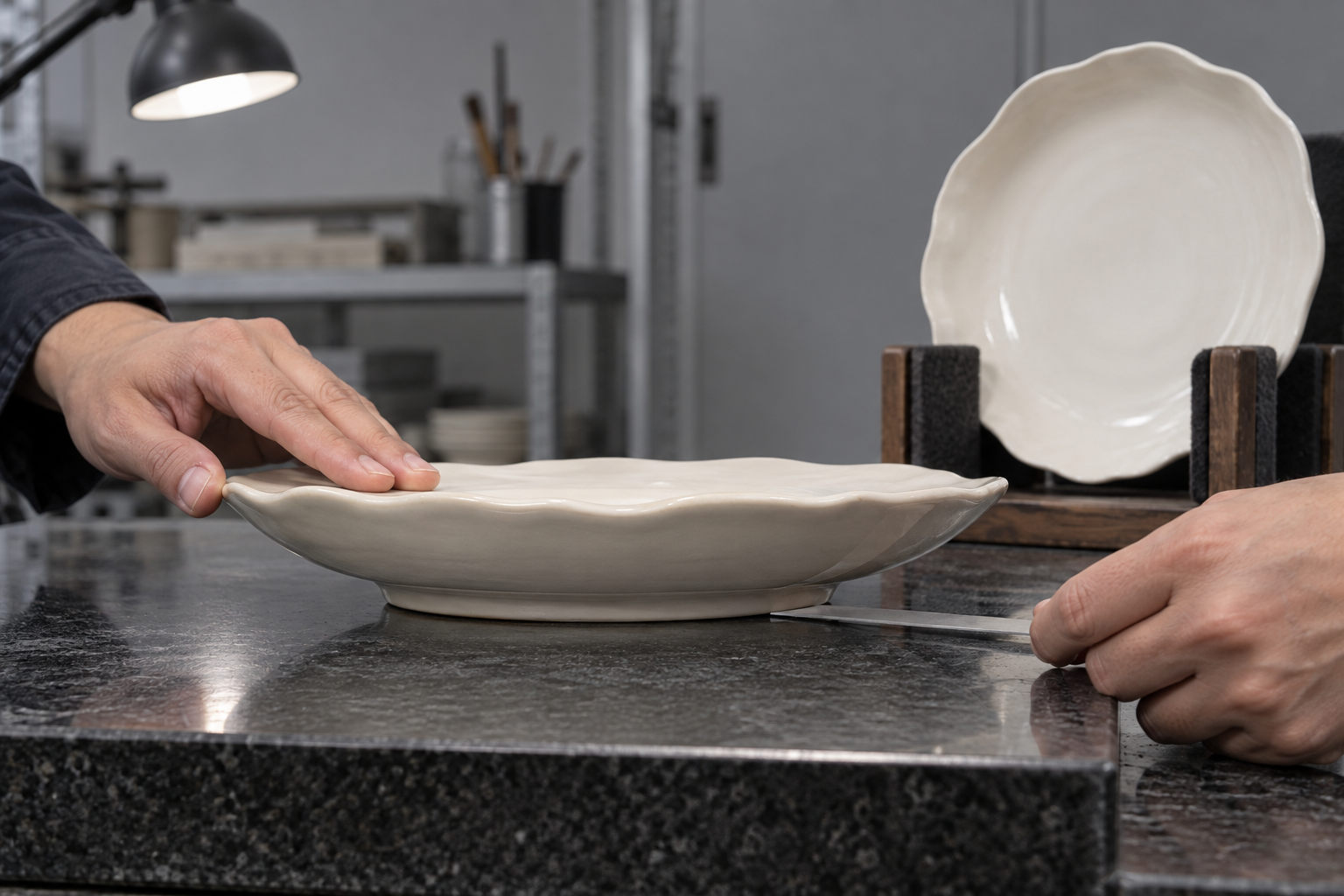
Rocking usually comes from the foot ring, base, or overall fired deformation—not from the attractive outer outline alone. Put the piece on a verified flat inspection surface and press lightly at several points around the rim. Then rotate it and repeat.
A small visual rim wave may be part of the design. A foot that alternates between contact points is a use problem. Restaurants notice it quickly because sauce, cutlery, and service speed make movement obvious.
Ask the factory to check forming support, drying direction, foot trimming, kiln support, and firing position. Large flat forms are naturally sensitive to uneven drying and firing. Practical guidance on preventing warping in large platters also shows why even support during drying matters.
Symptom 2: Six Plates Look Like Six Different Designs
This happens when the sample approval defines a mood but not a range. One master sample cannot show the lightest curve, deepest lobe, highest rim point, and maximum acceptable asymmetry.
I prefer an approved family:
- A central reference showing the intended look.
- One acceptable mild example.
- One acceptable strong example.
- Clear rejection photos for shapes that look collapsed, stretched, or unbalanced.
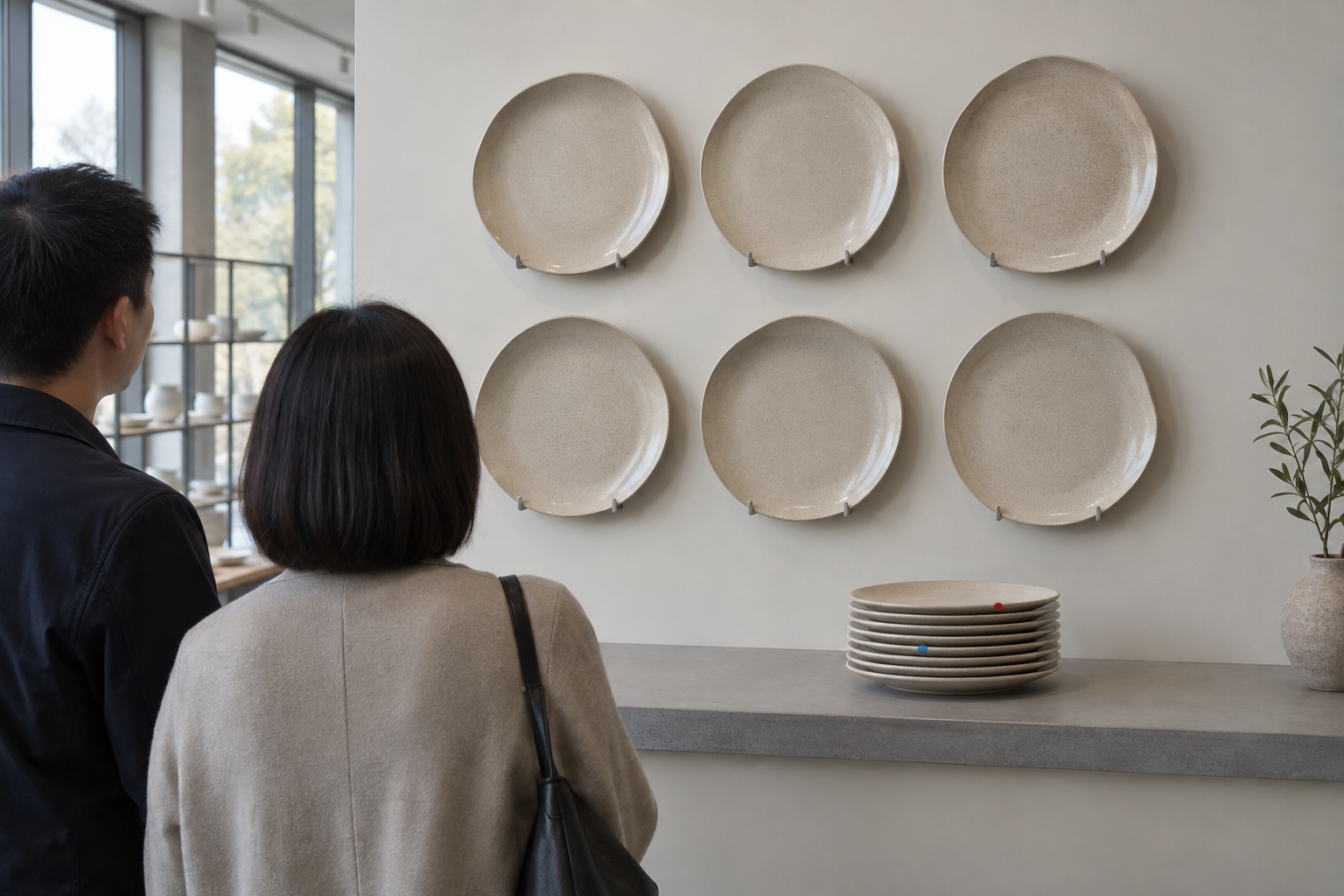
Arrange six to twelve irregular ceramic plates in a simple grid and step back. The group should read as one collection. If one plate immediately pulls the eye for the wrong reason, mark why. “Too irregular” is hard to inspect; “the left lobe extends beyond the approved overlay” is usable.
Symptom 3: The Stack Leans or Pieces Lock Together
Organic rims can hide a nesting problem until many pieces are stacked. A two-piece check is not enough.
Build the stack quantity used in storage, packing, or foodservice. Rotate alternate pieces, measure total height and lean, and lift each item out. Listen and feel for scraping. Mark the true contact points with removable tape or pencil on the test pieces.
If rims carry the load, one high lobe may press against the next plate and create a chip point. If feet nest too deeply, pieces may lock. If the shape rotates into different positions during packing, the protective insert must work in more than one orientation.
The buyer should receive a short stack record with quantity, total height, lean observation, contact map, and photos. A supplier answer based on “it stacks” after testing three hand-picked pieces is too weak for bulk approval.
Symptom 4: The Piece Passes Alone but Fails in the Carton
Handmade look dinnerware often needs packaging designed around its strongest and widest points. Standard round dividers may leave an organic edge loose in one direction and compressed in another.
Run a pack trial with real fired samples from the normal variation range. Include the strongest acceptable outline, not only the neat central sample. Check edge clearance, movement after gentle handling, pressure from sleeves or dividers, and whether the piece can be packed the wrong way.
If orientation matters, make that obvious in the packing method without relying on a worker to study every curve. A fitted inner box, shaped pad, or simple locating feature may be more dependable than tighter wrapping.
A Five-Step Bulk Shape Decision
Here is the workflow I would use before accepting a shipment:
- Confirm identity. Check the SKU, body, glaze, size family, and approved reference set.
- Check function first. Test foot stability, rim comfort, food area, and obvious sharp or thin points.
- Check the silhouette. Use the agreed overlay, key-point measurements, or approved visual range.
- Check the group. Review a grid and a service-size stack, not isolated pieces only.
- Decide by agreed sampling. Record each issue under the correct defect class and apply the purchase specification.
Acceptance sampling is a way to decide on a lot from a limited inspection sample; it does not replace the product specification. ISO 2859-1:2026 describes sampling procedures indexed by acceptance quality limit (AQL) for lot-by-lot inspection. Your shape definitions and defect classes still need to be written before inspection.
For porcelain projects, ISO 5644:2024 is also useful background because its scope includes specifications, test methods, sampling, marking, and labeling for porcelain tableware. Buyers should confirm whether that standard, another market standard, or their own specification applies to the actual material and sales market.
Set the Defect Classes Before Production
Do not wait for final inspection to decide whether a shape issue is major or minor. Agree it during sample approval.
I would normally treat loss of stable use, unsafe sharpness, serious nesting failure, or packaging damage risk more seriously than a visual outline difference within the approved range. The exact classification must match the product, channel, and contract.
Use photographs with arrows and short reasons. Keep the wording concrete:
- Accept: rim movement stays inside the approved outline band.
- Review: outline is inside the band but looks visibly unbalanced in the group grid.
- Reject: foot rocks on the flat reference surface.
- Reject: high rim point causes direct ceramic-to-ceramic pressure in the approved stack.
For food-use areas, remember that design and surface shape affect cleanability. The FDA Food Code describes easily cleanable surfaces in terms of normal soil removal and the surface’s material, design, construction, placement, and use. It is foodservice guidance, not a shape certification for a plate, but it gives buyers a sensible design question: can normal cleaning reach and clean the real surface?
My Advice as a Manufacturer
Start with one clear source of irregularity. If the outline, rim height, foot, glaze flow, and surface texture all vary at once, neither the factory nor the buyer can tell which change caused a failure.
I prefer a controlled mold or forming reference, a stable foot ring, and a photographed fired range. Then I test the strongest acceptable shape through stacking and packaging. That creates room for character without turning every inspection into an argument.
Also, price the control plan. Organic shape ceramic dinnerware may need more sample rounds, more sorting, special setters, slower packing, or a wider carton. A professional supplier should explain these cost drivers instead of promising a handmade look at no operational cost.
Questions Buyers Often Ask
Can every organic plate be exactly the same?
Not always, and exact sameness may defeat the design. The goal is a controlled family: stable function, recognizable shape language, and variation inside an approved visual and measured range.
Is a wavy rim the same as warpage?
No. A wavy rim can be intentional. Warpage is unwanted movement away from the approved form. Judge the foot, table stability, food area, stack, and approved outline together.
How many samples should we approve?
Approve enough fired pieces to show the normal center and the acceptable edges of variation. The right quantity depends on forming method, size, body, glaze, and risk. One selected sample is rarely enough.
Should we use exact millimeter tolerances everywhere?
Use measurements at functional and repeatable reference points. Use a photographed or overlay range for expressive curves. Trying to measure every wave can create paperwork without better control.
Can organic plates use standard packaging?
Sometimes, but verify it with the full approved shape range. Check widest points, rim pressure, movement, orientation, and stack height using production-style packaging.
Conclusion
Organic shape ceramic dinnerware works in bulk when beauty and control have separate jobs. Let the silhouette carry the handmade feeling, while the foot, food area, stack contacts, and pack contacts stay dependable. Approve a fired range, define ceramic plate shape tolerance by zone, and judge production both piece by piece and as a group.
If you are developing irregular ceramic plates, send FENN your drawing, target use, forming idea, glaze direction, stack quantity, and packaging plan. We can help turn the visual idea into a sample and inspection brief that a factory team can actually follow.