
Short Answer
To control ceramic glaze color consistency, approve a master sample, define a practical dinnerware color tolerance, keep firing and glaze records, and agree how variation will be judged before bulk production. For repeat order ceramic dinnerware, ask your supplier to keep retained samples, batch photos, kiln records, and change-control notes so the next order can be compared against evidence, not memory.
I have seen buyers feel happy after the first order, then worry when the reorder looks warmer, cooler, darker, or more speckled. This is not always a defect. Ceramic color comes from clay, glaze, firing heat, kiln position, and human control working together. But “ceramic is natural” should not become an excuse for poor control.
My simple advice is this: do not ask only, “Can you make the same color?” Ask, “How will we judge same enough?”
Best Criteria for Repeat Color Control
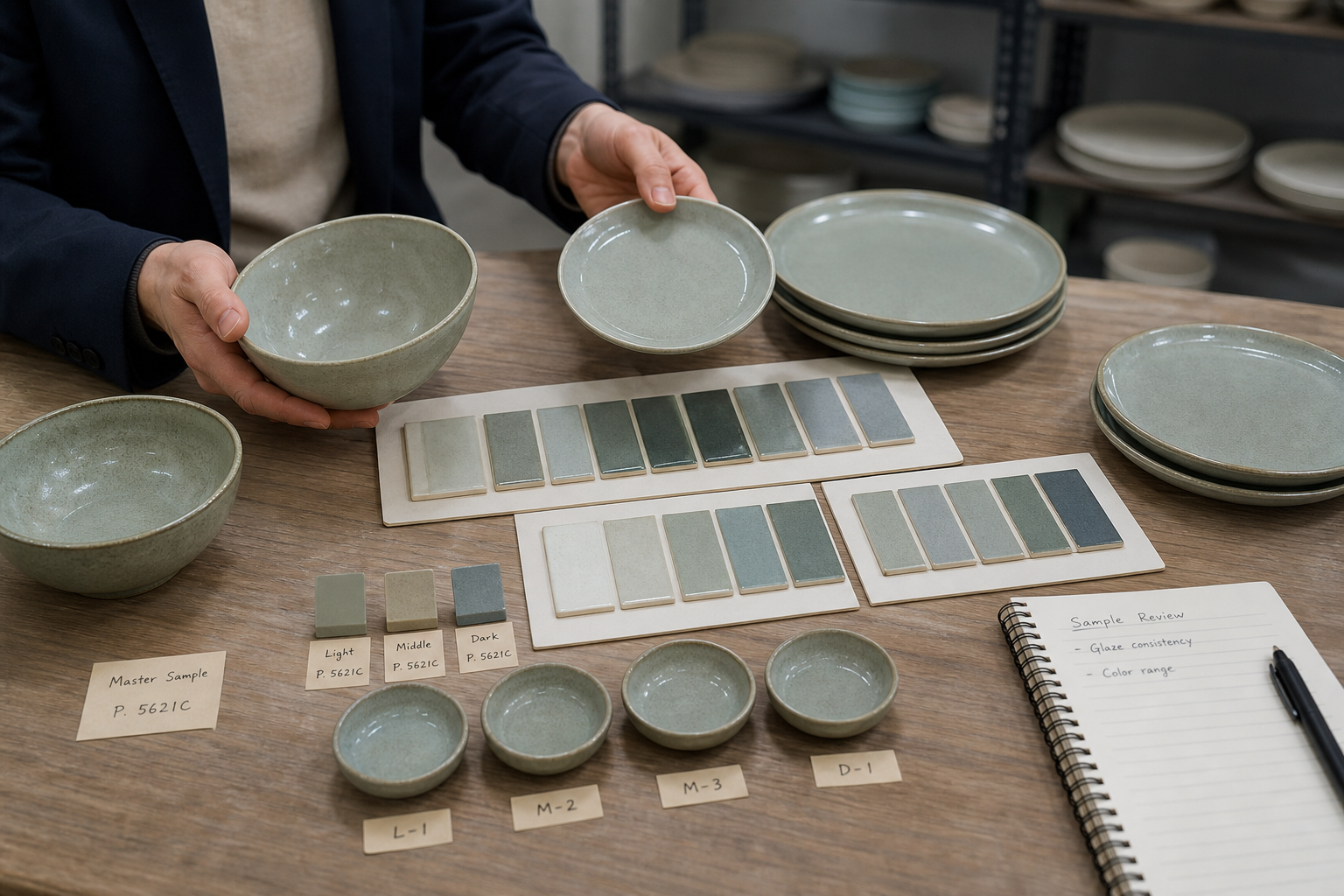
The best control standard is not one perfect plate. It is a full approval system: master sample, acceptable range, production records, inspection method, and repeat-order comparison.
Why Ceramic Colors Move from Batch to Batch
In real ceramic production, glaze color is affected at several stages. Clay body, glaze thickness, dipping time, spraying angle, drying condition, and firing curve can all push color slightly.
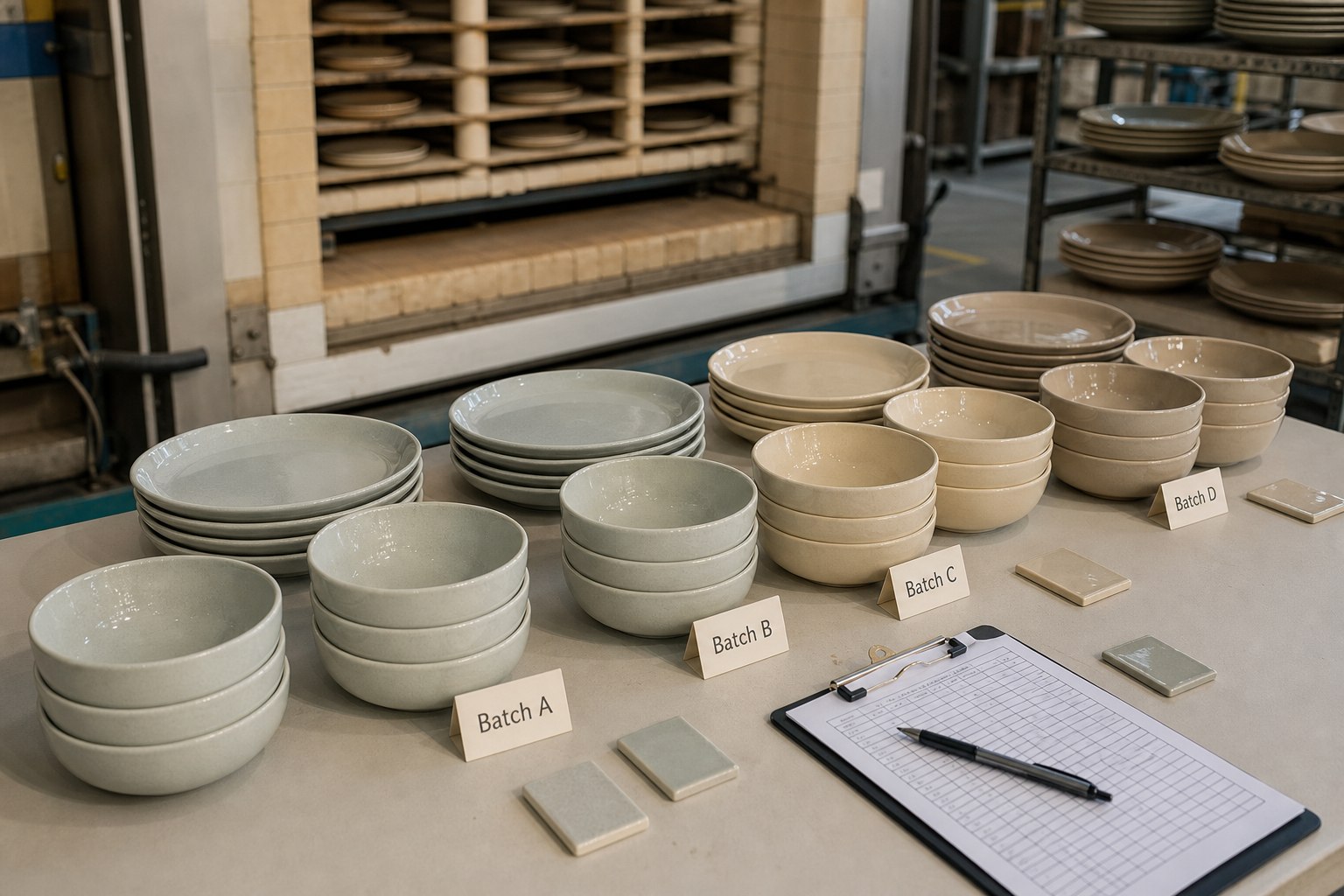
Kiln position is another big reason. A plate near one part of the kiln may receive heat differently from a bowl placed in another area. For reactive glaze variation, this can be part of the beauty. For a plain brand color, it must be controlled more tightly.
This is why I prefer control points over promises. If a supplier says, “No problem, 100% same,” I ask for retained samples, kiln records, and inspection standards.
A Factory Walkthrough: Where Color Is Controlled
Color consistency is not checked only at the end. By then, the order is already fired. A better supplier controls color step by step.
1. Before Sampling: Define the Target
The buyer should give a reference color, target finish, clay body, and expected product use. A photo alone is weak because screens and lighting change color. A physical sample is better. If you do not have one, give several natural-light photos and explain what matters: base color, speckles, rim effect, or gloss level.
For brand colors, some buyers use Pantone, ASTM color and appearance standards, or CIE color measurement ideas as a direction. These help communication, but the approved fired ceramic sample should be the real standard.
2. During Sample Development: Build a Master Standard
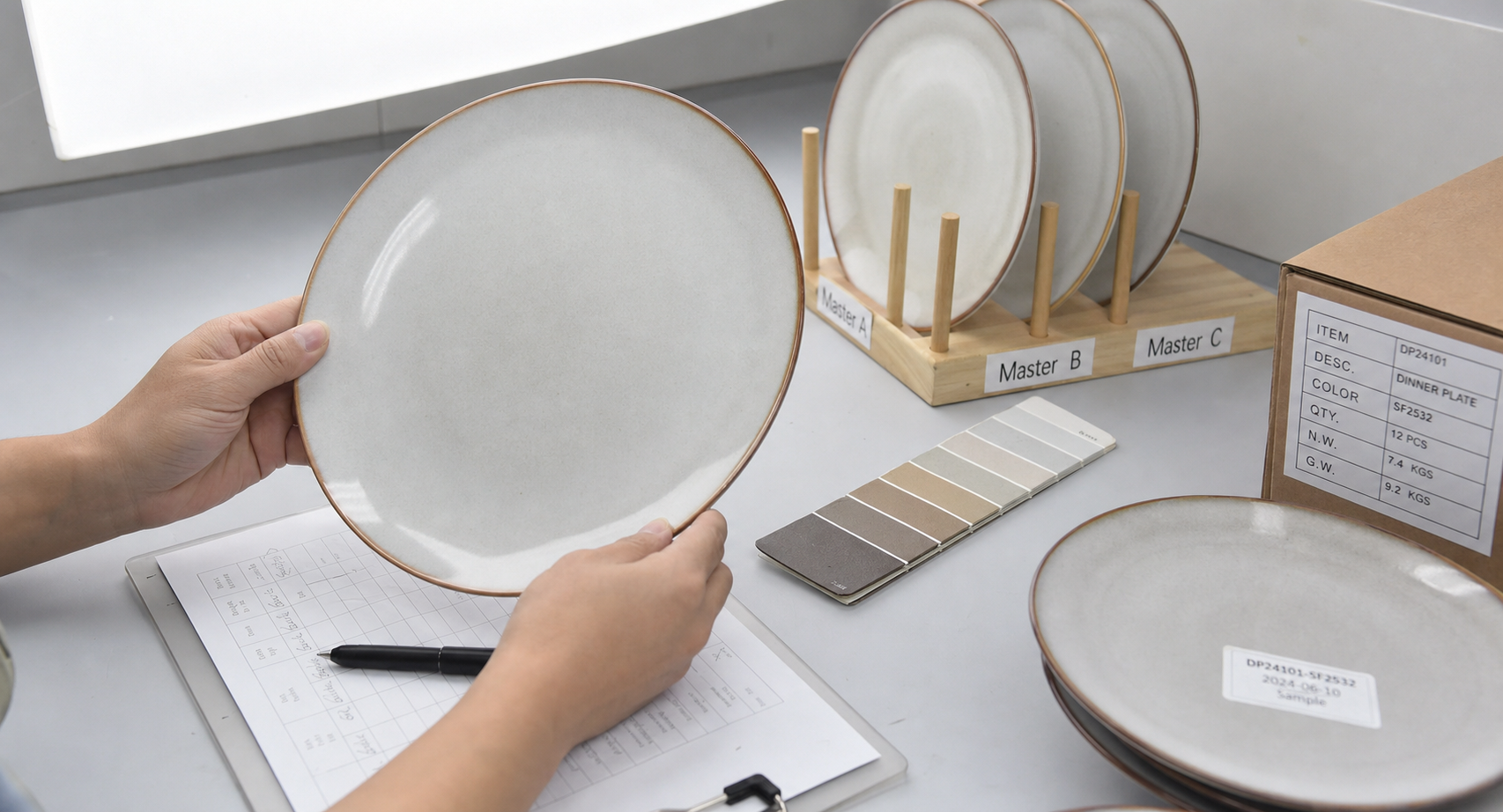
When we review samples, I like to keep the best approved piece as the master sample. For sets, one plate is not enough. A dinner plate, bowl, and mug may show color differently because shape, depth, and glaze pooling affect the surface.
The master sample should be clearly labeled with date, item code, clay body, glaze code, and approval notes. This sounds small, but it prevents arguments later.
3. Before Bulk Production: Set the Acceptable Range
A good dinnerware color tolerance should say what is acceptable and what is not. A reactive glaze may need a wider range. A solid white porcelain line should be tighter.
I often suggest a small color range board: light limit, approved middle, and dark limit. For speckled or reactive glaze, also show acceptable speckle density, rim flow, and pooling.
4. During Glazing and Firing: Keep Process Records
From a factory point of view, repeatability depends on records. The glaze batch, application method, firing curve, kiln load, and production date should be traceable. ISO 9001 quality management is a useful reference because it focuses on documented, repeatable processes.
This does not mean every buyer needs a thick audit file. It means the supplier should answer simple questions: Which glaze batch was used? Was firing changed? Was any material changed?
5. During Final Inspection: Compare Under Stable Light
Color should be checked under stable lighting, not beside a window in changing afternoon sun. Compare bulk pieces against the master sample and accepted range. For larger orders, check different cartons and kiln batches.
If the color is outside the range, separate it from normal handmade variation. “Different” is not always “defective,” but if it breaks the standard, the buyer needs to know before shipment.
6. Before Repeat Orders: Pull the Retained Sample
For repeat order ceramic dinnerware, the supplier should keep retained samples and compare new production to the original master sample and the last shipment. Real samples are more honest than memory.
Color Control Tool for Buyers
Use this table before approving bulk production or a repeat order.
| Control Point | What Buyer Should Ask | Professional Supplier Answer Should Include |
|---|---|---|
| Master sample | Which physical sample is the approved standard? | Labeled retained sample with item code, date, glaze code, and buyer approval record |
| Color range | What level of variation is acceptable? | Light/middle/dark samples or photo range with clear rejection boundaries |
| Glaze batch | How is the glaze mixed and recorded? | Batch record, formula control, and material-change note |
| Firing control | How do you track firing conditions? | Kiln date, load area, firing curve or practical firing record |
| Inspection light | How will color be checked? | Stable light condition and comparison against master samples, not only photos |
| Repeat order | What will be used for comparison next time? | Retained sample from the last approved shipment plus original master sample |
How to Judge Natural Variation vs a Problem
The right standard depends on the product.
For a simple white or solid color line, the surface should look consistent when pieces are placed together. Small differences may happen, but obvious warm/cool shifts across a boxed set can create complaints.
For reactive glaze variation, movement is part of the product story. But it still needs rules. If one bowl is soft blue and another is almost black, the set may feel mismatched unless that range was approved.
My test is simple: would the customer feel the pieces belong to the same family? If not, the range is too wide.
What Evidence to Request Before Shipment
Before final approval, ask for comparison photos with the master sample in the same frame. Ask for carton or batch sampling, especially if the order was fired over several days. ISO sampling procedures for inspection by attributes can help buyers understand planned sampling.
For important orders, ask for a pre-shipment inspection plan covering color, glaze surface, rim condition, logo, dimensions, and packaging.
If the supplier cannot explain how the sample, bulk order, and repeat order connect, color risk is still open.
Common Mistakes I See Buyers Make
- Approving color from one studio photo.
- Approving only one piece for a full set.
- Accepting “same as last time” without retained samples.
- Treating reactive glaze like a printed color instead of controlled variation.
Buyer Checklist for Repeat Glaze Orders
Before a repeat order, check these points:
- Do we have the approved master sample and the last shipment retained sample?
- Is the acceptable dinnerware color tolerance written down?
- Did the supplier confirm the same clay body and glaze route?
- Did any material, kiln, decoration, or finish process change?
- Will inspection compare different cartons and production batches?
- Do we need updated photos under stable light before shipment?
- Are customer complaints from the last order reflected in the new standard?
My Advice as a Manufacturer
My advice is to make color control practical, visual, and written. Do not depend on memory or one beautiful sample. Do not ask the factory to control something you have not defined.
At FENN, when a buyer is developing private-label dinnerware, I prefer to discuss color expectations early: solid color, speckled glaze, reactive glaze, matte finish, glossy finish, and how the set should look together.
Good color control is not about making ceramic lifeless. It is about protecting the brand promise while respecting the material.
Questions Buyers Often Ask
Can ceramic glaze color be exactly the same every time?
Not exactly like printed plastic or paper. Ceramic glaze is fired at high temperature, so small movement can happen. A professional supplier should control the range and keep records.
Is reactive glaze variation acceptable for retail dinnerware?
Yes, if the buyer defines the acceptable range. The brand must decide what counts as natural variation and what counts as a defect.
Should I use Pantone for ceramic dinnerware color?
Pantone can be useful for direction, especially for brand color, but the approved fired ceramic sample should be the final standard.
Conclusion
Ceramic glaze color consistency is controlled by master samples, clear dinnerware color tolerance, glaze and firing records, stable inspection, and retained samples for repeat orders. The goal is not to remove all natural ceramic character. The goal is to make every shipment feel like the same product family.
If you are planning a private-label dinnerware line or a repeat order ceramic dinnerware project, send FENN your approved sample photos, target finish, order history, and concern points. I can help you build a practical color-control standard.
Need help setting a color standard for your next dinnerware order?
Send FENN your approved sample photos, target finish, order history, and concern points. I can help you build a practical color-control standard before production.