
Short Answer
When ceramic sample cost points to an unaffordable bulk order, first separate one-time development charges from repeat production cost. I protect the design features buyers notice most, then compare changes to shape, glaze, decoration, packaging, and assortment. Ask the supplier to explain each saving and prove the revised design with fired samples before approving production.
A lovely sample can make the whole team smile. Then the quotation arrives, and the room gets quiet. I would not put the sample away just yet. Often, the right question is which parts of the work create value for your customer.
Dinnerware value engineering means changing how a product is made or supplied while protecting its useful function and the features people buy it for. It needs a clear design priority, a comparable quotation, and a sample that proves the change works.
Find Out Which Ceramic Sample Cost Is Too High
Start with two separate numbers: what it costs to develop the product, and what each accepted production piece costs to supply. A sample fee may cover model making, trials, or courier delivery. Dividing that fee by a few sample pieces does not tell you the bulk unit price.
Ask for development, tooling, production, packing, and testing charges to be identified separately. Confirm whether any charge is included elsewhere, refundable, or payable again on reorders. A professional answer names the charge and its trigger. “Everything included” is difficult to use unless the scope is written down.
Next, check the comparison basis. The same quantity must mean the same mix of shapes and colors. Keep the delivery term, currency, packaging, and inspection requirements consistent. A price with the retail box removed cannot be compared directly with one that includes it.
I also ask what makes this particular design costly. Extra handwork? A separate decoration firing? Low first-quality yield? The supplier may keep its detailed costing private, but it should still explain the main production drivers and quote realistic alternatives.
Protect Two Features Before Changing Anything
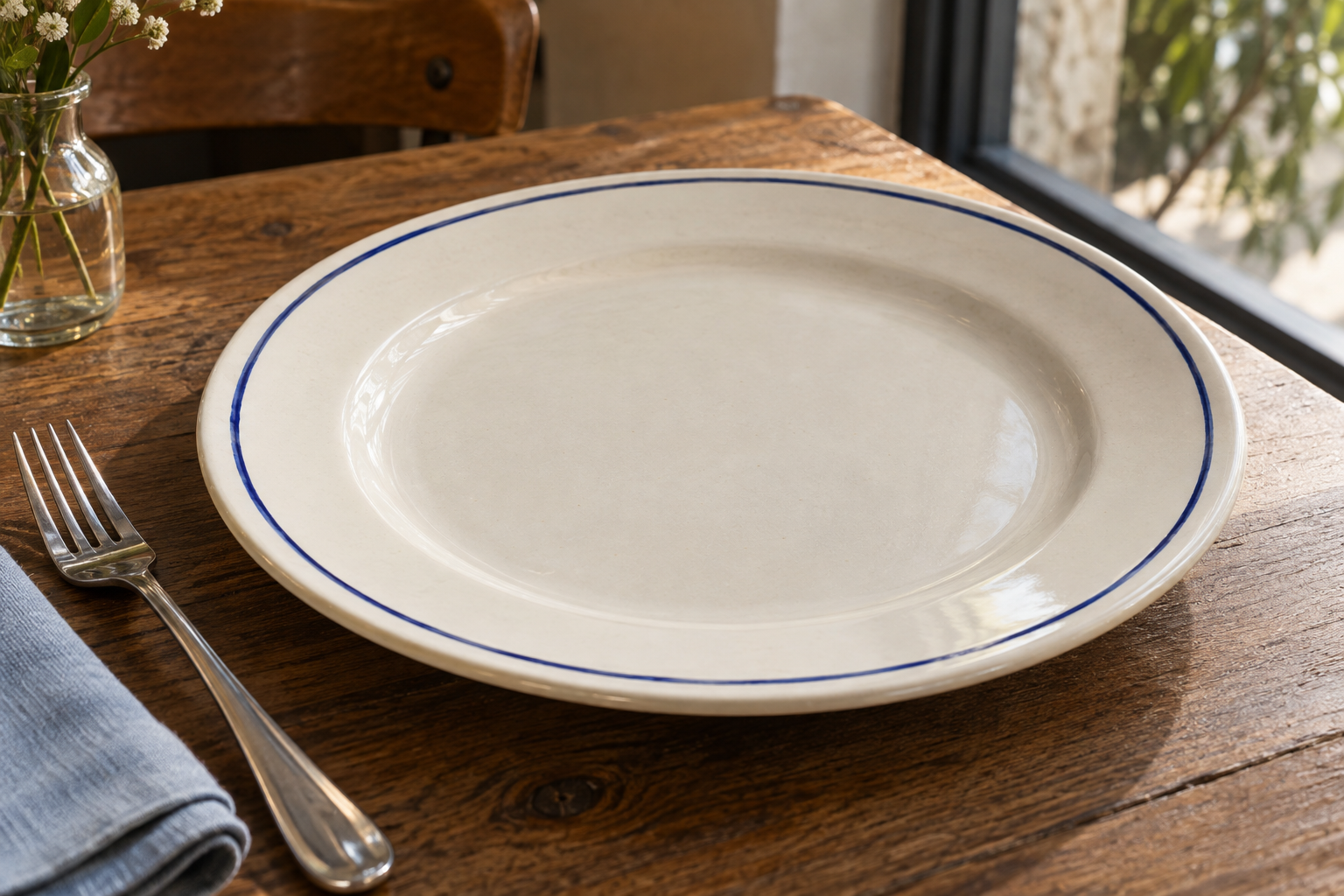
Imagine a cream dinner plate with a broad curved rim, a hand-painted blue line, and a small underside logo. This is an illustrative project, not a FENN quotation or customer case.
The brand team decides that the rim silhouette and blue line carry the identity. The hidden logo technique and box finish have more room to change. That small decision stops five departments from redesigning the plate in five different directions.
Write a short “keep, flex, reject” card:
- Keep: the curved rim, blue accent, usable food area, and agreed handling performance.
- Flex: logo process, box printing, and the number of launch colors.
- Reject: savings that cause unstable stacking, poor cleaning, unsupported use claims, or inadequate protection.
Let the person responsible for the range approve this card. A supplier needs to know whether a surface detail is essential or simply something the team liked in an early sample.
Choose the Change That Removes the Right Work
I use the table below to choose a trial, not to promise a saving. The result depends on the factory route and the complete order.
| Possible change | Work or cost it may remove | What the buyer must judge |
|---|---|---|
| Adapt an existing shape | New model work, tooling, or difficult forming | Does the fired silhouette still fit the range and its use? |
| Simplify a hidden profile | Trimming, handling, or firing-support difficulty | Do stability, stack contact, and hand feel remain acceptable? |
| Use an established glaze route | Repeated glaze trials or difficult application | Does the fired finish retain the intended color, texture, and care performance? |
| Simplify the logo or decorative area | Application time, setup, or a firing step where feasible | Is the mark readable, durable for its intended use, and visually acceptable? |
| Simplify printed packaging | Print setup, finishes, or extra presentation parts | Does the revised complete pack still protect the product? |
| Launch fewer colors or shapes | Small-batch setups and packaging variants | Is the smaller range still useful to the intended customer? |
If the shape causes the cost
A large flat area, thin edge, or deep foot detail can make a plate harder to produce consistently. In real ceramic production, forming, drying shrinkage, and firing support work together. A small profile adjustment may matter more than reducing the amount of clay.
Ask the factory to show the proposed section drawing and a fired piece. Check stack height, table stability, and rim contact against the original. Technical guidance on preventing warping in large platters is useful background for understanding why support and drying matter; it is not a guarantee for a factory redesign.
I would be cautious about “just make it thinner.” Lower weight can come with new forming or strength problems. The supplier should identify what needs to be checked before quoting the change as a reliable saving.
If the surface causes the cost
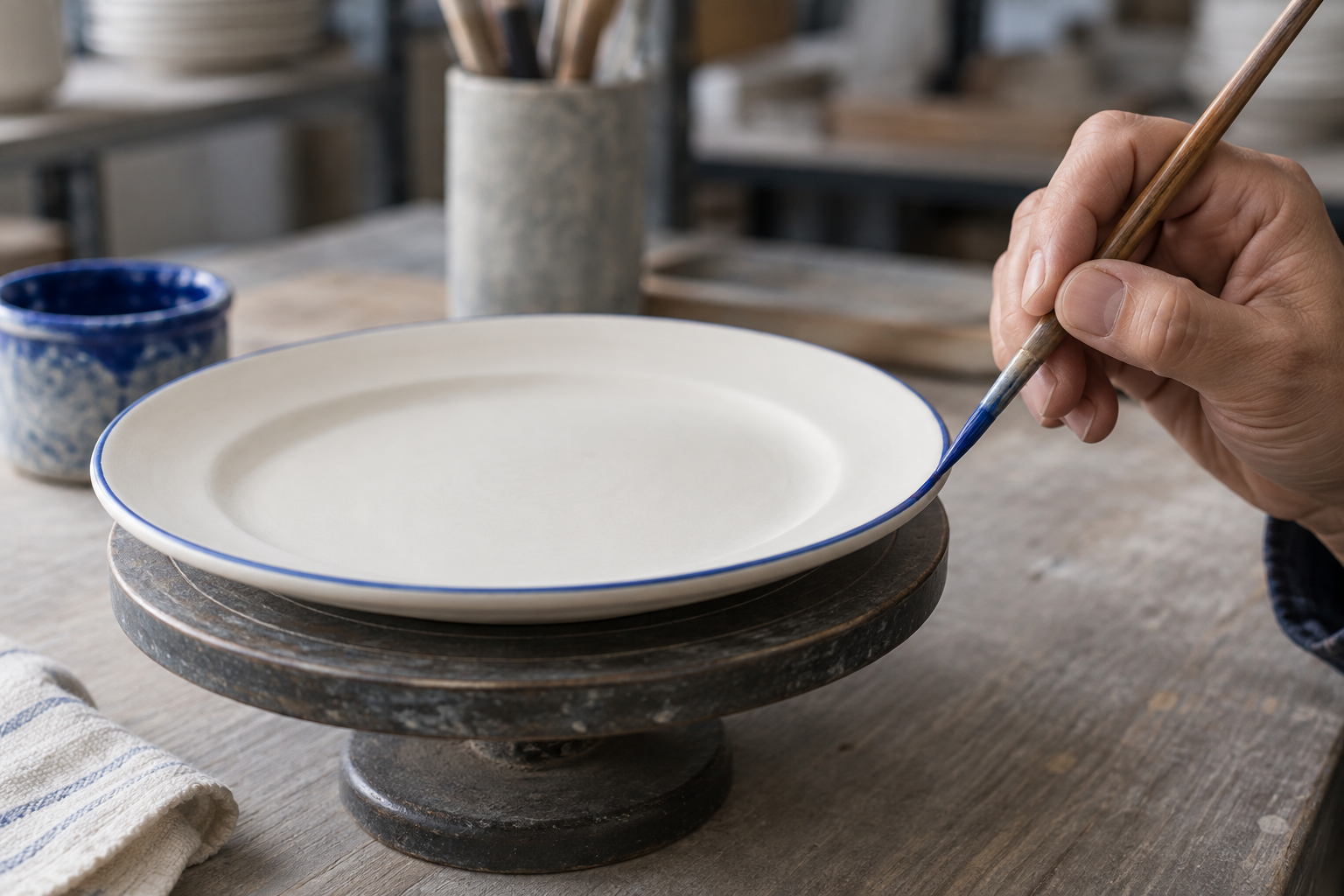
For our blue-rim plate, changing the entire glaze would risk losing the look before exploring easier options. I would first ask whether the underside logo can use an existing decoration route without adding a separate operation.
That is a question, not an assumption. Different materials and decoration systems need different firing conditions. A fired decal does not automatically mean fewer firings, and a standard glaze does not automatically mean a lower accepted-piece cost.
For any glaze alternative, compare fired samples on the actual shape. Glaze thickness and flow can change the rim and inner curve even when a flat test tile looks close. Ask which body, glaze, and decoration combination the new quote covers.
If the range or box causes the cost
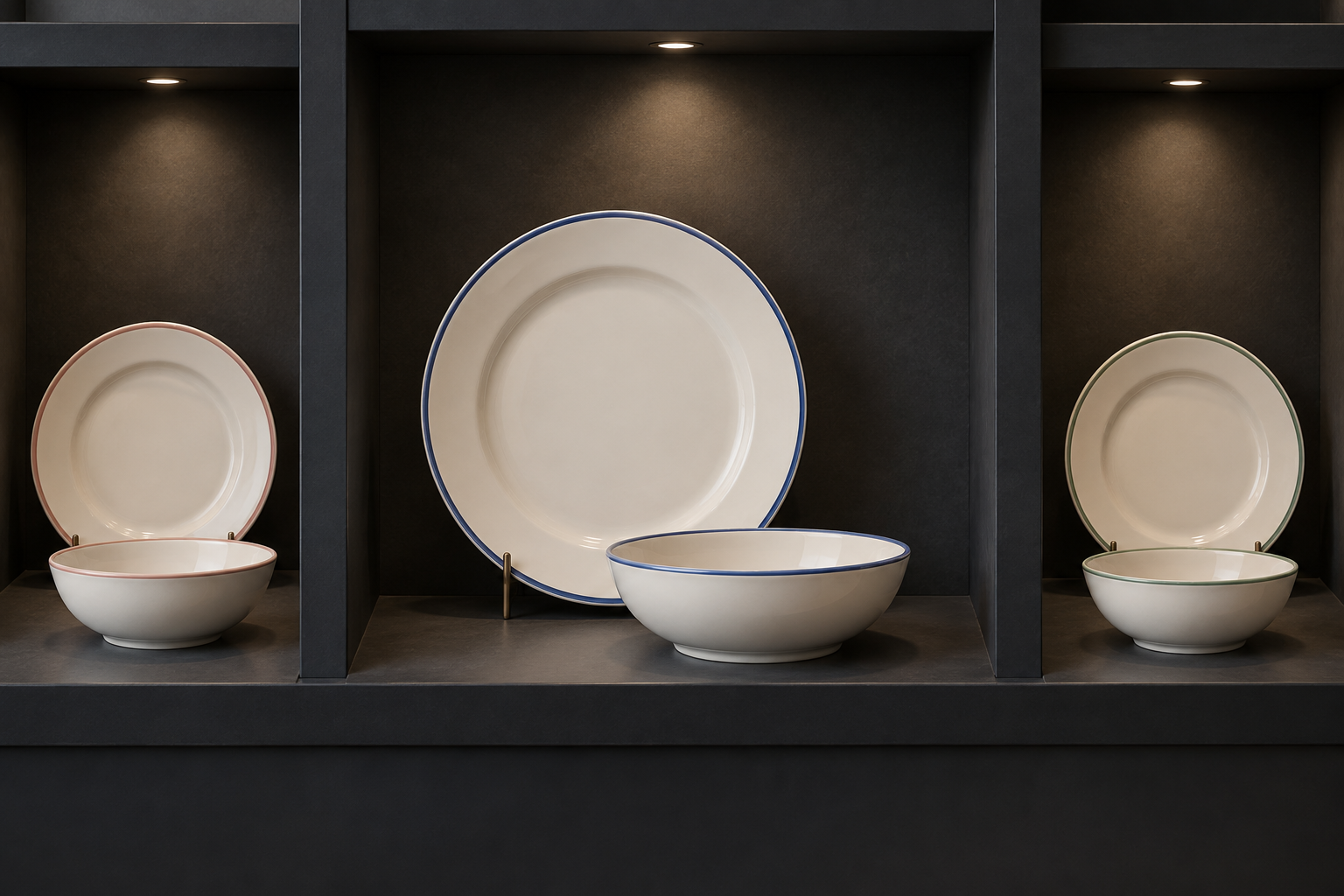
Fewer colors may concentrate quantities into longer runs, but check whether the factory batches by glaze, shape, decoration, or all three. Three shapes in one color are still three products to form, inspect, and pack.
For packaging, separate presentation from protection. Removing a decorative sleeve is a different decision from removing a plate separator. Ask a test provider to select suitable ISTA test procedures for the shipping route and complete revised pack. A carton photograph cannot establish transport performance.
Compare a Saving Over the Order You Will Actually Place
Here is a simple planning example. All figures are invented US-dollar amounts for 3,000 accepted plates, using the same packing and delivery basis. Freight, taxes, and other unchanged costs are excluded. The extra cost includes all change-related spending assumed for this example.
| Route | Quoted price per accepted plate | Extra change cost | Comparable order total | Saving against original |
|---|---|---|---|---|
| Keep the original | $4.80 | $0 | $14,400 | $0 |
| Simplify the underside logo | $4.55 | $300 | $13,950 | $450 |
| Move to another shape | $4.25 | $1,800 | $14,550 | -$150 |
The second redesign has the lowest unit price but costs more on this first order. Its $0.55 per-piece saving would recover $1,800 after roughly 3,273 pieces, assuming the saving continues and no further change costs arise.
That does not make the shape change wrong. It means the buyer needs credible reorder demand and must still accept the design change. I would not buy extra stock just to make the arithmetic look better.
Also check how yield appears in the quotation. If the price already covers accepted pieces, do not add the factory’s reject allowance again. If you are asked to pay separately for rejects or rework, define that exposure before comparing totals.
Ask for a Revision Offer You Can Approve
A useful supplier proposal names the original sample revision, the proposed change, the expected saving, the extra development cost, and the checks needed. It should also say what stays the same and when the revised quotation expires.
Try the low-disruption option first. For the blue-rim plate, that could mean keeping the main decoration and reviewing a simpler underside mark. Compare original and revised samples side by side, then confirm the effect on the actual production route.
Changes to the body, glaze, or decoration deserve a review of the supporting evidence. FDA guidance on lead in food and foodwares is background for that discussion. Have the appropriate laboratory review whether existing reports cover the revised product and destination; a cheaper recipe is not evidence of suitability.
Give the accepted revision its own reference. Update the drawing, finish standard, pack specification, and order description together. Otherwise, purchasing may order the cheaper version while inspection still checks against the beautiful original.
My Advice as a Manufacturer
I prefer a supplier who says, “This detail costs money, and here are two ways to change it,” over one who quietly removes work to reach a target price.
Do not demand that every feature survive if the target is far below the current route. Sometimes the honest choices are a simpler launch, a different positioning, or pausing development. Keep the feature your customer values most, and spend around it with care.
Questions Buyers Often Ask
Can I negotiate without changing the sample?
Yes. Check quantity, repeat-order assumptions, packing, and quotation scope first. But ask what supports a lower price. A discount alone does not explain whether the original specification is still included.
Is an existing mold always cheaper?
No. It may avoid new tooling, but the shape can still have costly finishing, poor pack efficiency, or difficult yield. Compare the finished, packed product and confirm tool condition and availability.
Should I approve changes from photographs?
Photos help screen ideas. They cannot fully show weight, stack contact, surface feel, or use performance. Approve the relevant physical samples and supporting evidence before releasing the changed specification.
Can savings from several changes be added together?
Only after the factory quotes the combined version. Changes may share one setup saving, or one change may create new work elsewhere. Adding separate estimates can overstate the final saving.
Conclusion
High ceramic sample cost is a reason to examine the design and quotation carefully. To reduce ceramic dinnerware cost, start with the work behind each feature. Protect the look and function, remove work that adds little value, and compare the complete cost of the next order.
Review Your Dinnerware Cost Options
If your sample is over budget, send FENN the sample reference, target quantity, cost gap, and two features you want to keep. We can help frame practical alternatives for a focused development review.