
Short Answer
For a first private label dinnerware assortment, start narrow: one user, one shape family, two or three hero pieces, one or two colors, and packaging that supports reorder. Before adding more SKUs, ask your supplier to prove MOQ logic, carton efficiency, food-contact documents, and repeat-order control.
When a buyer asks me how many items to launch, I usually answer with another question: “Which pieces will your customer use every week?” In my factory experience, the first assortment should prove what customers buy again.
I have seen new brands spend too much money on many shapes, colors, and gift boxes. The range looks exciting in a presentation, but the order becomes heavy and hard to control. A good ceramic dinnerware product assortment is easy to make, pack, sell, and repeat.
Definition Box: What an Assortment Means
A dinnerware assortment is the group of SKUs a brand sells together. It includes shapes, sizes, colors, pack formats, item codes, barcode needs, cartons, and reorder rules. In ceramic production, it also affects mold use, glaze batching, kiln loading, inspection time, and packaging cost.
Start With the Table Moment, Not the Catalog

I like to build a private label dinnerware assortment from the real table moment first.
Is this line for apartment breakfasts, family dinner, cafe service, giftable holiday sets, or open stock replacement? Each answer changes the SKU plan.
For example, a cafe-style line may need a mug, cereal bowl, side plate, and dinner plate. A giftable line may need a boxed four-piece place setting. An open stock line may need replacement-friendly item codes and stable colors.
If the use case is unclear, the supplier can still quote, but the quote may not protect you. From a factory point of view, “one more color” and “one more bowl size” add glaze batches, packing materials, inspection points, and inventory pressure.
The First-Assortment Builder
Use this builder before sending your RFQ. It keeps the launch focused but still commercial.
| Planning Step | Good First Launch Choice | Risky First Launch Choice | What to Ask the Supplier |
|---|---|---|---|
| Target user | One clear customer and one main meal occasion | Many users with different style needs | “Which shapes already fit this use case?” |
| Core pieces | 3-5 pieces that can sell as open stock or a set | 8-15 pieces before sales proof | “Can these pieces share clay body, glaze, and packing logic?” |
| Colors | 1-2 tested colors, plus a future color plan | Many colors in low quantity | “What is the MOQ per glaze batch and color?” |
| Pack format | One retail set or simple open stock cartons | Too many box structures at once | “Can cartons share inserts or master carton size?” |
| Reorder path | Keep master samples and item codes stable | Change color, size, and box after launch | “How do you archive samples and batch records?” |
My simple advice is this: build the first line like a small family. The pieces should share a body, glaze direction, rim style, foot ring logic, and packaging system.
Choose a Core Shape Family
For ceramic dinnerware SKU planning, shape family matters more than many buyers expect.
A good family means the plate, bowl, mug, and serving piece feel related. Similar rim thickness, foot ring style, curve, and stacking behavior make the line feel planned.
The factory benefit is real. Existing molds can reduce development time. Shared body material can reduce test confusion. Similar shapes can make packing easier. A supplier should explain which shapes need more careful firing control.
I prefer buyers to approve the base shape family first, then add color and decoration. If you approve a color on one bowl but later change the plate shape, surface angle and kiln position can change the final look.
Keep Color Strategy Small at the Beginning
Color is often where a private label tableware line becomes too complicated.
One white or neutral base color plus one brand color is enough for many first launches. If the brand story needs more warmth, a speckled glaze or soft reactive effect can work, but the accepted variation must be written down.
In real ceramic production, every glaze color needs batching, firing checks, and approval samples. If you order five colors in small quantities, each color may become less efficient and harder to match later.
Ask the supplier for a master sample, not only a nice photo. For repeat orders, the master sample should show the accepted color range, surface finish, rim effect, and natural variation.
Decide Open Stock, Boxed Sets, or Both
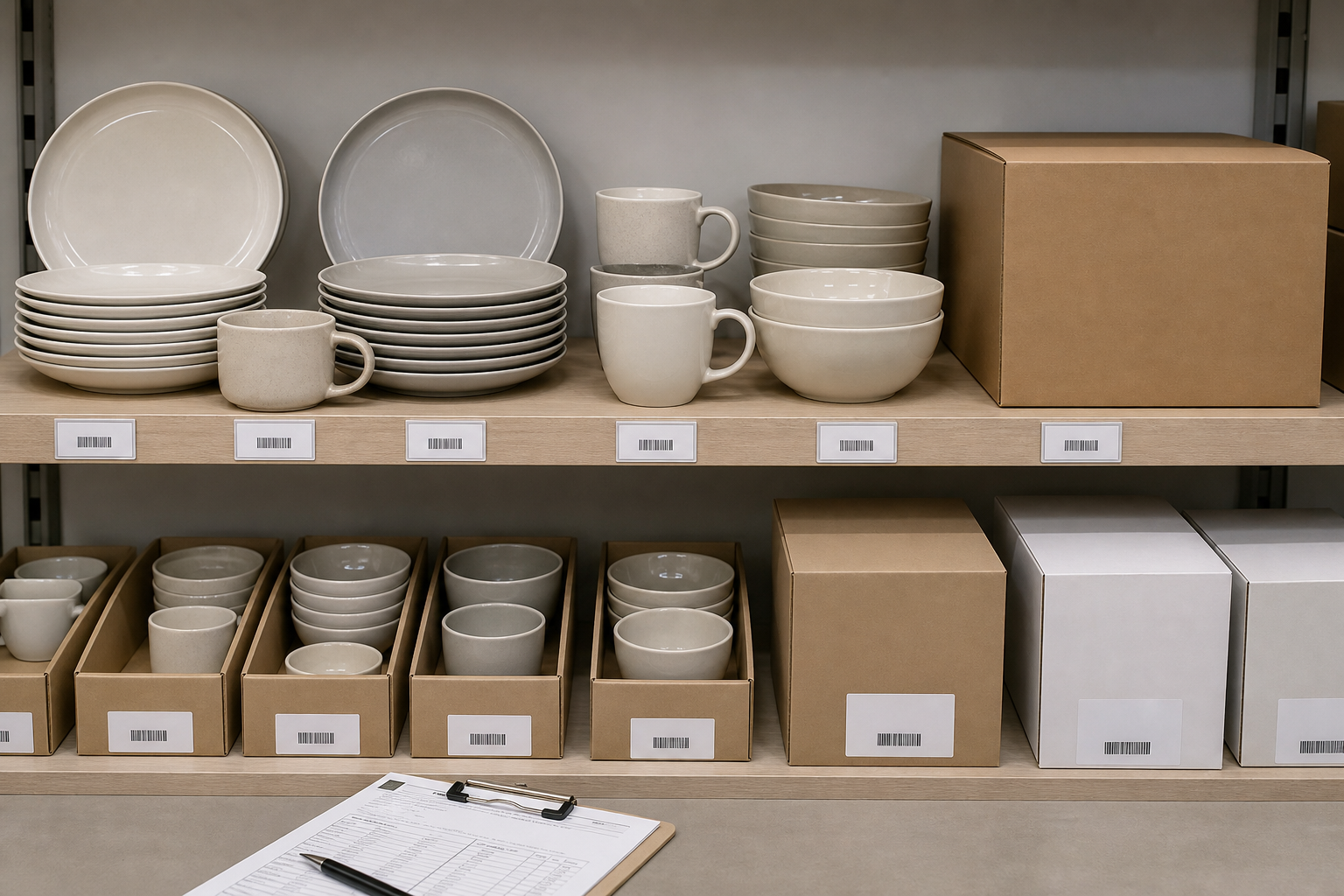
The selling format should guide the SKU count.
Open stock works well when retailers want replacement pieces or flexible shelf planning. It needs clean item codes, clear barcodes, stable carton labels, and inventory control. A boxed set is easier for launch and gifting, but the packaging must protect the pieces.
Some brands start with one boxed set and a few open stock hero pieces. This can work, but only if the MOQ and packaging are planned together. If every item needs a different color box, insert, and master carton, the launch becomes larger than it looks.
When we review a first assortment, I ask: “If one SKU sells faster, can you reorder it alone?” If not, the assortment may look neat but operate poorly.
SKU Architecture Checklist
Before placing the first order, check these points with your supplier and your sales team.
- Give every piece a clear SKU name, size, color, pack format, and item code.
- Decide which pieces can sell alone and which pieces only sell inside a set.
- Keep the first launch to one main clay body unless there is a strong reason.
- Limit first-order colors so glaze batching and inspection stay controlled.
- Confirm whether each retail unit needs a GTIN or barcode for your channel.
- Confirm HS codes, product descriptions, and commercial invoice wording with your import or logistics partner.
- Ask for lead/cadmium or food-contact documents based on your target market.
- Keep approved master samples, color boards, artwork files, and carton specs for repeat orders.
- Write a rule for future colors: what can be added later without changing the core line?
This checklist looks simple, but it prevents expensive mistakes. A dinner plate in a gift box, sold open stock, and used in a four-piece set may need different item setup even if the ceramic piece is identical.
How MOQ and SKU Count Work Together
MOQ is not only about total pieces. It is about how many times the factory must change material, color, decoration, packing, and inspection setup.
A 10,000-piece order with two colors and four shapes can be easier than a 10,000-piece order with eight colors, twelve shapes, three box types, and two logo positions. The second order may look larger, but it can be less efficient.
This is why I often suggest a phased launch.
Phase one: choose the core place setting and one hero color. Phase two: add one serving piece or second color after sales feedback. Phase three: add seasonal versions only after the core line has reorder proof.
This plan is not less creative. It lets buyers learn from real sales before locking too much cash into slow-moving SKUs.
What Evidence to Request Before You Confirm the Line
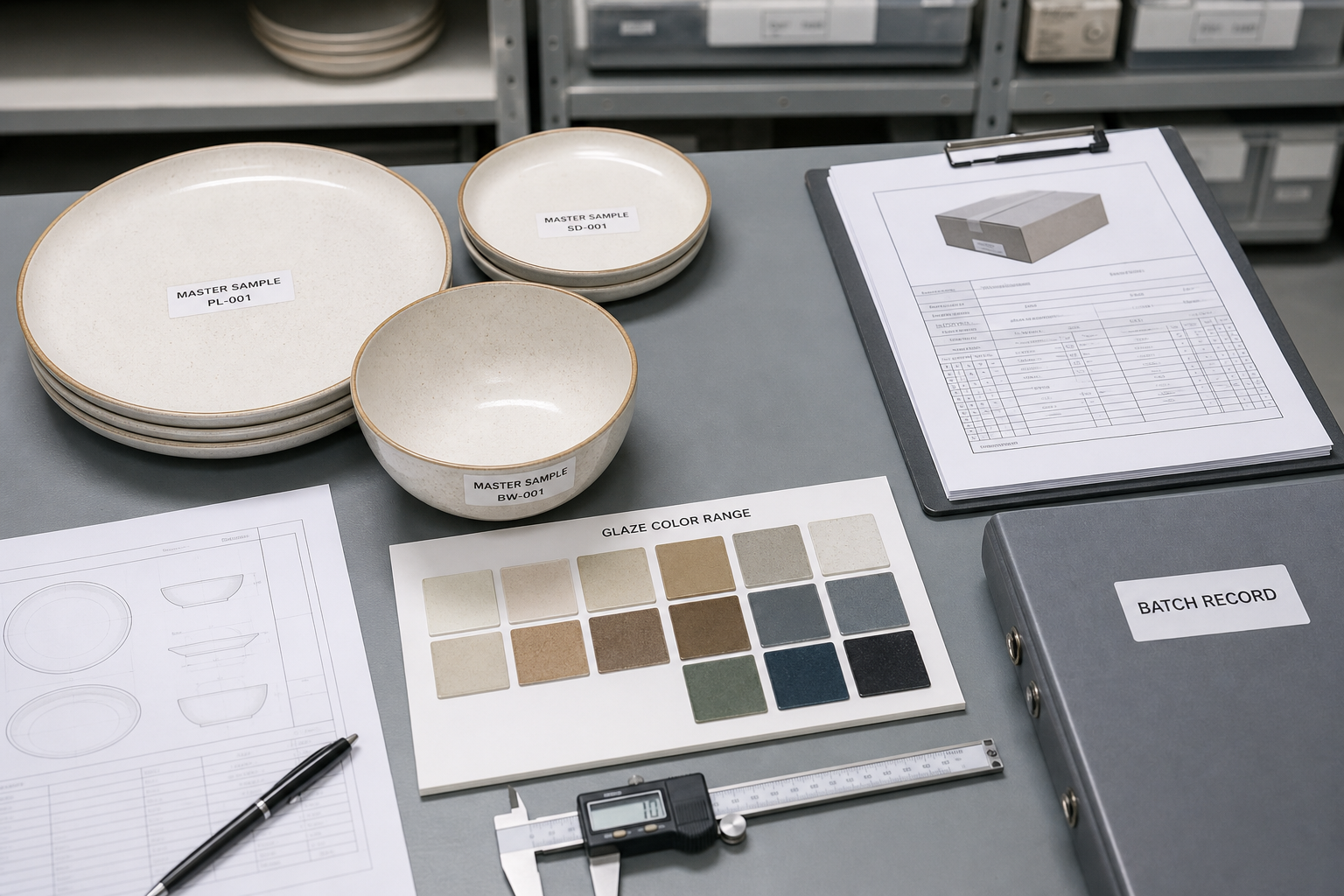
A professional supplier should not only say, “Yes, we can make it.” They should help you see the control points.
Ask for photos or samples of the existing shape family. Ask how the supplier controls glaze color between sample and bulk. Ask whether the shape has risks such as warping, chipping, heavy weight, poor stacking, or difficult packing.
For export projects, ask what documents will be prepared for your target market. For U.S. or EU food-contact dinnerware, FDA-related checks and test reports should match the actual material, decoration, and food-contact surface. A general factory certificate does not replace product-specific checks.
Quality-system references such as ISO 9001 can help buyers understand why process records matter. But the question is whether the supplier uses records to control real products.
Common First-Assortment Mistakes
The first mistake is launching too many similar pieces. If two bowl sizes are too close, buyers may not understand why both exist.
The second mistake is separating design from packaging. A beautiful coupe plate can create trouble if it does not stack well or needs a costly insert.
The third mistake is changing the line after samples without updating the documents. If the color, logo size, carton, or set count changes, the SKU sheet should change too.
The fourth mistake is forgetting the reorder. A launch is successful when the buyer can reorder without rebuilding the whole project.
My Advice as a Manufacturer
My advice is to plan the first assortment like a repeatable system. Start with the pieces that carry your brand and sell most often. Keep the first SKU group small enough that the supplier can control color, packing, and inspection carefully.
When a buyer sends me a focused assortment plan, I can give better advice. I can tell which existing shapes may work, where a new mold may be worth it, which colors are easier to repeat, and which packaging route fits the sales channel.
If your line feels too wide, remove one SKU at a time and ask, “Will the customer miss this piece in the first three months?” If no, save it for the next phase.
Questions Buyers Often Ask
How many SKUs should a first private label dinnerware assortment include?
Many first launches work better with 3-8 focused SKUs. The right number depends on sales channel, MOQ, pack format, and reorder plan.
Should I launch open stock or boxed sets first?
Choose open stock if replacement and flexibility are important. Choose boxed sets if gifting or simple shelf presentation matters more. Use both only after checking MOQ and packaging impact.
Can I use many colors if I keep the same shapes?
You can, but every color needs glaze control, sample approval, and inspection. I prefer fewer colors first, with a plan to add more later.
What should be in a dinnerware SKU sheet?
Include item name, size, clay body, glaze, decoration, logo position, pack format, barcode need, carton information, test requirement, MOQ, and approved sample reference.
How do I make the assortment easier to reorder?
Keep master samples, color boards, artwork, carton specs, item codes, and test documents organized. Ask the supplier to record material, glaze, or process changes before repeat production.
Conclusion
A strong private label dinnerware assortment is not the biggest range. It is the clearest range. Start with a focused user, a stable shape family, limited colors, smart packaging, and a reorder plan. If you want help checking your first SKU plan, send FENN your target channel, shape list, colors, pack format, and quantity goal. I can help you see what is ready for sampling and what needs simplification first.
Need help planning your first dinnerware SKU range?
Send FENN your target channel, shape list, colors, pack format, and quantity goal. I can help you see which parts are ready for sampling and which parts need simplification first.