
Short Answer
A practical cafe mug must match the real drink volume, feel balanced when full, give fingers enough handle space, keep the rim comfortable, and survive repeated washing without trapping water or damaging the decoration. Before ordering custom ceramic coffee mugs, test several production-representative samples with your espresso recipe, staff, dishwasher rack, saucer, and storage system. Ask the supplier to record dimensions, weight, capacity tolerance, glaze range, decoration position, and reorder controls.
When a buyer shows me a beautiful mug drawing, my first question is, “How much coffee will actually go inside?” In more than 20 years around ceramic dinnerware, I have seen projects begin with style and discover practical problems later. A cafe mug works harder than its small size suggests.
Begin With the Drink, Not the Catalog Capacity
Nominal mug capacity and working drink volume are not the same. A mug may hold 300 ml when filled to the very top, but a cafe needs headspace for milk foam, carrying, and presentation. Ask the cafe mug supplier how capacity is measured and agree on the fill line used for approval.
Test the actual recipes. Put the normal espresso, milk, foam, ice, or garnish into the sample. Check whether the drink looks generous, whether latte art has enough surface area, and whether staff can carry it without spills. A wide cup gives more surface area but may cool faster. A taller, narrower shape may hold heat differently and can be harder for a barista to pour into.
Ceramics shrink during drying and firing, so small changes in diameter and height affect capacity. Check capacity with water by weight at the same fill point across several pieces.
Use a Five-Minute Mug Fit Test
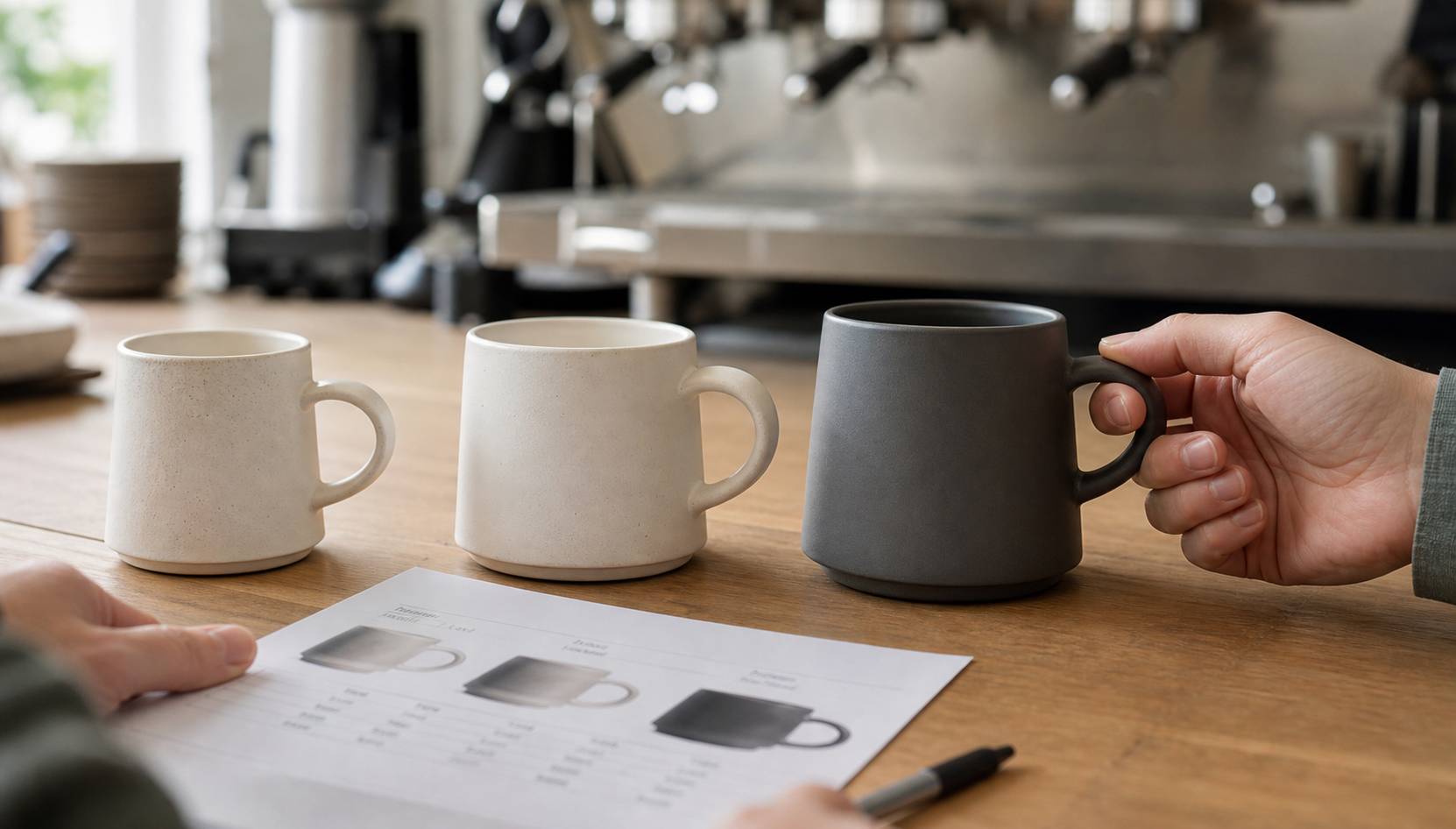
Instead of reviewing a mug only on a sample table, give each person five minutes with it. Fill it with a drink at the normal serving temperature and run this simple sequence:
1. Lift it with dry hands, then slightly damp hands.
2. Hold it for 30 seconds without supporting the body.
3. Take several normal sips and notice the rim angle.
4. Set it on the saucer or counter from different directions.
5. Carry two mugs together as staff would during service.
6. Empty, rack, wash, drain, and return it to storage.
Watch what people do naturally. A second supporting hand, fingers touching the hot body, or a mug twisting forward can reveal poor handle clearance or balance.
Score the Mug at Seven Contact Points
This scorecard turns “it feels nice” into a useful sample decision. Ask at least three people with different hand sizes to score each point from 1 to 5. Record comments, not only the total.
| Contact Point | What to Test | A Good Result | Warning Sign |
|---|---|---|---|
| Rim | Sip hot and cold drinks | Smooth, even, comfortable angle | Sharp feel, thick lump, or glaze roughness |
| Handle opening | Use one-, two-, and three-finger grips | Intended grip fits without touching hot body | Knuckles press the wall or opening pinches |
| Handle join | Lift a full mug and inspect both joins | Smooth transition with no visible stress line | Thin join, crack, or difficult-to-clean corner |
| Balance | Hold the filled mug for 30 seconds | Mug stays level without wrist strain | Heavy body pulls forward or handle twists |
| Body wall | Feel heat during the real drink time | Warmth suits the service and grip | Body becomes uncomfortable too quickly |
| Foot | Place on counter, tray, and saucer | Stable, smooth, and dry underneath | Rocking, rough foot, or trapped wash water |
| Decoration area | Grip, sip, and rack the mug | Logo stays visible and away from wear points | Hand covers logo or rack rubs decoration |
A score does not replace judgment. Treat any safety, cleaning, or breakage concern as a stop item rather than hiding it inside the average.
Judge Handle Comfort With the Mug Full
Handles often feel smaller after firing shrinkage. Review the clear opening, knuckle clearance, thickness, and grip angle. A large opening is not automatically comfortable; a thin or sharply curved handle can still concentrate pressure.
From a factory point of view, the handle joins deserve special attention. The handle and body must dry and fire together. Poor joining, uneven thickness, or stress around the attachment can lead to cracks. Inspect several samples at both the upper and lower joins under good light. Then lift a full mug repeatedly. Do not approve a handle only by pulling on an empty sample once.
Ask your porcelain coffee cup manufacturer to state the intended handle dimensions after firing and the acceptable visual standard at the joins. “Handmade variation” should not be used to excuse cracks, sharp edges, or an uncomfortable grip.
Match Rim, Wall, and Heat to the Service
The rim changes how the drink reaches the mouth. Thick rounded and finer rims create different experiences; neither is right for every cafe. Look for an even rim, a comfortable drinking angle, and no rough glaze.
Wall thickness affects weight, heat movement, capacity, and perceived value, but thicker does not always mean stronger. Sudden changes between the base, wall, rim, and handle can create stress. The clay body, firing, shape, and glaze fit all matter.
Test with the hottest drink the cafe normally serves. Measure the drink temperature if useful, but also ask staff and customers how the handle and body feel over the normal drinking time. If you plan to claim that the mug is microwave safe, arrange product-specific testing and clear care guidance rather than relying on the material name.
Put the Sample Through a Real Cafe Shift
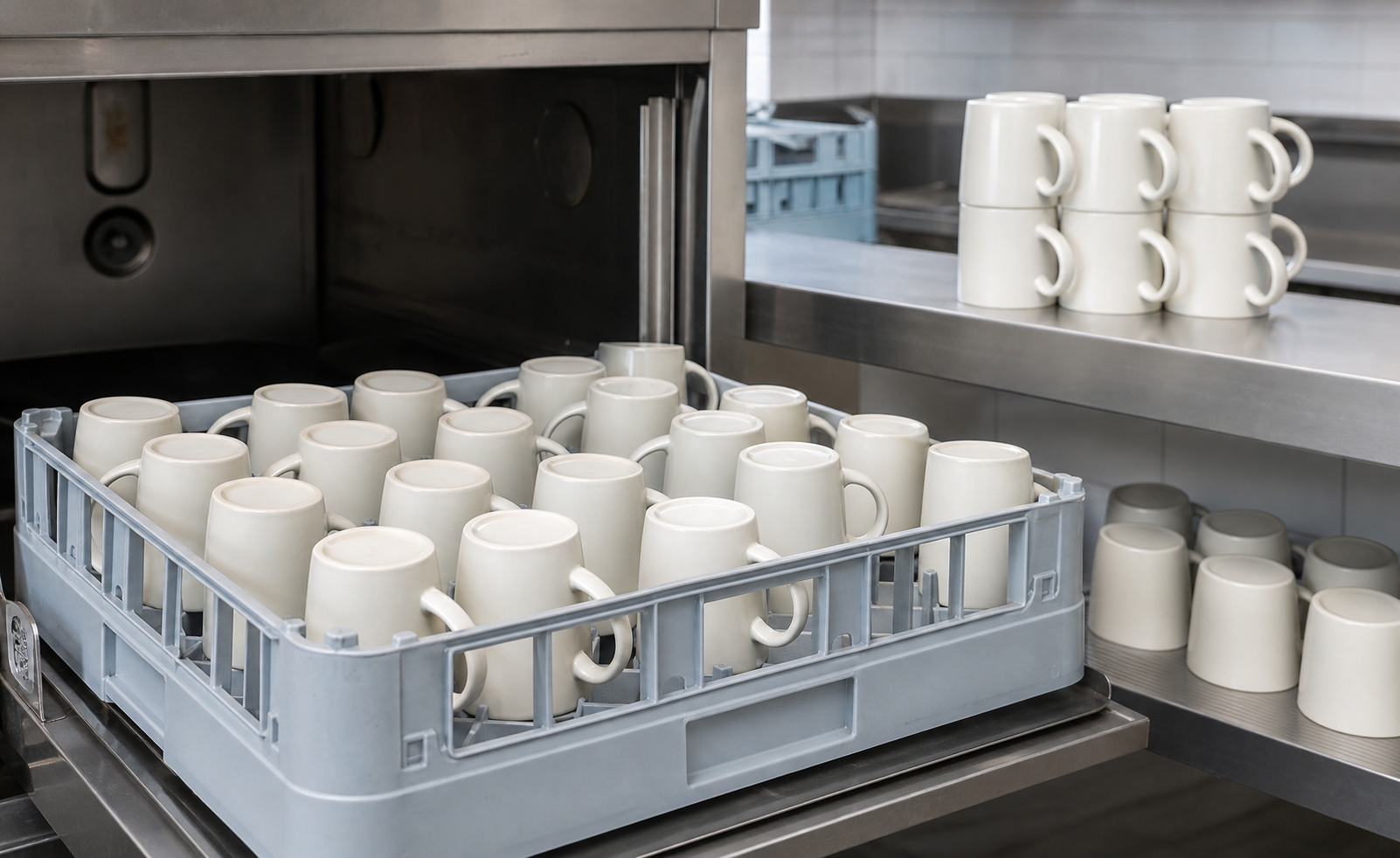

I like a small trial better than a long meeting. Put several samples through controlled service and washing cycles. Record comfort, chips, marks, stains, glaze change, decoration wear, drainage, and rack contact.
The Specialty Coffee Association World Coffee Championships rules offer useful context on service vessels in professional coffee competitions, although your own menu and operation should control the final choice. For U.S. hygiene planning, the FDA Food Code gives broader official guidance for retail food operations and food-contact surfaces. Neither source replaces product testing for your exact mug.
During washing, check whether the mug fits the rack without handles striking nearby pieces. Turn the washed mug upright and look for water trapped in the foot. See whether staff must place every handle in one exact direction. A mug that needs special care during every cycle may be a poor match for a busy chain.
Place the Logo for People and Machines
Logo position should work when the mug is held, photographed, served, washed, and stacked. Decide whether the mark faces the customer, faces outward in the barista’s hand, or appears on both sides. Make this decision with the handle orientation clear on the artwork.
Underglaze, in-glaze, and on-glaze decoration bring different looks and limits. Suitability depends on color, firing route, surface, supplier process, and food-contact position. Keep decoration away from the rim unless the method and compliance plan clearly allow it.
Approve a measured artwork position, color reference, and alignment tolerance, then test repeated washing. A digital mockup cannot prove fired color, adhesion, wear, or curved-body appearance.
Verify Food-Contact Evidence Against the Finished Design
The food-contact review should match the actual clay body, glaze, colors, decoration, and target market. The official FDA guidance on lead in foodwares is a sound starting point for U.S. buyers. EU buyers can use the European Commission food contact materials overview to understand the wider framework and should confirm the current ceramic test plan with a qualified laboratory or compliance adviser.
When reviewing a report, check the tested item description, colors, food-contact surface, method, laboratory, date, and result. A report for a plain white mug may not cover a new colored glaze or rim decoration. A general statement saying “food safe” is not enough evidence for a buyer to connect the result to the ordered SKU.
Build the Reorder Standard Before the First Order
Cafe chains need replacement mugs. Record fired dimensions, capacity method, weight range, handle opening, glaze range, decoration position, foot finish, packing, and approved samples.
Agree on reorder MOQ, lead-time assumptions, and change notice. A change in clay, glaze, decal, mold, or firing route can affect color, capacity, stacking, or testing scope.
My Advice as a Manufacturer
Give each reviewer a clear job. The barista checks pouring and speed; operations checks washing and storage; brand checks shape and logo; the buyer checks tolerances, documents, packaging, and supply.
My simple advice is to approve the mug with hot liquid inside and a dishwasher nearby. That is where comfort and practicality become clear. If a sample works only when empty and carefully displayed, it is not ready for cafe service.
Questions Buyers Often Ask
What capacity is best for a cafe mug?
There is no single best size. Start with the real recipe and required headspace. Record both the brimful capacity and the agreed working fill volume so suppliers and cafe teams mean the same thing.
Should a cafe choose porcelain or stoneware mugs?
Porcelain can give a refined look and useful strength-to-weight performance. Stoneware can offer a warmer, crafted feel. Judge the actual mug’s body, firing, weight, glaze, handle, and service test rather than choosing by material name alone.
How many mug samples should we test?
One sample can confirm a direction, but several pieces are needed to judge variation, rack fit, handling, and service use. For an important chain program, include pieces from a representative trial batch before bulk approval.
Where should the cafe logo go?
Choose the viewing direction first, then test the position while holding, serving, photographing, and racking the mug. Keep the mark away from high-wear or food-contact areas unless the decoration and compliance plan support that use.
What should I send a cafe mug supplier for a useful quote?
Send the drink recipe and working volume, target dimensions and weight, material and glaze direction, handle preference, logo artwork, expected quantity, target market, testing needs, packaging, dishwasher use, and reorder plan.
Conclusion
The best custom ceramic coffee mugs connect the drink, hand, cafe operation, and brand. Test working volume, handle comfort, rim feel, balance, washing, drainage, decoration, food-contact evidence, and reorder control before bulk production.
If you are planning a cafe mug program, share your drink sizes, target shape, logo, quantity, market, dishwasher setup, and replacement needs with FENN. We can help you turn those details into a practical sample plan before production.
Review Your Cafe Mug Sample Plan
Share your drink sizes, mug shape, logo, quantity, market, dishwasher setup, and reorder needs with FENN for a practical sample review.