
Short Answer
Good custom hotel dinnerware should suit the menu, survive repeated handling and commercial washing, stack safely, stay comfortable for staff, meet food-contact requirements, and remain available for replacement orders. I suggest testing a small working set in real service before bulk production.
When a hotel buyer asks me which plate is “best,” I first ask where it will work. After more than 20 years around ceramic production, I have learned that the safest decision starts with the operation, not the catalog.
Start With the Hotel Operation, Not the Decoration
Before discussing glaze color or a logo, map each piece to a real job. A wide plate may frame food beautifully but fit poorly under a banquet cover. A heavy bowl may feel rich yet tire a server.
I would define these points for every important SKU:
- outlet and meal period;
- food or drink served;
- portion size and plating area;
- service method, such as buffet, à la carte, banquet, or room service;
- washing and storage method;
- daily rotation and replacement needs;
- any cover, trolley, rack, or tray that must fit.
The Hotel Dinnerware Operating Scorecard
Score each item from 1 to 5 and add notes from staff use. A supplier should explain how shape, body, glaze, and firing control support each result.
| Check | What to Test | A Strong Result | Warning Sign |
|---|---|---|---|
| Menu fit | Plate the real dish and sauce | Useful food area with a clean presentation | Food crowds the rim or sauce collects badly |
| Rim strength | Handle, rack, and stack several samples | Rim feels protected and samples show no easy contact points | Thin exposed rim knocks against the next plate |
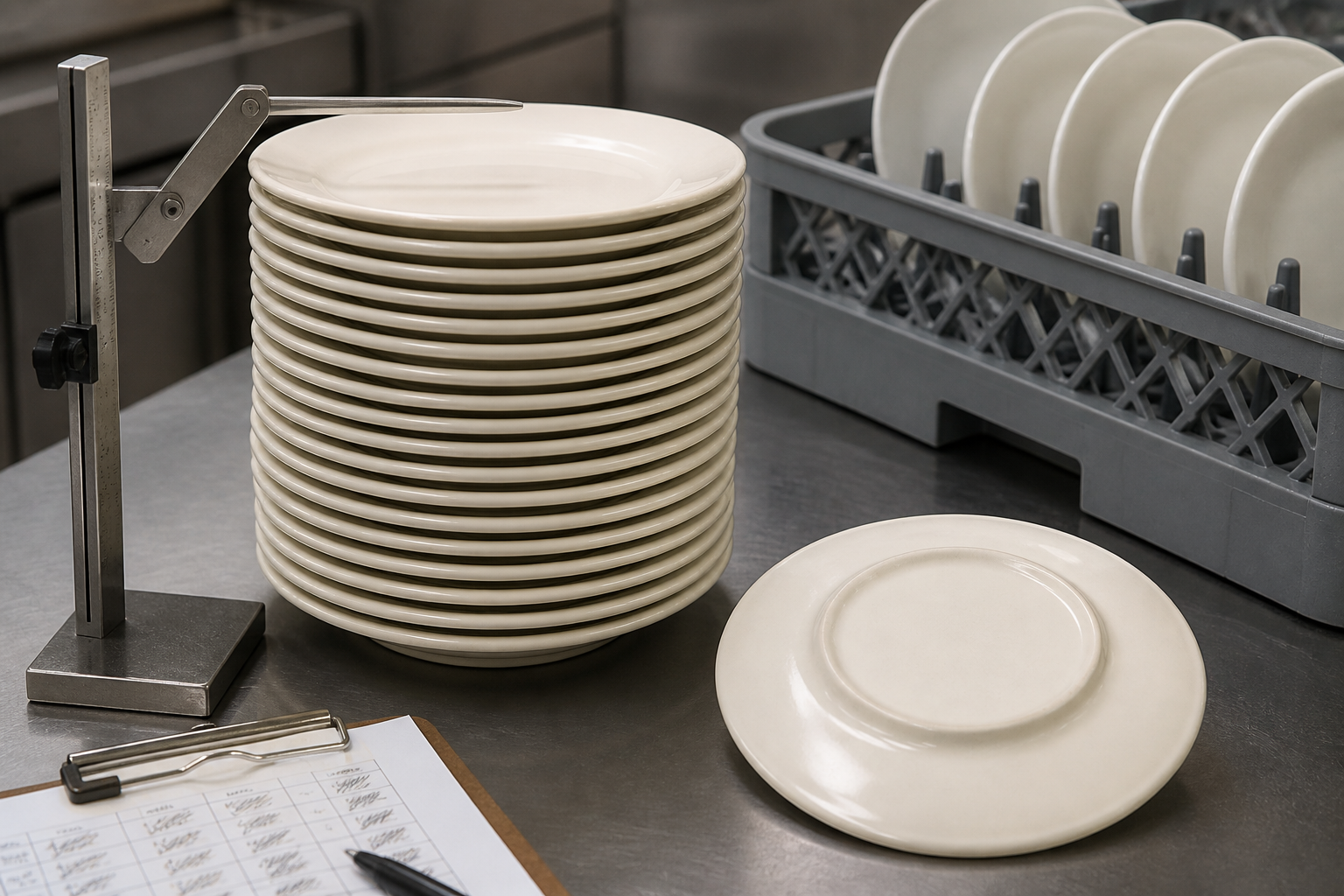
| Stackability | Stack 12-20 pieces on a level surface | Stack stays stable and separates without sticking | Stack leans, rocks, or puts pressure on glazed surfaces |
| Staff handling | Ask servers to carry and clear a realistic load | Weight and grip feel manageable | Piece is tiring, slippery, or hard to lift from a stack |
| Washing fit | Run through the actual rack and dishwasher | Piece drains, dries, and fits the rack well | Water pools or the piece moves and knocks others |
| Heat and service fit | Test with hot food and any covers or warmers | Shape works with the planned service system | Cover touches food or size does not fit equipment |
| Appearance range | Compare several fired samples together | Natural variation stays within an approved range | Mixed pieces look like different collections |
| Replacement logic | Review reorder MOQ, records, and retained samples | Supplier can reproduce the agreed shape and shade range | No retained standard or change-control record |
Do not hide a low score with an average. If stack safety or food-contact documentation scores poorly, that is a stop point, not a small tradeoff.
Choose Shape and Rim Strength for Real Handling
Many hotel chips start at exposed edges. Rim strength depends on the rim profile, clay body, firing, glaze coverage, and points of contact inside a stack. A reinforced edge may suit high-volume service, while a thin rim needs careful engineering and honest use limits.
When we review samples, I prefer to place several pieces in a real stack and watch where ceramic touches ceramic. I also check the foot ring. A rough foot can scratch the table or the plate below it, while an uneven foot can make the plate rock.
Ask the hotel dinnerware supplier to explain:
1. which areas are most likely to touch during stacking;
2. how rim and foot-ring dimensions are controlled;
3. what appearance and dimension tolerances will be used for bulk inspection;
4. how the approved sample will be retained and compared with production.
“It is hotel quality” is not enough. A professional answer connects design detail to production control.
Test Stackability, Weight, and Staff Comfort Together
For bulk hotel plates, record the weight of several samples rather than one piece. Then ask restaurant and stewarding staff to lift a normal service quantity.
Stack height is equally important. Measure 12 or 20 pieces, not only two. A small variation at each foot ring can become a leaning tower in a large stack. For bowls and cups, check whether pieces nest too tightly. A tight nest slows service and can create chips when staff pull pieces apart.
Place a realistic stack on a trolley, move it through normal turns, then let staff unload it. Their comments are often more useful than another studio photo.
Approve Glaze for Cleaning and Daily Appearance
Hotel glazes must suit both the brand and cleaning routine. Matte or reactive finishes can look special, but may show cutlery marks, water spots, or shade variation more clearly.
I would test the selected finish with the hotel’s usual food, stainless-steel cutlery, detergent, dishwasher, and drying method. Run repeated cycles if the launch timing allows. Look for:
- cutlery transfer or visible abrasion;
- staining from coffee, tea, sauces, or strongly colored food;
- water pooling in recessed decoration;
- rough areas that trap residue;
- loss of decoration or change in surface appearance;
- uncomfortable hot spots on cups and handles.
“Dishwasher safe” or “microwave safe” claims should match the design, decoration, and suitable test evidence. Metallic decoration needs special care before any microwave claim.
Check Food-Contact Evidence Against the Actual Design
A hotel should not accept “food safe” as a complete document answer. The evidence should relate to the actual clay body, glaze, colors, decoration method, and food-contact areas used in the order.
For U.S. projects, the supplier and importer can review the official FDA guidance on lead in foodwares. For EU projects, the European Commission food contact materials overview and the EU ceramic articles rules provide useful regulatory context. At test-method level, buyers may also see reference to ISO 6486-1 for lead and cadmium release from ceramic ware.
Destination markets and hotel groups can add requirements, so ask a qualified laboratory or compliance adviser to confirm the current test plan. Plan testing before bulk production, especially when decoration, glaze, or color changes.
A useful report should identify the tested item, test method, result, laboratory, and date. A report for a plain white plate does not automatically cover a newly decorated rim plate.
Run a Small Banquet Trial Before Bulk Approval
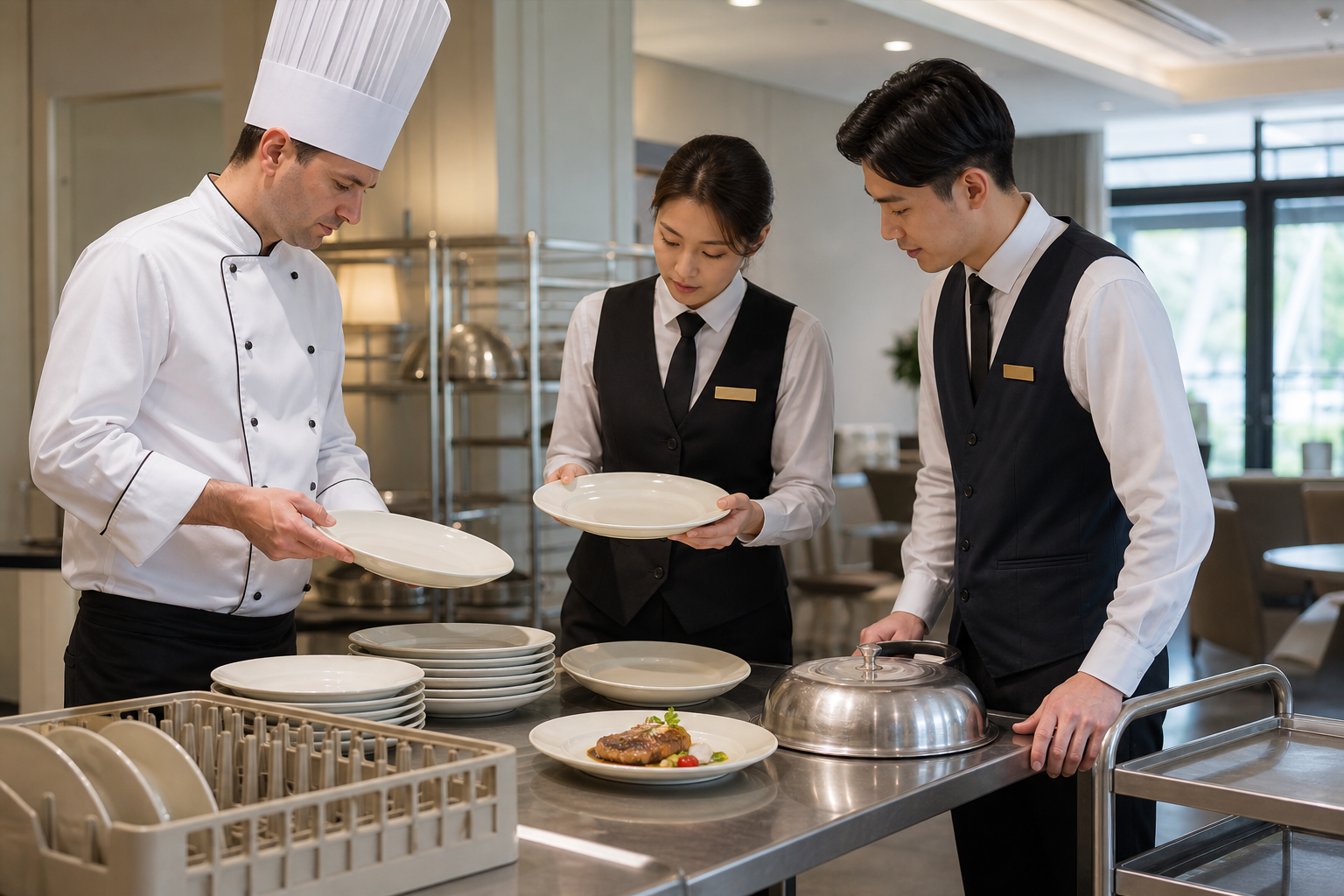
Treat the final sample as a working tool. A short trial should copy the real service path.
A Practical Trial Route
1. Plate the intended menu items.
2. Carry the normal number of pieces on trays.
3. Use plate covers, trolleys, racks, and warmers where relevant.
4. Clear and scrape the pieces as staff normally would.
5. Wash, dry, stack, and store them.
6. Repeat the cycle and record chips, marks, pooling, and handling comments.
7. Photograph the approved range and sign the control sample.
One trial cannot predict years of use, but it reveals obvious fit problems and gives every team a shared reference.
Plan Packaging, Delivery, and Opening Checks
Export packaging should match the final shape, set count, route, pallet plan, and handling method. Ask for the inner protection layout, carton specification, gross weight, dimensions, and test plan. Check whether pressure falls on a fragile rim or handle.
On arrival, keep enough cartons together for an incoming check. Compare count, shape, glaze range, logo, foot finish, carton condition, and breakage with the approved standard. Record batch details for traceability.
Build Replacement Supply Into the First Order
Hotels lose and chip pieces over time. Plan replacement without changing the table setting.
Before placing the first order, agree on:
- which core pieces will remain open for reorder;
- reorder MOQ by SKU or shared glaze batch;
- expected production lead time;
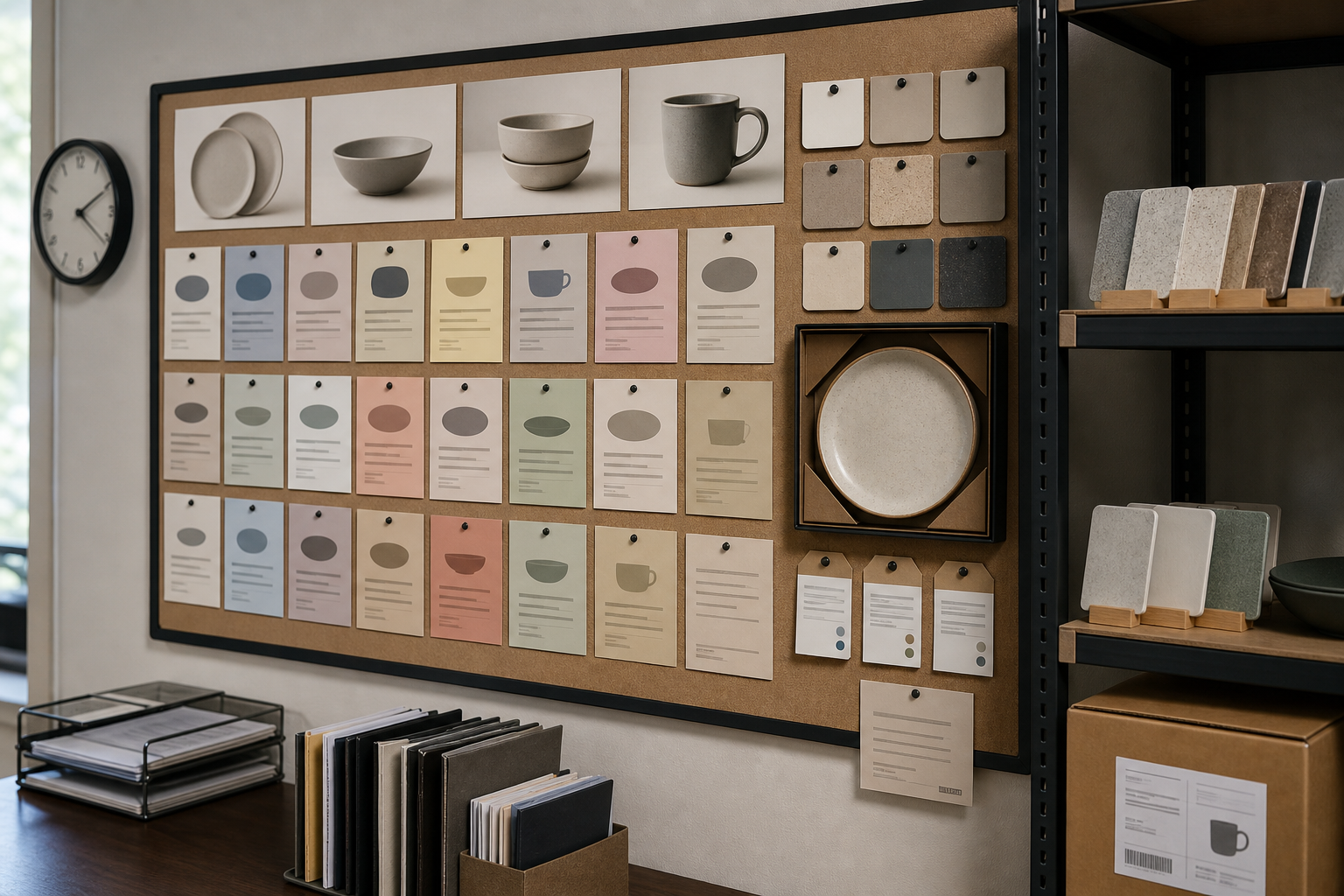
- retained samples, color range boards, and specification records;
- notice rules if clay, glaze, decal, mold, or process must change;
- how replacement pieces will be checked against earlier stock.
Give high-use plates, bowls, and cups a simpler reorder path than special presentation pieces.
Final Buyer Checklist Before a Deposit
- [ ] Each SKU has a clear outlet, menu, portion, and service use.
- [ ] Real samples fit racks, covers, trolleys, trays, and storage.
- [ ] A 12-20 piece stack has been checked for height, lean, and sticking.
- [ ] Staff have reviewed weight, grip, clearing, and washing comfort.
- [ ] Glaze and decoration have been tested with real food and cleaning conditions.
- [ ] Food-contact reports match the actual product and destination market.
- [ ] Bulk tolerances and defect standards are written and understood.
- [ ] Export packaging is designed around the final shapes.
- [ ] Approved samples and appearance range references will be retained.
- [ ] Reorder MOQ, lead time, and change-control rules are recorded.
My Advice as a Manufacturer
Buy for the busiest working day, not the quiet sample room. Let chefs judge plating, service staff judge handling, stewarding judge washing, and buyers judge documents, cost, and replacement supply.
I would rather adjust a rim, weight, stack, or glaze during sampling than explain repeated chips after opening day.
Questions Buyers Often Ask
Is porcelain always better than stoneware for hotels?
No. Porcelain may offer a refined look and good strength-to-weight performance; stoneware may feel warmer and more crafted. Test the actual body, shape, firing, glaze, and use.
How many pieces should a hotel test before ordering?
Use enough pieces to copy a working load, often 12-20 for a key plate, plus the covers, racks, or trays used in service.
Can reactive glaze work in a hotel?
Yes, if the hotel accepts a controlled variation range. Approve several samples together and test cleaning and cutlery contact.
Should every hotel outlet use the same dinnerware?
Not necessarily. Shared shapes or glazes simplify reorders, but each outlet may need different weights, rims, sizes, and replacement plans.
What should be the golden sample?
It should record shape, dimensions, weight range, glaze, decoration, foot finish, logo, and approved appearance. Buyer and supplier should retain references.
Conclusion
The best custom hotel dinnerware supports the whole service system: food presentation, staff comfort, washing, storage, compliance, delivery, and replacement. Start with real operating needs, score several samples, run a banquet-style trial, and write the control standards before bulk production.
If you are planning a hotel line, send FENN your menu style, outlet list, key sizes, expected quantity, equipment limits, and visual direction. We can help review shape, glaze, stackability, packaging, and sample steps before you commit to a bulk order.
Planning custom dinnerware for your hotel?
Send FENN your menu style, outlet list, key sizes, expected quantity, equipment limits, and visual direction. We can help review shape, glaze, stackability, packaging, and sample steps before you commit to a bulk order.