Short Answer
A reliable ceramic dinnerware manufacturer should prove five things before you place a private-label order: real production capability, food-contact compliance support, sample-to-bulk control, written QC standards, and export packaging experience. Price matters, but only after the supplier explains how they will control material, glaze, MOQ, testing, inspection, and repeat orders. I have seen buyers fall in love with one beautiful sample, then feel disappointed when bulk goods look different, chip too easily, or arrive with weak packaging. In real ceramic production, clay body, glaze thickness, kiln position, firing temperature, decoration, and carton structure all affect the result.
When a buyer asks me how to choose a supplier, my simple advice is this: do not start with price only. Start with proof.
Quick Definition: What Is a Ceramic Dinnerware Manufacturer?
A ceramic dinnerware manufacturer is a factory or production partner that develops and produces plates, bowls, mugs, and serving pieces through ceramic forming, drying, glazing, firing, decoration, quality control, packaging, and export documentation.
Best Supplier Criteria for Private-Label Brands
The best ceramic dinnerware manufacturer for a private-label brand should prove production capability, food-contact compliance support, sample-to-bulk control, written QC standards, and export packaging experience.
If a supplier cannot explain these points clearly, I would not treat a low quote as a real quote yet.
Supplier Type Comparison
| Supplier Type | Best For | Main Risk |
|---|---|---|
| Catalog trader | Fast sourcing from existing items | Weak production control and unclear responsibility |
| Low-cost factory | Simple mass items with stable specs | Limited product-development support |
| OEM/ODM manufacturer | Private-label projects with custom details | Needs a clear brief before accurate quotation |
| Design-led manufacturer | Brand collections and product-line planning | More discussion is needed before sampling |
FENN is closer to the design-led manufacturer model: we look at shape feasibility, glaze risk, packaging, compliance, and repeat-order control before production starts.
9 Checks Before Choosing a Ceramic Dinnerware Manufacturer
Use this table to judge not only what to ask, but whether the answer sounds professional.
| Supplier Check | What To Ask | Professional Answer Should Include | Red Flag |
|---|---|---|---|
| Product development | Can you develop from my brand brief? | Shape, material, glaze, logo, packaging, market, and launch quantity review | Only sends catalog photos |
| Material and glaze | Which body and finish fit my use case? | Stoneware/porcelain tradeoffs, glaze risks, sample testing advice | Cannot explain finish or body differences |
| Compliance | Which food-contact tests support my market? | Test scope, product match, food-contact surface, decoration notes | Says “food safe” with no documents |
| Sample control | How do approved samples become bulk standards? | Master sample, color range, weight/size tolerance, photo record | Treats samples as loose references |
| MOQ and price | What drives MOQ for this project? | Mold, glaze batch, kiln loading, decal, packaging, QC explanation | One fixed MOQ for every project |
| QC standards | What defects are critical, major, and minor? | AQL discussion, defect library, inspection stages | “We check quality” with no standard |
| Packaging | How do you prevent export breakage? | Inner protection, carton strength, set packing, drop-test option | Same box for every shape |
| Repeat orders | How do you keep reorders consistent? | Retained samples, batch records, change-control notes | No sample archive |
| Communication | Who confirms specs and changes? | Written project sheet and approval records | Important details stay only in chat |
Check 1: Product Development Capability
For private-label dinnerware, a supplier should turn your idea into a production-ready specification. I want to know the target market, price band, shape, material, glaze, logo method, packaging style, compliance market, and launch quantity.
A good answer includes feasibility comments, not only “yes.” If a brand wants a wide matte dinner plate for daily use, the supplier should discuss possible warping, rim strength, cutlery marks, cleaning performance, and packaging protection before sampling.
For many custom projects, a first sample round may take about 2-4 weeks after the brief is clear. New molds or special glaze trials can take longer.
Check 2: Material and Glaze Expertise
A strong ceramic tableware manufacturer should explain material and glaze tradeoffs in simple language.
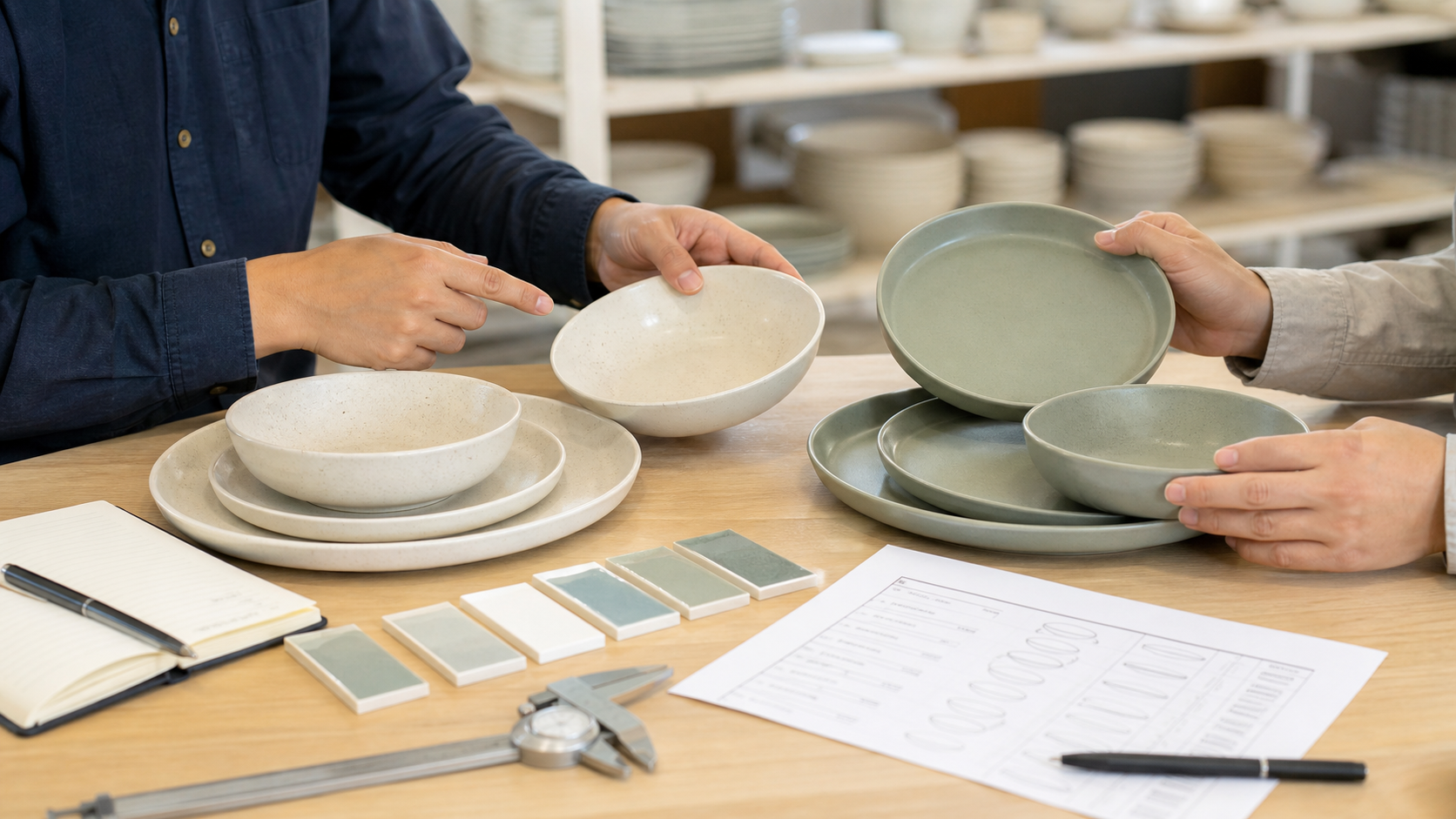
Porcelain can feel lighter and more refined. Stoneware can feel warmer and more handmade. Matte glaze can look premium, but it should be tested for cutlery marks and cleaning behavior. Reactive glaze can be beautiful, but buyers should never approve only one perfect piece.
For reactive glaze dinnerware, we usually keep a small approved range because kiln position, glaze thickness, and firing atmosphere can affect final color. This is a practical way to define what is acceptable before bulk production.
Check 3: Food-Contact Compliance Support
For dinnerware, compliance is not a decoration after the order. It is part of the product plan.
If you sell in the United States or European Union, ask what food-contact testing and documentation may be needed. For U.S. buyers, FDA guidance on lead in foodware is a useful starting point. For EU buyers, the European Commission food contact materials page gives a broad regulatory overview, and EU ceramic articles Directive 84/500/EEC is worth checking when ceramic food-contact rules are part of your review.
Pay close attention to food-contact surfaces, rims, metallic effects, decals, and bright colored decoration. Check whether the test report matches the actual product type, food-contact surface, glaze or decoration area, and target market. A report for a plain white plate may not fully cover a decorated rim, metallic decal item, or new colored glaze.
Check 4: Sample Approval Workflow
The approved sample is not just a nice thing to photograph. It should become the control standard for bulk production.
From a factory point of view, sample approval should record:
- Shape and size.
- Weight range.
- Glaze color and finish.
- Logo position and color.
- Acceptable natural variation.
- Packaging structure.
- Care or safety notes.
For handmade-look or reactive glaze dinnerware, I prefer approving a range, not one perfect sample. The better method is to keep a master sample plus boundary samples that show the lightest, darkest, and most typical acceptable look.
Check 5: Realistic MOQ and Price Explanation
MOQ is not only a sales number. It comes from production economics.
Clay preparation, glaze batching, kiln loading, decoration setup, packaging printing, and QC all need a reasonable quantity. Existing shapes and shared glazes can lower pressure. New molds, new colors, special decals, and gift boxes usually raise MOQ and cost.
A professional OEM dinnerware supplier should separate the cost drivers. New mold, new glaze, custom decal, and gift box should not be hidden inside one vague quote. Sometimes the best first launch is one plate, one bowl, one mug, and two colors that share the same body and package logic.
Check 6: Production Quality Control
Ceramic quality control should be written before production, not argued after production.
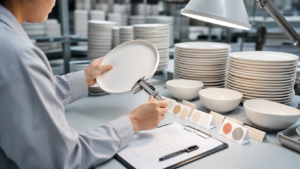
Ask the supplier to define critical, major, and minor defects. Critical defects may include food-safety concerns, sharp edges, serious cracks, or wrong material. Major defects may include visible chips, bad warping, wrong logo position, serious color mismatch, or poor packaging.
For export dinnerware, buyers often use AQL-style final inspection. The exact AQL level should be agreed by buyer, supplier, and inspection partner. But AQL cannot help if nobody agrees what counts as critical, major, or minor.
Check 7: Export Packaging and Breakage Prevention
Dinnerware can pass factory inspection and still fail if packaging is weak.
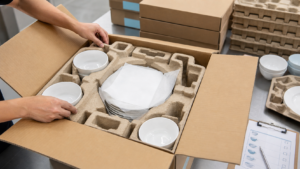
Packaging should be confirmed together with product shape, not after production. A flat plate, deep bowl, mug handle, and gift set all need different protection.
For heavier sets or gift boxes, discuss carton structure, inner dividers, pallet loading, and whether a drop-test or transit test is needed. ISTA test procedures can also help buyers and suppliers use the same language when discussing transport testing. Thicker cartons alone do not solve every breakage problem.
Check 8: Repeat-Order Consistency
Many buyers think about the first order, but the repeat order is where trust is really tested.
For repeat ceramic orders, the supplier should keep retained samples, glaze records, packaging specs, inspection history, and change notes. If a raw material, glaze, mold, decal, or carton changes, the buyer should be told before production.
This matters for open stock dinnerware. Exact sameness is not always realistic in ceramics, but controlled consistency is realistic.
Check 9: Communication and Documentation
Good communication is not only fast replies. Before deposit, I suggest keeping one project sheet that records the final shape, material, glaze, logo, package, target market, MOQ, price, lead time, testing needs, and inspection standard.
Many problems come from small details discussed in chat but never confirmed in the final project sheet. A reliable supplier should put key details in writing.
Supplier Red Flags I Would Not Ignore
Here are signs that make me careful:
- Very low price before checking your specification.
- No clear reason for MOQ changes.
- “Food safe” claims with no test scope.
- No defect standard or sample control.
- Exact reactive glaze promises with no variation range.
- One packaging design for many shapes.
- Deposit pressure before the sample path is clear.
One red flag does not always mean you must walk away. It means you should ask for proof before moving forward.
Buyer Checklist Before You Pay for Samples
Use this checklist before you choose your ceramic dinnerware manufacturer:
- Target market and sales channel are clear.
- Material, size, weight, shape, and finish expectations are written.
- Existing shape or new mold route is decided.
- Food-contact testing needs are discussed.
- Approved sample and acceptable variation range are agreed.
- MOQ drivers are explained separately.
- QC checklist or defect standard is shared.
- Export packaging and repeat-order control are discussed.
If you cannot tick these points, the project is not ready for a clean quote yet.
My Advice as a Manufacturer
My advice is to choose the ceramic dinnerware manufacturer who explains risk clearly, not the one who only says yes.
In ceramic dinnerware, small choices can become big costs. A sharper rim may chip more easily. A matte glaze may need extra testing. A custom gift box may raise MOQ and lead time. A decorated rim may need different compliance attention from a plain white plate.
The right supplier helps you balance beauty, cost, durability, compliance, and delivery. That is what private-label buyers really need.
Questions Buyers Often Ask
Should I choose the cheapest ceramic dinnerware manufacturer?
Not first. Compare price only after the specification, material, glaze, packaging, compliance support, and QC standard are clear. Otherwise, you may be comparing different products.
How many samples should I approve before bulk production?
Approve enough samples to control the key risks: shape, size, glaze, logo, packaging, and acceptable variation. For reactive or handmade-look glaze, keep a range of approved samples, not only one perfect piece.
What should I check in a food-contact test report?
Check whether the report matches the actual product, glaze or decoration, food-contact surface, test method, date, and target market. Do not assume one old report covers every new item.
Can a supplier guarantee no color difference?
For ceramics, exact color sameness is not realistic, especially with reactive glaze or special firing effects. A better standard is an agreed color range with master samples and inspection rules.
Conclusion
Choosing a ceramic dinnerware manufacturer is about finding a partner who can control material, glaze, compliance, sampling, MOQ, QC, packaging, and repeat orders in a way your brand can trust.
If you are comparing ceramic dinnerware suppliers, send FENN your target market, product references, order quantity, and packaging expectations. We can help review the feasibility, MOQ logic, compliance needs, and sampling path before you commit to production.