
Short Answer
A modular dinnerware collection starts with a small group of shared shapes, glaze rules, and packaging standards that can support future pieces. Approve the core plate, bowl, and mug first. Then add extensions only when they fit the same visual language, production route, stack, pack, and reorder plan. Ask your supplier for mold records, retained samples, glaze standards, and production-representative pack tests before you promise that future pieces will match.
When buyers show me a mood board, they often have fifteen beautiful pieces in mind. My first question is simpler: which five pieces must still make sense if the other ten never launch?
A modular dinnerware collection is not a large set released slowly. It is a product system. Each new SKU should connect to the core without forcing the brand to rebuild its sourcing and inventory rules.
Simple definition: A modular dinnerware collection is a coordinated range designed so pieces, colors, packs, and future extensions can be added or combined under shared product rules.
Draw the Collection in Three Rings
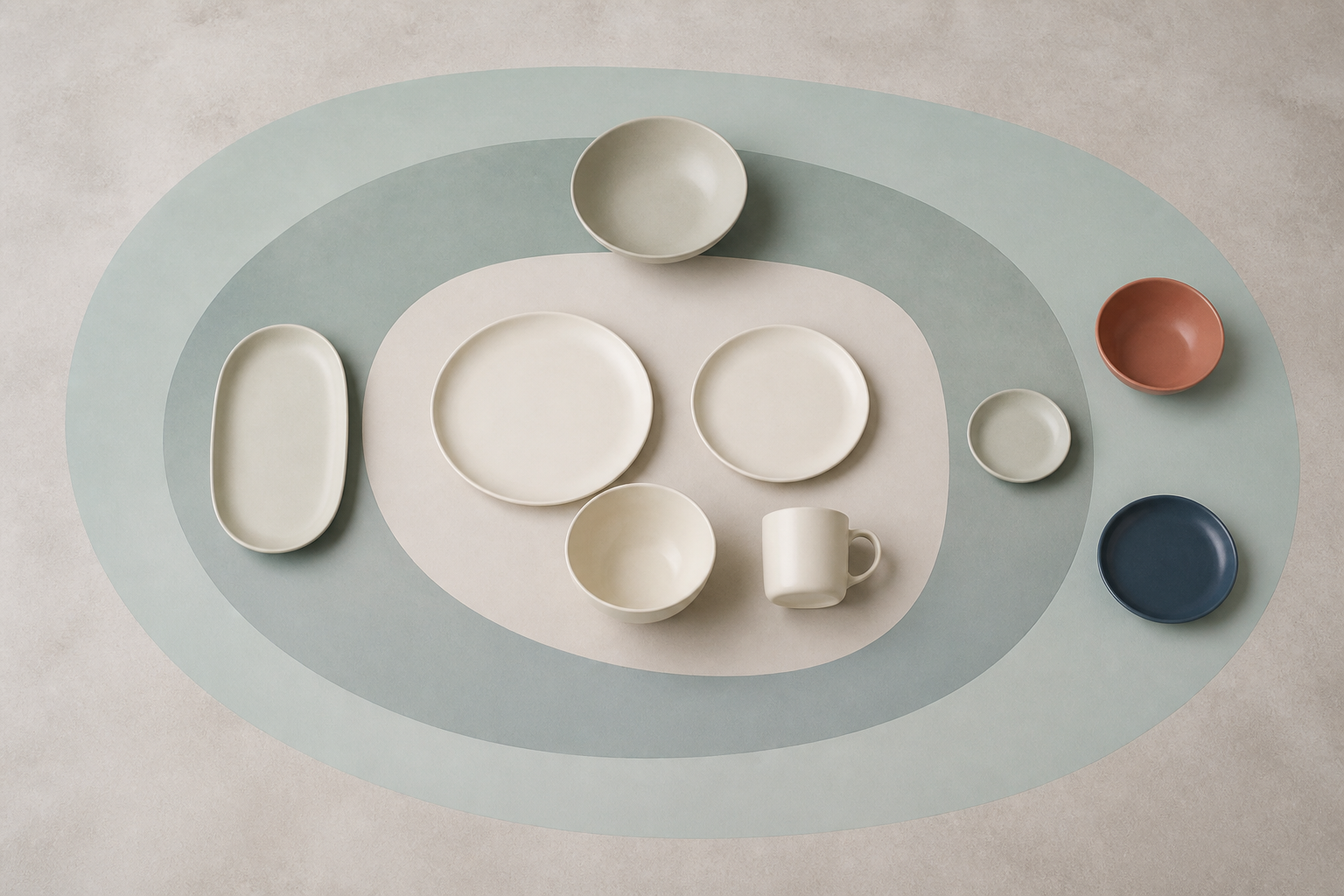
I like to plan the range as three rings rather than one long SKU list.
Ring 1: The Core
The core solves everyday eating and should carry most sales. It may include a dinner plate, useful bowl, side plate, and mug. The exact mix depends on the channel.
Core shapes deserve the strongest repeat-order control. Record the mold reference, fired dimensions, weight, capacity method, glaze standard, foot finish, stacking, and approved defects. An attractive sample without these controls is not ready to become the range foundation.
Ring 2: Useful Extensions
Extensions add a meal, serving need, or sales format: perhaps a pasta bowl, serving platter, small dish, or replacement mug. Their relationship to the core should be immediately clear.
I do not require the same rim on every piece. I look for repeated choices in curves, feet, glaze family, edges, and visual weight.
Ring 3: Accents and Seasonal Pieces
Accents create freshness: a new color, printed side plate, holiday serving piece, or limited gift item. They can take more creative risk because the core carries the commercial work.
Before adding an accent, decide whether it will be reordered, retired, or reviewed after a fixed selling period. Do not let a limited piece quietly become a forever SKU with its own low-volume problems.
Use This Modular Collection Map
This is the working map I would use in an early ceramic tableware collection planning meeting.
| Layer | Product Job | Shared Rules | Approval Proof | Release Gate |
|---|---|---|---|---|
| Core | Covers daily eating and leads the range | Main body, design language, glaze standards, foot finish | Golden samples, drawings, fired measurements, stack check | Must work as open stock and in the main set |
| Extension | Adds a meal or serving use | Compatible proportions, glaze family, handling and pack logic | Fit check beside core, use test, production sample | Must add a clear use or measurable demand |
| Accent | Adds color, story, or season | Selected palette and brand details | Approved color range, decoration proof, sales window | Must have an exit or reorder rule |
| Replacement | Keeps the promise after launch | Stable core shape and color reference | Retained samples, version record, repeat MOQ | Must be practical to identify, pack, and reorder |
This map makes every SKU earn a place. “It looks nice” is not a product job. “It adds a pasta bowl without replacing the core set” is.
Build Compatibility, Not Perfect Sameness

There are five kinds of compatibility I check before calling a line modular.
1. Visual Compatibility
Place the new piece beside the approved core, not a rendering. Check proportion, color temperature, glaze movement, rim thickness, and exposed clay at the foot. Reactive and semi-matte glazes need an approved range, not one perfect photo.
2. Use Compatibility
A new bowl should solve a different use. Fill it, lift it, use cutlery in it, and wash it as intended. A beautiful wide bowl may take too much dishwasher space; a matching mug may still fail if its handle is awkward.
3. Stack and Storage Compatibility
Test stack height and stability with production-representative pieces. Check contact, scratching, rocking, and whether one piece lifts cleanly. Because ceramic shrinks, a CAD stack is not proof.
4. Production Compatibility
Shared clay and glaze routes can reduce complexity, but the same glaze may look different on a deep bowl, vertical mug wall, and flat plate. Kiln position, glaze thickness, body absorption, and firing curve matter.
Ask whether the shape needs a new mold, forming method, firing support, decoration step, or inspection limit. A professional supplier should explain the change, not simply say it is possible.
5. Commercial Compatibility
The extension must fit the price ladder, MOQ, carton quantities, barcode structure, and replacement promise. Confirm the product and pack identification rules for your sales channel before artwork is locked. Keep each sellable configuration traceable to its approved record.
Put Every New SKU Through a Compatibility Gate
Before I approve a dinnerware line extension, I ask six yes-or-no questions:
1. Does it add a use that the core does not cover well?
2. Can a buyer recognize it as part of the range without reading a label?
3. Has it been reviewed beside real core samples under neutral light?
4. Can it stack, wash, store, and pack safely for the intended channel?
5. Can production and QC control its important differences?
6. Can the brand order, identify, photograph, and replace it without confusion?
If the answer to two or more questions is no, I pause the SKU. Sometimes the right answer is a revised shape. Sometimes it is a later release. Sometimes the piece simply does not belong.
Plan Glazes as a System
Color expansion looks easy on a spreadsheet. In production, every glaze can add trials, cleaning, scheduling, inspection, photography, and stock risk.
I prefer to define three levels:
- Permanent colors: the stable base of the brand and the highest priority for repeat control.
- Compatible colors: approved for selected shapes, but not automatically for every SKU.
- Experimental colors: tested on a limited shape and quantity before wider use.
Create a physical range board showing accepted variation. Record the body, shape, firing, and glaze application. A color chip cannot show glaze depth, pooling, speckle, or edge break.
For food-contact pieces, make sure evidence matches the actual body, glaze, decoration, and destination market. The FDA guidance on lead in foodwares is useful U.S. context, while the European Commission food contact materials overview explains the broader EU framework. These sources do not replace a market-specific compliance review or testing plan.
Keep the Product Record Alive
A modular range can grow for years, so keep one controlled record for every approved SKU and color. It should connect:
- Current drawing and revision number
- Mold, master, or tooling reference
- Approved fired dimensions, weight, and capacity method
- Body, glaze, and decoration codes
- Golden sample and approved variation range
- Known critical defects and inspection method
- Packaging structure, packed weight, and carton dimensions
- Test reports and the exact products they cover
- Product identifier, image set, and listing copy version
- First production date and every approved change
For bulk inspection, an agreed sampling approach such as the ISO 2859-1 acceptance sampling framework can help organize lot decisions, but the buyer and supplier still need written defect definitions and acceptance levels. A sampling table cannot decide whether a glaze pool is beautiful or unacceptable; your approved range must do that work.
Design Packaging for More Than One Selling Format
Packaging is part of the architecture. A plate may sell alone or inside several set sizes. Each route changes contact points, carton weight, unboxing, and replacement packing.
Build physical packs for the likely formats. Share carton footprints or protective parts only when the fit is real; oversized “universal” inserts often leave movement around rims and handles. Ask a packaging laboratory to select tests that represent the intended distribution route, then retain the pack version and results.
I also check whether a replacement piece can ship without borrowing a large set carton.
Release the Range in Waves

A modular roadmap needs dependencies, even if the first meeting has no fixed dates.
Wave 1 — Prove the core: Approve the main shapes, one or two permanent colors, the first pack formats, compliance scope, and quality standards.
Wave 2 — Fill real gaps: Use sales questions, returns, and customer requests to choose extensions. Develop only the pieces with a clear job.
Wave 3 — Add controlled freshness: Test accents, gifts, or seasonal colors without changing the core promise.
At each wave, update the master record. If a core mold, body, glaze, or carton changes, review every connected SKU.
My Advice as a Manufacturer
My simple advice is to design the family resemblance before designing the whole family.
Approve a small core that customers can use, factories can repeat, and your team can explain. Give every future SKU a gate. Without clear technical records, “modular” is only a nice word for pieces in similar colors.
I have seen strong collections grow from four controlled pieces. I have also seen large launches struggle because every bowl, mug, and gift pack had its own rule. The smaller launch had the better foundation.
Questions Buyers Often Ask
How many pieces should a modular collection launch with?
There is no universal number. Start with the fewest pieces that serve your main customer and channel. Four to six strong core SKUs may be more useful than twelve weak ones, but validate the choice with price, packaging, and demand data.
Must every piece use the same ceramic body?
No. Different bodies may solve different performance or design needs. However, document the visual and technical differences. Do not assume one test report, glaze result, or care claim applies across bodies.
Can one glaze be used on every shape?
Not automatically. Surface angle, glaze thickness, application, and firing can change the appearance. Trial the glaze on each shape family and approve a realistic range.
Should new pieces use existing molds?
Existing molds can save time and tooling cost when the shape fits the design system. A poor fit is not a saving. Compare dimensions, proportion, foot style, stack, and glaze behavior before choosing.
How do we keep repeat orders matching the original launch?
Keep retained production samples, controlled specifications, glaze range standards, mold records, and change history. Review repeat samples against those records, not against website photos.
Conclusion
A modular dinnerware collection grows well when its core is useful, its shared rules are visible, and every extension passes a compatibility gate. Build the product architecture around real ceramic behavior, packaging, identifiers, and repeat-order control. If you are planning a private label dinnerware range, start by mapping the core, extensions, glaze system, and sample approvals.
Plan Your Modular Dinnerware Range
Contact FENN with your target market, core pieces, glaze references, expected quantities, and release plan. We can help review how future pieces fit your ceramic dinnerware manufacturing and repeat-order requirements before sampling.