
Short Answer
The right dinnerware carton size protects the pieces, fits the planned pallet or shipping route, and stays within agreed handling limits. Develop it around real packed samples, then measure the sealed carton and check gross weight. Before approving a smaller box, ask for an updated packing drawing and suitable testing of the complete product-and-package combination.
When I review a packing proposal, I like to see one open carton and one closed carton. The open one tells me how the ceramics are supported. The closed one tells me what the warehouse and freight company will actually handle.
Both matter. A neat number on a quotation can hide a box that bulges when packed, or a rim pressed hard against the side wall.
My approval rule: a carton change needs to work inside the box, across the load, and through the actual delivery route. Saving space in only one of those places is not enough.
Begin With the Pieces Inside

A master carton is the outer shipping box holding the agreed number of pieces, inner packs, or retail sets. Its size should follow the protective packing arrangement, not just the largest plate diameter.
Start with representative finished ceramics. Firing shrinkage and normal dimensional variation mean that the smallest sample is a poor basis for a tight insert. Ask the supplier to check fit across the approved product size range.
I pay particular attention to the rim, foot ring, and handle. A bowl can look secure from above while its foot rests against the glaze of the bowl underneath. A mug cavity can grip the body nicely while leaving its handle against a partition.
Look for deliberate support and separation. The factory should show the packing order, separator material, contact points, and how movement is controlled. Loose filler added wherever a gap appears is harder to repeat consistently.
Do not confuse a close fit with pressure. Flaps should close normally without forcing the ceramics down. If the box needs strong pressure to stay shut, investigate the stack height and insert fit before adding more tape.
For a range with several shapes, record a separate packing arrangement for each SKU. Review custom ceramic bowl profiles and nesting requirements and mug and cup handle geometry before choosing shared inserts. A common carton size does not mean that the same internal protection suits every item.
Follow the Pack Onto the Measuring Bench
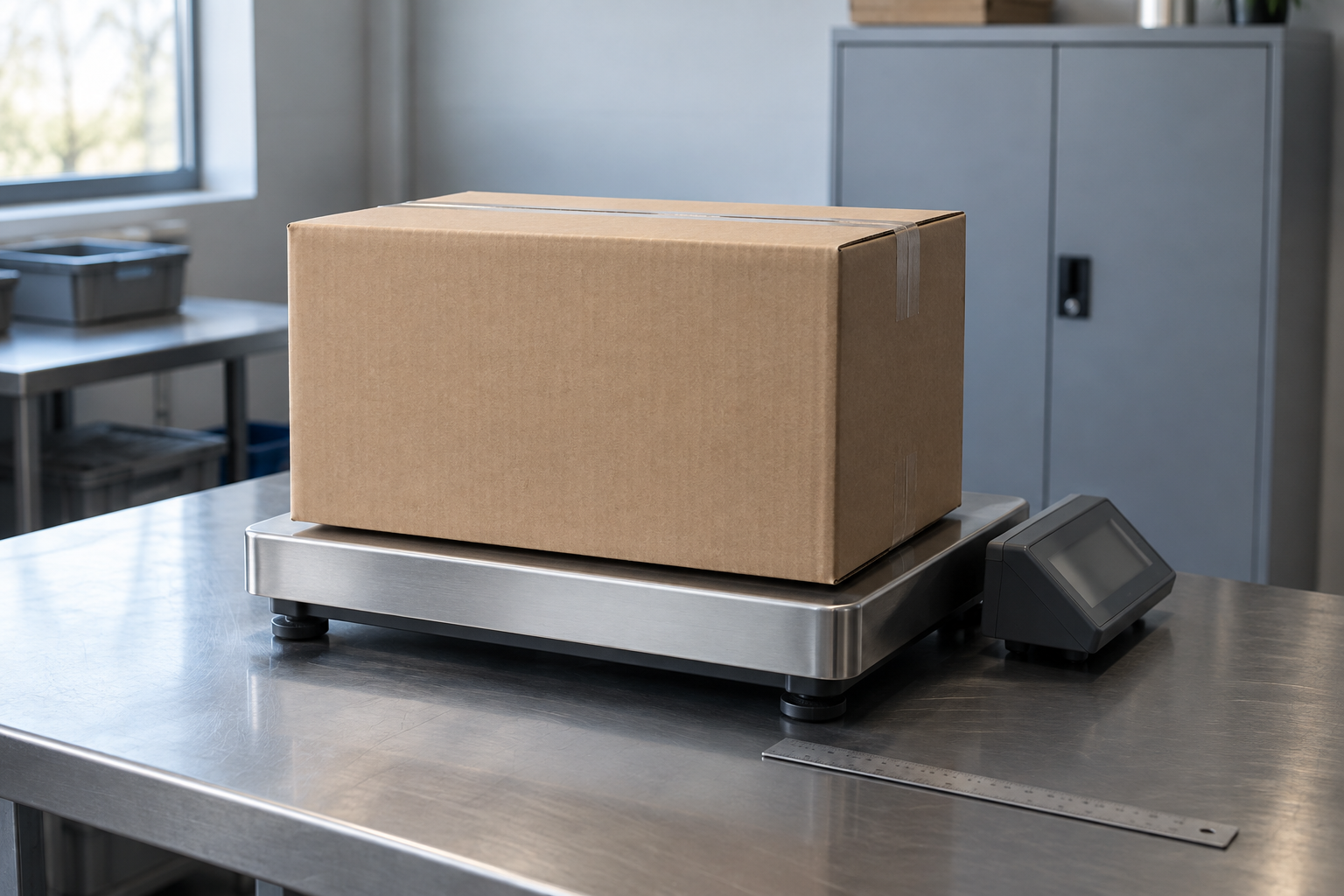
Before approving master carton dimensions, separate three different sizes: the ceramic product, the usable space inside the carton, and the finished carton outside. Record each clearly.
The internal dimensions help the packaging supplier develop the fit. The external dimensions describe the space occupied in storage and transport. Corrugated board thickness, folds, inserts, and packing pressure connect the two, but they are not interchangeable.
For freight data, measure a normally filled and sealed production-style carton. Include any outward bulge in the measurement. Use the carrier’s measurement and rounding rules when requesting a quote; do not quietly copy dimensions from an empty-box drawing.
Also weigh it. Gross weight includes ceramics, inserts, inner boxes, the master carton, and closures. Net product weight alone cannot tell the receiving team what they will lift.
My quick check is to ask the supplier for a photograph of the sealed pack and the matching measurement record. The SKU mix, pieces per carton, and packing revision should agree. A photo of a different set size does not close the question.
Test a Dinnerware Carton Size Change on the Pallet
Here is a deliberately simple design example, not a FENN packing specification.
Imagine a 1,200 × 1,000 mm pallet and two candidate cartons with the same contents. Version A has an external footprint of 410 × 310 mm. Version B is 400 × 300 mm. Both are 250 mm high.
For a uniform grid with no overhang, A fits either 2 × 3 or 3 × 2 cartons: six per layer. B can fit 3 × 3 cartons: nine per layer. Rotating cartons and using mixed patterns may produce another arrangement, so these numbers compare only the stated grids.
The important lesson is the boundary. A small dimension change can affect the layer layout much more than the carton volume suggests.
But I would not approve B from this arithmetic. It has no spare space along the 1,200 mm side. Bulging, dimensional variation, protective boards, and the pallet itself can change the real fit. The packing team needs a physical trial and an allowance for repeatable loading.
Ask for the proposed pattern from above and the stack from the side. Confirm pallet dimensions, carton orientation, layer count, total loaded height, and gross pallet weight. Check deck support beneath the carton edges, stability, and load-bearing performance with the packaging specialist.
More cartons per layer does not automatically mean more layers are safe. Dense ceramic loads can reach a weight or strength limit before they fill the available height.
Separate Space Savings From Freight Savings
In that example, A occupies 0.031775 cubic meters per carton. B occupies 0.030000 cubic meters, about 5.6% less. This calculation says something useful about space. It does not promise a 5.6% reduction in dinnerware shipping cost.
For parcel services, dimensional weight can affect the bill alongside actual weight. FedEx explains that the greater of the two is used in its dimensional-weight pricing. Ask for the rules of your specific service and account. A heavy ceramic pack may still be billed by actual weight after its size falls.
For pallet or container transport, give the forwarder the revised loaded dimensions and weight. Minimum charges, pallet positions, load limits, and handling can prevent a small carton-volume reduction from changing the quotation.
Then check the warehouse cost. Combining more sets in one master carton may mean fewer boxes, but it can make lifting, picking, and damage isolation harder. Ask the receiving warehouse for its carton weight and size limits before finalizing the pack count. There is no single carton weight that suits every operation.
I compare the delivered, usable result: packaging, transport, handling, repacking where needed, and recorded damage. The smallest box wins only when the rest still works.
Put Both Carton Versions Through the Same Review

Use this compact carton spec worksheet for the original and proposed pack. Keep photos and reports under the same revision reference.
| Record for each version | What closes the review? |
|---|---|
| Product IDs, size range, and pieces or sets per carton | Representative finished pieces fit the documented arrangement |
| Internal and sealed external dimensions, in mm | Drawing and physical measurements are clearly distinguished |
| Inserts, board specification, closure, and gross weight | Materials and pack count match the tested sample |
| Pallet footprint, pattern, layers, loaded height and weight | Actual trial supports the proposed layout without overhang |
| Delivery route, handling stages, and test plan | Test scope reflects the intended distribution conditions |
| Acceptance criteria, report, and release owner | Results identify this exact packing revision and approved contents |
For a ceramic tableware carton, “five-ply” alone is an incomplete strength specification. Ask the packaging supplier to identify the board construction and relevant performance requirements.
FEFCO testing methods distinguish tests such as edgewise crush resistance of board and compression resistance of packaging. Those results answer different questions. A board test is not, by itself, proof that the complete dinnerware pack will survive its route.
Have the laboratory or packaging specialist select suitable ISTA test procedures for the product and distribution environment. Agree the damage criteria before testing, including ceramic cracks, chips, unacceptable surface damage, and any required retail-box condition.
A recognizable test name is useful only when the tested contents, materials, dimensions, and closure match the shipment. Changing an insert or carton size should trigger a review of when to retest a packaged product, rather than automatic reuse of an old report.
My Advice as a Manufacturer
I would look for avoidable space around a well-supported pack before removing the protection between pieces. The separator that seems small on the packing list may be the part keeping a foot ring away from a glazed surface.
Change one design variable at a time where practical. If you change carton dimensions, piece count, insert material, and board construction together, a later failure becomes harder to explain.
Once approved, keep a complete packing reference: an assembled sample, revision-controlled drawing, material list, photos of the packing sequence, and test record. The person packing the next order should not need to guess what made the first one work.
Questions Buyers Often Ask
Is a smaller carton always better for ceramic dinnerware?
No. It can reduce unused space but may remove necessary protection or press fragile areas against the box. Approve it only after fit, handling, load layout, and testing have been reviewed.
Should I quote internal or external carton dimensions?
Label both when developing packaging. For freight, provide the measured external dimensions of the filled, sealed carton, plus the final pallet dimensions where applicable. Confirm the service’s measurement rules.
Can I add more pieces to the same carton?
Treat that as a packing change. It alters gross weight, support, and possibly pressure on the lower pieces. Check warehouse limits and have the revised product-and-package combination reviewed for testing.
Can one carton serve several ceramic shapes?
Sometimes, with suitable inserts. Check each approved arrangement, especially the largest, heaviest, and most vulnerable pieces. A fit check for plain plates does not establish protection for handled mugs.
Conclusion
Good dinnerware carton size decisions begin with the ceramics and end with a verified load. Keep the fit, sealed dimensions, gross weight, pallet plan, and test evidence connected. A small saving is useful when it survives that whole review.
Plan the packaging approval alongside the custom dinnerware development steps, so a change to shape, quantity per carton, or insert material is reviewed before production release. See FENN’s manufacturing and quality review process for the wider project context. Our buyer Resources offer further sourcing guidance.
Prepare a carton review brief
Send product dimensions and tolerances, SKU mix, pieces or sets per carton, packing drawings or photos, sealed external dimensions, gross weight, delivery route, and receiving-warehouse limits. Identify which measurements are confirmed and which still need a packed-sample check.