
Short Answer
To prepare for packaging EPR for dinnerware, record each packaging component, its material, weight, quantity, and sales route. Include packaging added after the factory shipment. Ask the responsible business or adviser to confirm market-specific registration, reporting, fees, and labels. A supplier’s material list supports that review; it does not settle who has the legal obligation.
I like to start this conversation with an empty dinnerware box. Once the plates are out, we can see what is easy to overlook: the pads, sleeve, tape, bag, and little foam pieces protecting a rim.
Those small parts deserve proper names. “One carton with protection” may work in a quick email, but it is a poor starting point for a packaging data file.
EPR means extended producer responsibility: rules that place responsibilities for packaging waste on defined businesses. The business treated as the producer depends on the market and supply arrangement. It is not automatically the ceramic factory.
My practical test is simple: could another person rebuild the approved pack and understand its material totals from your records? If not, I would improve the file before approving bulk packing.
Follow One Dinnerware Set Through Its Packaging Journey
Imagine a four-plate set that leaves the factory in a retail box. Four retail boxes go into one export carton. At the destination warehouse, some sets go to shops. Others receive an extra parcel box for online orders.
The plates are identical. Their packaging journeys are not.
I draw that journey before discussing totals:
Factory retail pack → export carton → destination warehouse → shop or customer parcel.
At each stop, I ask what is added, removed, reused, or discarded, and by whom. I also record the country involved. A warehouse removing the export carton does not mean that carton disappears from every packaging obligation.
For the regulatory starting point, use the European Commission packaging waste overview. The EU Packaging and Packaging Waste Regulation has a general application date of 12 August 2026, but individual provisions have their own timing. Do not assume every future labelling or design requirement began on that date.
For a UK route, the UK EPR obligation checker helps businesses review their activities and size. EU and UK records may share raw measurements, but their reporting decisions should be reviewed separately.
A useful responsibility note names the legal business, destination, sales channel, reviewer, and review date. “Our logistics partner handles it” leaves too much unanswered.
A FENN Reference: Match the Pack to the Actual Plate

Our irregularly shaped dinner plates provide a real example of why product identity comes first. The FENN photograph shows two white speckled plates with uneven outlines and brown-edged rims. I would identify the ordered shape and size before asking for a packaging component list.
A round plate and an irregular plate may need different clearances or protection. That is a reason to review the pack, not proof that one needs more material. The photo does not establish box dimensions, packaging weights or a tested packing arrangement. Those details must come from the approved pack for the order.
At the Packing Line, Separate the Materials Before Weighing
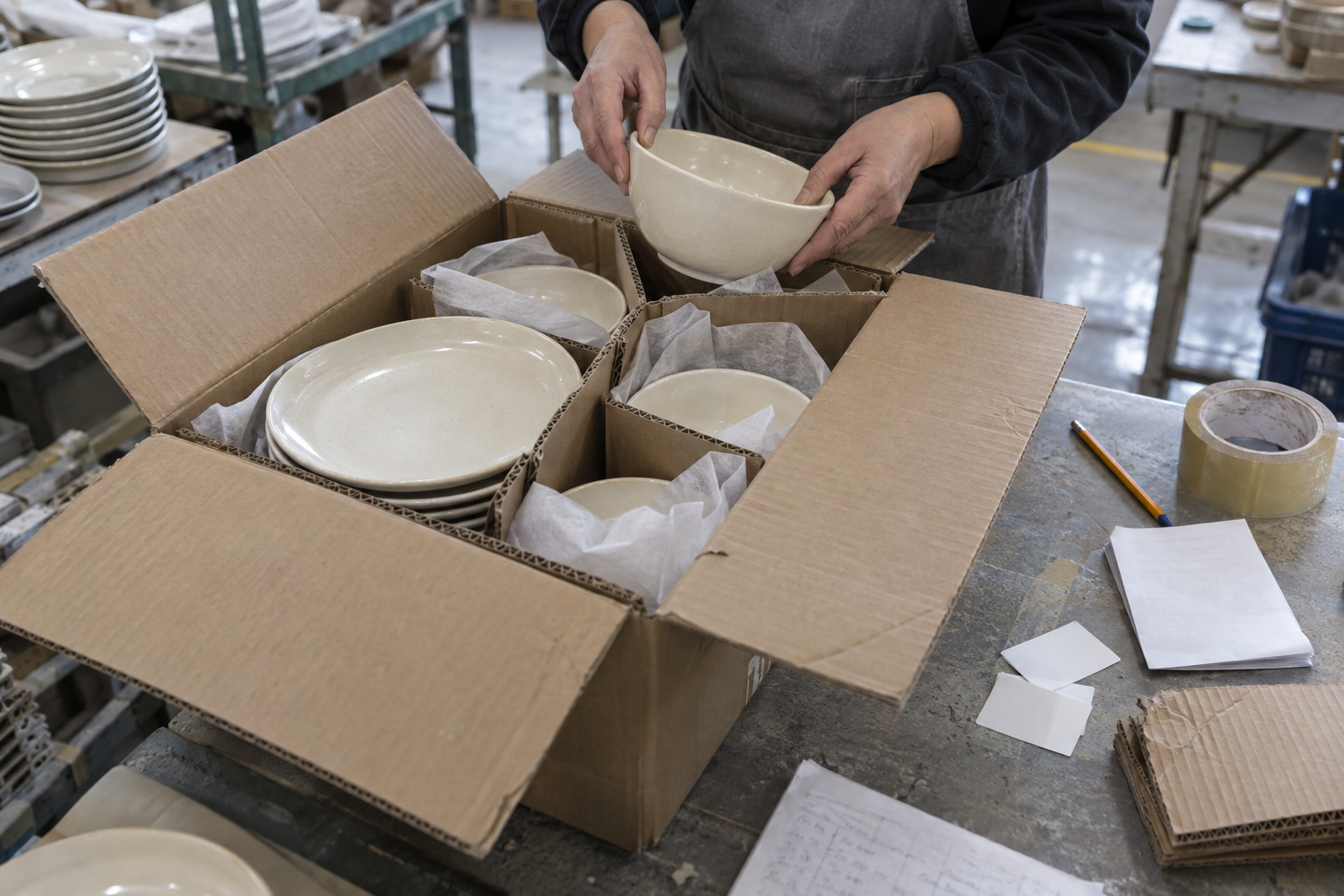
From a factory point of view, the best reference is the final approved pack with the actual ceramic pieces inside. An early box mock-up may use different board, pads, or tape.
First, photograph the complete pack. Then unpack it and assign a component reference to each part. Record quantities per retail set, per export carton, or per pallet. Keep those units visible.
I would give a corrugated box and a polyethylene foam pad separate lines. If a paper sleeve has a plastic film layer, ask the packaging maker for its construction rather than calling it plain paper by appearance. Let the market reviewer decide how that construction should be classified.
Weigh the empty packaging components, not the plates plus the box. For light parts, use a suitable scale and a counted group when one piece is too light to measure reliably. Record the count and divide the combined weight. Follow any measurement method required by the relevant scheme.
Keep the measurement date, sample count, scale resolution, supplier specification, and photograph together. Weighing ten pads is useful only if we know which pad revision those ten represent.
A professional supplier response should identify the material and the measured part. “Eco-friendly foam, about five grams” needs a follow-up on polymer, dimensions, and how the weight was obtained.
Packaging EPR for Dinnerware: A Worked Weight Reconciliation
Here is a deliberately small example. These figures illustrate factory data arithmetic, not reporting categories, legal rates, or FENN packaging specifications. All four retail sets use the same pack, and there is one export carton for the order unit below.
| Component | Material for this example | Weight each | Count per export carton | Material subtotal |
|---|---|---|---|---|
| Retail box | Uncoated corrugated paperboard | 180 g | 4 | 720 g paperboard |
| Plate separator | Uncoated corrugated paperboard | 12 g | 12 | 144 g paperboard |
| Protective pad | Polyethylene foam | 3 g | 16 | 48 g plastic |
| Export carton | Uncoated corrugated paperboard | 600 g | 1 | 600 g paperboard |
The listed subtotal is 1,464 g paperboard plus 48 g plastic, or 1.512 kg of packaging per export carton. The ceramic weight is excluded.
For 250 identical export cartons, those listed components total 366 kg paperboard and 12 kg plastic. That means 1,000 retail sets, because each export carton holds four sets.
This example intentionally leaves out tape, labels, pallet materials, and any parcel pack. In a real file I would flag those as missing, not call 378 kg the final total. It is a useful way to spot incomplete supplier data.
For each line, use: component weight × component count × number of relevant packs. Convert grams to kilograms once, clearly. Then reconcile the pack count against actual movement records for the reporting period and market.
Do not multiply all packaging by the number of ceramic pieces. A four-plate set does not use four retail boxes. Equally, do not allocate a whole export carton to every set and then count the carton again.
The UK large-producer packaging data guidance explains how material, weight, packaging activity, and other classifications enter that particular reporting system. My calculation above is an input to review, not a completed regulatory return.
At the Warehouse, Capture What the Factory Cannot See
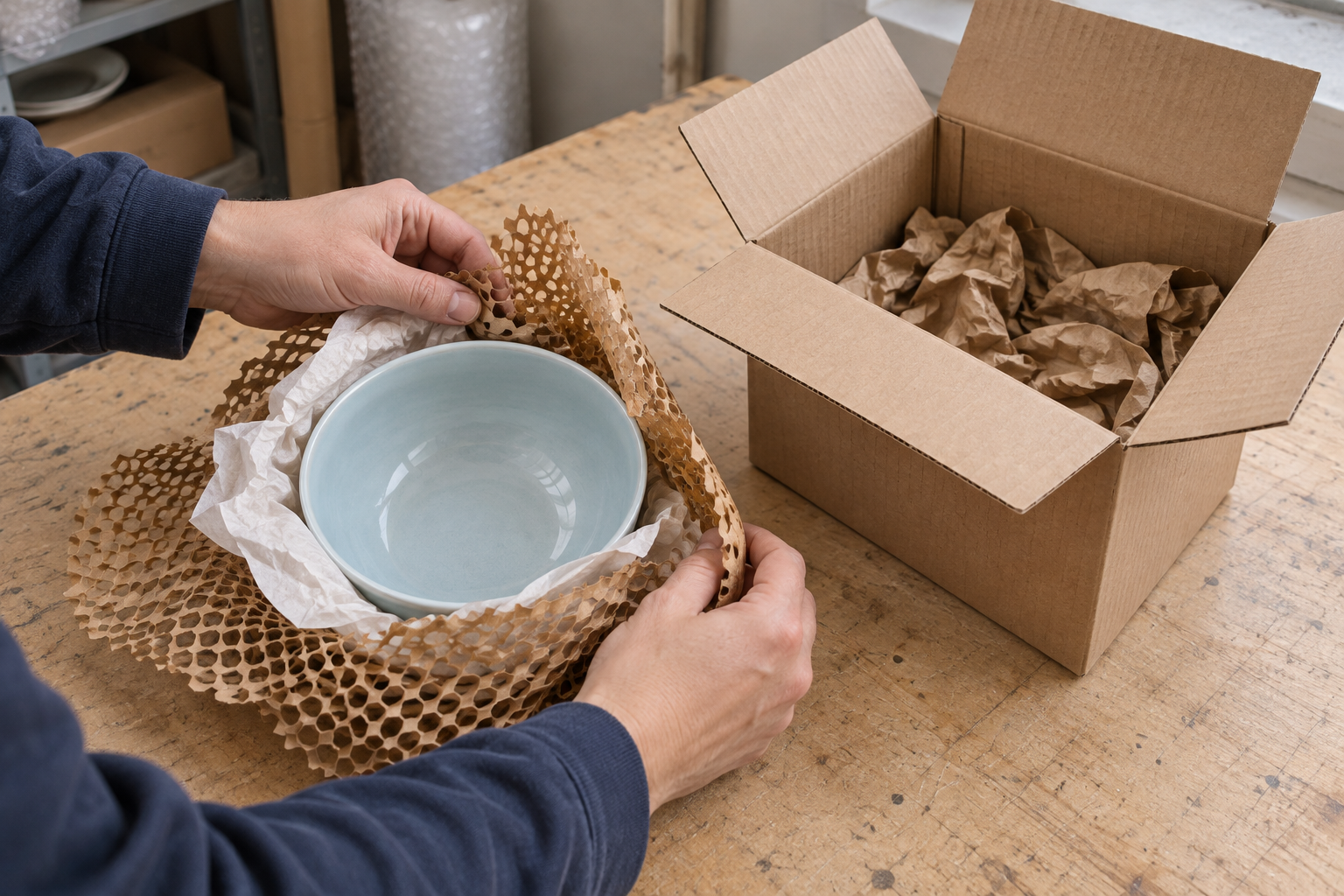
Now follow the online-order sets. The fulfilment team adds a parcel carton, paper cushioning, and tape. The original factory file cannot tell you those weights unless someone supplies them.
I would ask the warehouse to give each approved parcel format its own reference. Link actual shipments to the format used. If one order contains two retail sets, check whether the pack changes rather than doubling the packaging for a single-set parcel.
Keep the original export carton record too. Record where it was removed and what happened next. These facts help the responsible reviewer assign the right treatment without losing material or counting it twice.
A replacement plate or bowl needs attention as well. Its small parcel may use a completely different protective structure. I would keep a separate packaging version for replacement orders instead of borrowing the full-set figures.
This is where tableware packaging responsibility becomes a team task. The factory supplies its pack data, the warehouse supplies additions and removals, and the responsible business brings the records together.
When You Change Protection, Reopen the File
Ceramic dinnerware packaging compliance and breakage control need to stay connected. Removing foam can change how a plate rim takes a knock or how its foot ring contacts the next piece.
I would compare the old and proposed pack using the same fired shapes and the intended distribution route. Check movement inside the box, rim-to-rim contact, pad compression, and the packing team’s ability to repeat the arrangement. Agree suitable transport testing and acceptance criteria with the buyer.
If paper protection works, record its actual weight and construction. Do not copy the old foam figure into a new material column. A heavier paper part may change the totals even when the box looks unchanged.
Keep a revision history with an effective shipment date. Otherwise, a year-end calculation may apply the newest pack to stock shipped months before the change.
I also separate three questions: what the material is, whether the destination system accepts it for recycling, and what claim or disposal label may appear on the pack. A brown surface answers none of those by itself. For Germany, the ZSVR packaging register is an official starting point for checking the local obligations; confirm the relevant route before using registration details or disposal artwork.
My Advice as a Manufacturer
I prefer a modest file that matches the packing line over a beautiful sustainability slide that nobody can reproduce.
Before bulk approval, I would ask three people to check the same pack revision: the supplier who builds it, the warehouse that handles it, and the person responsible for the market review. Each should be able to identify their own missing information.
Do not let a material substitution happen quietly because the original pad is out of stock. Agree that packaging changes need approval, fresh weights where relevant, and a review of protection. This is as much a repeat-order control issue as a reporting issue.
Questions Buyers Often Ask
Can the ceramic supplier handle all EPR obligations?
I would not assume so. The supplier can provide packaging facts and support the review. Legal responsibility depends on the market, business role, and sales arrangement. Name the responsible business before assigning tasks.
Is paper packaging exempt because it is recyclable?
Do not assume that. Material choice alone does not settle whether packaging is in scope. Check the destination rules and distinguish reporting obligations from recyclability claims.
Can I use shipping gross weight minus product weight?
That may help check an overall total, but I would not use it as the whole file. It cannot reliably separate paper, plastic, and other components, and may include pallet materials or packing variations.
Should I prepare data before knowing whether fees apply?
Yes. I would collect the final pack facts during sampling, when the components are easy to identify. The responsible reviewer can then determine which registrations, reporting duties, or fees apply.
Does a packaging change require new ceramic food-contact testing?
It does not automatically answer that question. Review whether the change affects the product or introduces relevant contact or contamination concerns. Packaging data and ceramic food-contact evidence serve different purposes.
Start With One Approved Pack
My advice on packaging EPR for dinnerware is to start with one real pack, trace its journey, and make every weight traceable. Expand that method across your range after the first file makes sense.
If you are preparing a new range, share your destination countries, set contents, sales channels, and current pack photos with FENN. I can help turn the factory packing plan into clear component data for your market review. You can also explore the FENN buyer resources for related packaging and sourcing guidance.