
Short Answer
Choose dinnerware set pieces by place settings, channel, target price, packed weight, and replacement plan—not by copying a competitor. A 12-piece set usually gives four people a dinner plate, side plate, and bowl. A 16-piece set often adds four mugs, but that is only useful when mugs fit the customer and channel. Before approval, build and weigh the complete pack, check margins, and test whether each piece earns its space.
When a buyer asks me whether 12 or 16 pieces will sell better, I ask one question first: “What meal and customer are you building the box for?”
A set count is not a product strategy by itself. Sixteen weakly connected pieces do not create more value than twelve useful ones. In my factory experience, the best set feels complete at home, clear on the shelf, sensible in the carton, and easy to replenish.
> Simple definition: Set size is the total number of ceramic items in one sellable pack. Place setting means the group of pieces intended for one person.
Do the Place-Setting Math First
Most confusion disappears when the buyer writes the configuration as a formula.
- 12-piece service for four: 4 dinner plates + 4 side plates + 4 bowls.
- 16-piece service for four: 4 dinner plates + 4 side plates + 4 bowls + 4 mugs.
- 18-piece service for six: 6 dinner plates + 6 side plates + 6 bowls.
- 4-piece place setting: 1 dinner plate + 1 side plate + 1 bowl + 1 mug.
These are common patterns, not rules. A modern casual set may replace the side plate with a pasta bowl. A breakfast range may use a mug but no side plate. A restaurant starter pack may focus on plates and bowls with no mug at all.
Write the exact piece names, dimensions, and quantities everywhere: quote, sample approval, artwork, barcode record, carton mark, listing, and purchase order. “16-piece set” is incomplete information.
Match the Set to the Sales Channel
Use this channel configuration card before choosing the final count.
| Sales Channel | Strong Starting Format | Why It Can Work | Main Risk to Check |
|---|---|---|---|
| Mass retail | 12- or 16-piece service for four | Familiar value comparison and clear shelf message | Shelf price, carton cube, lifting weight, barcode level |
| DTC ecommerce | 12-piece core or smaller modular sets | Lower parcel weight and easier replacement | Parcel damage, dimensional weight, mixed-order protection |
| Gift and boutique | 4-, 8-, or 12-piece edited set | Clear story and manageable gift price | Presentation box may not survive shipping alone |
| Marketplace | 12-piece core with exact listing images | Simple set-content communication | Returns from size, color, count, or care confusion |
| Hospitality | Open stock or project packs | Replacement and quantity flexibility | Consumer-style mugs or gift boxes may add no value |
| Club or value channel | Larger family pack where demand is proven | Strong price-per-piece message | Heavy cartons, cash tied in one SKU, breakage exposure |
The table is a starting point. Your account requirements and customer data should decide the final pack.
When a 12-Piece Set Is the Better Choice
A 12 piece dinnerware set is often strong when the meal set does not need mugs. Many customers already own drinkware, and mug style is personal. Removing four mugs can lower product cost, carton size, gross weight, and handle-breakage risk.
It also gives the brand room to sell mugs separately in two sizes or colors. That can support add-on sales without forcing every customer to accept the same cup.
Choose twelve pieces when:
- the bowl completes the main meal use;
- the target price is tight;
- ecommerce shipping cost matters;
- the channel values a compact box;
- mugs would make the set less flexible;
- replacement plates and bowls are more important than drinkware.
My judgment standard is simple: if removing the mugs does not make the table feel incomplete, the 12-piece format may be commercially cleaner.
When a 16-Piece Set Earns Its Space
A 16-piece set can create a clear “complete service for four” offer when mugs are part of the customer’s daily routine. It may work well for first-home buyers, coordinated kitchen ranges, registry programs, and gift-led retail.
But four mugs add more than four pieces. Handles need protection. Mug height can increase carton depth. The extra weight may move the parcel into another shipping band. Mugs can also create color or replacement demand that differs from plates.
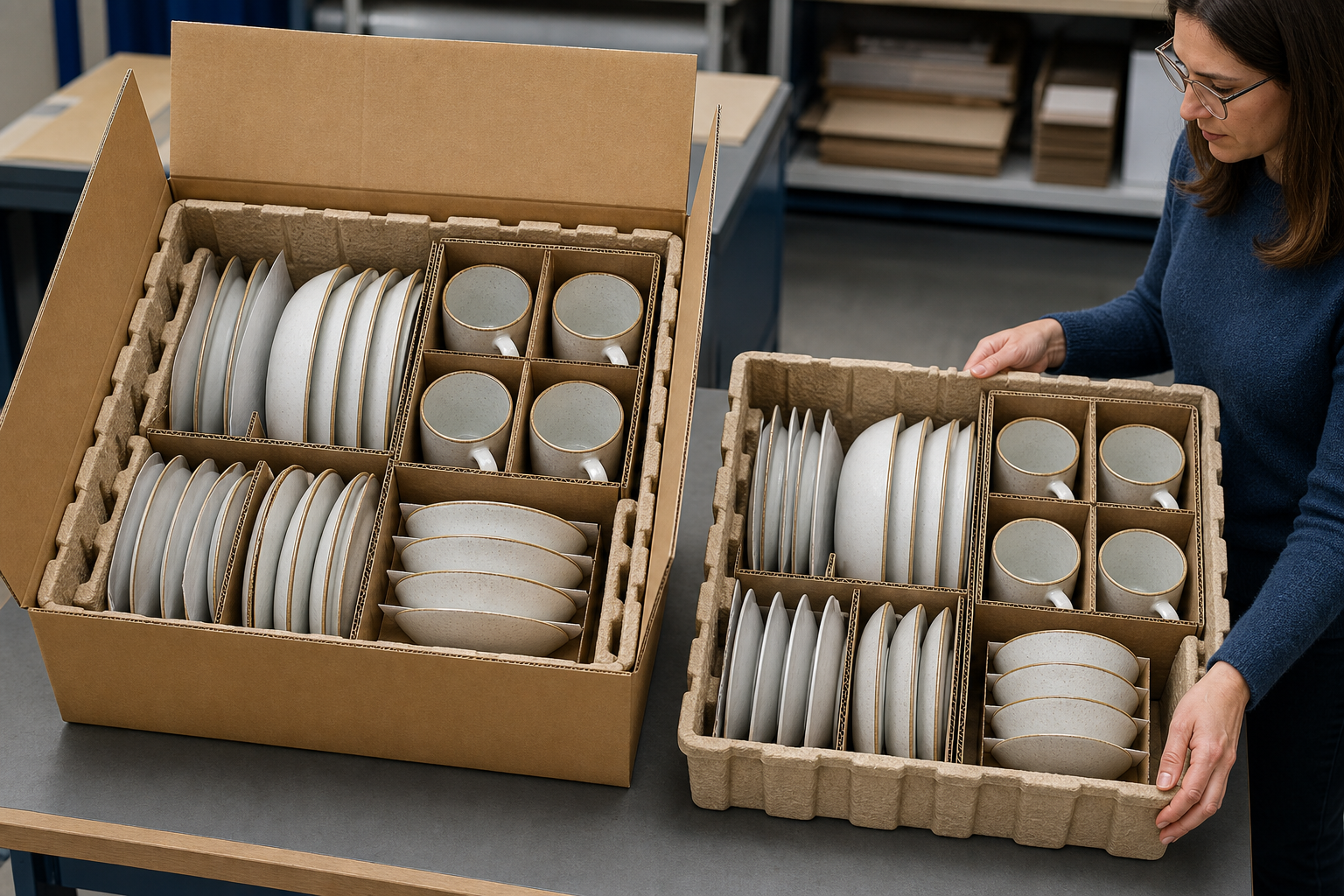
Ask a 16 piece dinnerware set supplier to show the final pack arrangement, mug-handle clearance, gross weight, carton dimensions, and test record. A drawing with sixteen icons is not packaging proof.
Choose sixteen pieces when the mug strengthens the use story, the target price carries the added cost, and the finished pack remains practical for the channel.
Price the Set as One SKU and as Separate Pieces
Create two simple models.
Set model: total product, packaging, testing, inspection, freight, duty, handling, expected breakage, and channel fees divided by sellable sets.
Piece model: the same costs assigned to each plate, bowl, and mug, including likely replacement handling.
This comparison finds hidden problems. A mug may be cheap to produce but expensive to protect. A large bowl may increase carton cube more than its unit cost suggests. A decorative side plate may add little customer value but require another divider level.
Do not judge only by price per piece. A lower price per piece is not a saving when the larger box sells slowly or creates more damage.
Build the Real Pack Before Freezing the Set
Pack production-representative samples using the proposed inner protection, dividers, retail box, and master carton. Then record:
1. finished product and packed dimensions;
2. net and gross weight;
3. contact points between ceramic pieces;
4. rim, handle, and foot-ring clearance;
5. unit and master-carton quantities;
6. pallet or container pattern where relevant;
7. packing sequence and orientation;
8. test method, observations, and approved pack version.
For distribution testing, the ISTA testing overview is a useful high-trust starting point. Carrier dimensional weight guidance also helps buyers understand why an oversized light carton may cost more than expected. The final test plan and freight calculation must match the real route and service.
Watch the person who packs the sample. If inserts can be reversed, mugs can face the wrong way, or one plate moves after closing, improve the structure or instruction before bulk production.
Decide Whether to Bundle or Sell Open Stock
The strongest private label dinnerware set often sits inside a wider piece strategy.
Keep the core set easy to understand. Then decide which pieces should also sell separately. Dinner plates, bowls, and mugs usually receive the most replacement or add-on interest. Side plates may move more slowly depending on the market.
Use separate product identification for each sellable unit. The official GS1 barcode standards are a useful reference for product and packaging-level identification. Make sure the barcode, SKU, set contents, color, and physical pack all point to the same version.
Open stock can reduce the fear of one broken piece ruining a set. It also helps customers expand from four to six places. However, it requires inventory space, picking control, and practical reorder MOQs. Confirm these costs before promising permanent replacement pieces.
Use Household Data Carefully
Household size can guide service count, but national averages do not describe every customer. The U.S. Census families and households data is one official source for market context. Your own order history, registry behavior, replacement requests, and channel feedback are more useful for choosing one sellable configuration.
Do not assume every household wants service for four. Smaller urban households may prefer compact sets. Family or holiday customers may buy six or eight settings. A modular plan—core set plus extra plates, bowls, and mugs—can serve both without creating too many boxed SKUs.
My Advice as a Manufacturer
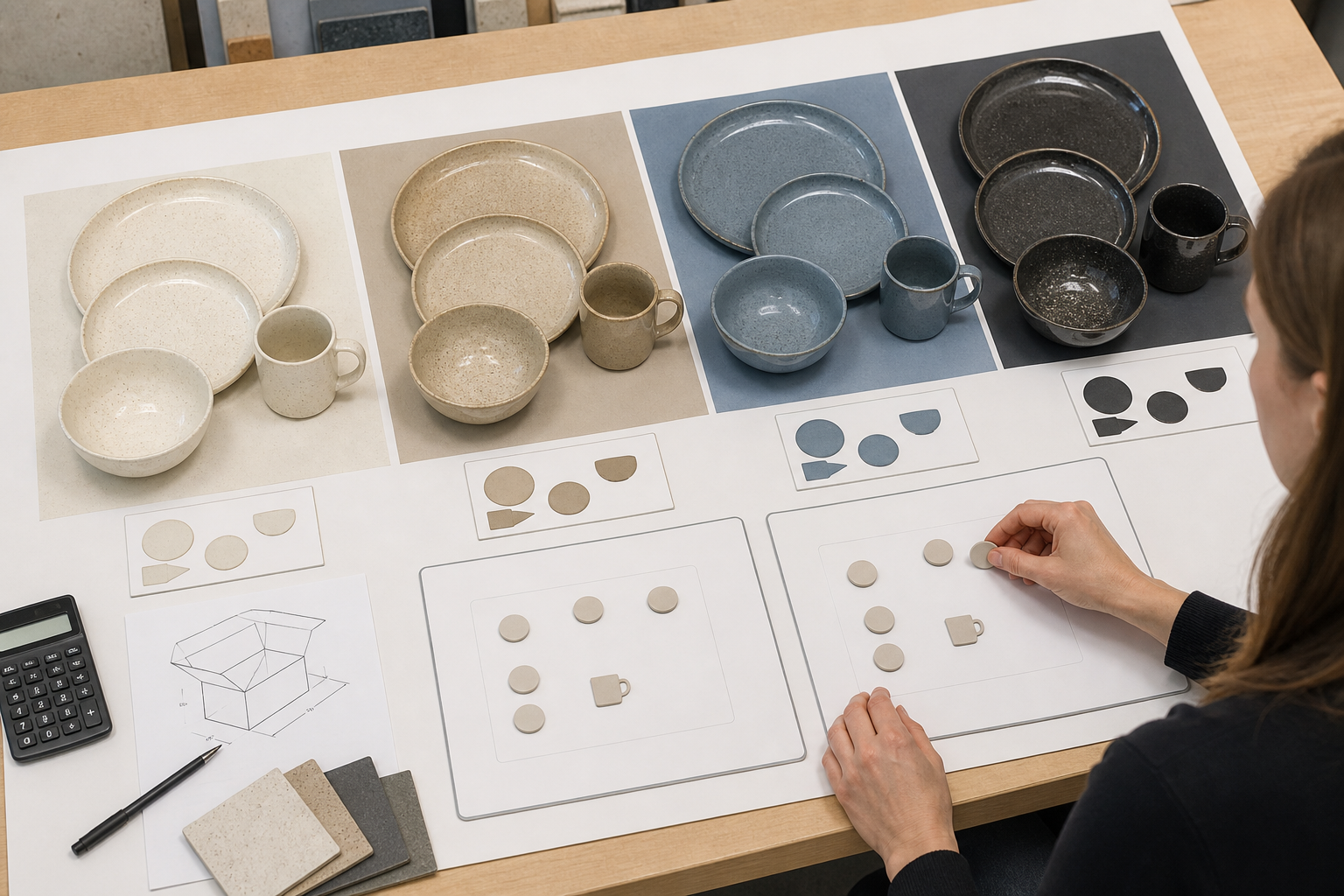
Put every proposed piece on a real table, then put every piece into the real box. The table checks whether the set makes sense to the customer. The box checks whether it makes sense to production, logistics, and margin.
I prefer one strong core configuration with carefully chosen add-ons. It is easier to explain, photograph, inspect, stock, and reorder. Add a piece only when it improves the meal, channel offer, or repeat-sale plan enough to justify its cost and space.
Questions Buyers Often Ask
Is a 12-piece set always service for four?
No. It is a common formula, but buyers must state the exact contents. Twelve pieces could also mean six plates and six bowls, or another channel-specific combination.
Should mugs match the dinnerware glaze exactly?
They should sit within the approved design range, but shape and kiln position can change how a glaze appears. Approve the glaze on the mug itself and define acceptable variation.
Can one compliance report cover the whole set?
Sometimes a laboratory can group items, but do not assume this. Body, glaze, color, decoration, shape, and food-contact use can affect scope. Ask a qualified testing partner to define representative samples for the target market.
How should replacement pieces be packed?
Design a separate safe pack for single-piece or small-quantity shipping. The full set insert may not protect one plate or mug moving alone.
When should we approve the barcode?
Approve the product identity early, then verify the printed barcode on final packaging before production shipment. Check every sales and logistics level required by the channel.
Conclusion
The right number of dinnerware set pieces depends on the meal, customer, channel, price, carton, and replacement plan. A 12-piece set is often cleaner without mugs; a 16-piece set works when mugs complete the offer and the pack remains practical. Build the formula, price every piece, test the real carton, and let channel evidence—not habit—choose the count.
If you are developing a private-label set, send FENN your target channel, price, place-setting idea, preferred shapes, and shipping route. We can help review the configuration before you approve samples and packaging.

Plan a Dinnerware Set That Fits Your Channel
Share your target channel, price, place-setting idea, preferred shapes, and shipping route with FENN. We can help review the set configuration before you approve samples and packaging.