
Short Answer
A good reactive glaze defect standard separates natural handmade ceramic variation from problems buyers should reject. Approve a visual range board, define unacceptable defects, set rules for shade matching, and ask the supplier for inspection photos before packing. Natural color flow can be beautiful, but chips, cracks, sharp edges, unsafe food-contact surfaces, and dirty-looking marks need firm control.
When a buyer asks me, “Kitty, is this normal variation?”, I always ask to see the approved range first. Without a range, the discussion becomes personal taste.
Reactive glaze is not a printed pattern. It moves with glaze thickness, clay body, kiln position, firing temperature, and shape angle. Buyers should not expect every piece to look identical. But “not identical” does not mean “anything can pass.”
Myth vs Reality: Natural Does Not Mean No Standard
| Buyer Myth | Factory Reality | Buyer Action |
|---|---|---|
| “Reactive glaze should all match the sample exactly.” | The final pieces will vary because the glaze reacts in firing. | Approve a light-to-dark range, not only one perfect sample. |
| “Handmade look means small defects are fine.” | Some marks are normal, but chips, cracks, sharp edges, and bad glaze coverage are not style. | Separate allowed variation from reject defects. |
| “Photos are enough for approval.” | Photos help, but lighting and angle can hide color and surface issues. | Keep physical master samples and request controlled approval photos. |
| “Set matching happens automatically.” | Bowls and plates from the same kiln can still look different. | Ask for shade sorting before packing sets. |
| “Food-contact testing is separate from appearance.” | Decoration, glaze, and food-contact surface all matter for safety claims. | Make sure test reports match the actual item and market. |
My simple rule is this: variation should look intentional to the customer. A defect looks accidental, unsafe, dirty, or badly controlled.
Build the Visual Range Before Bulk Production
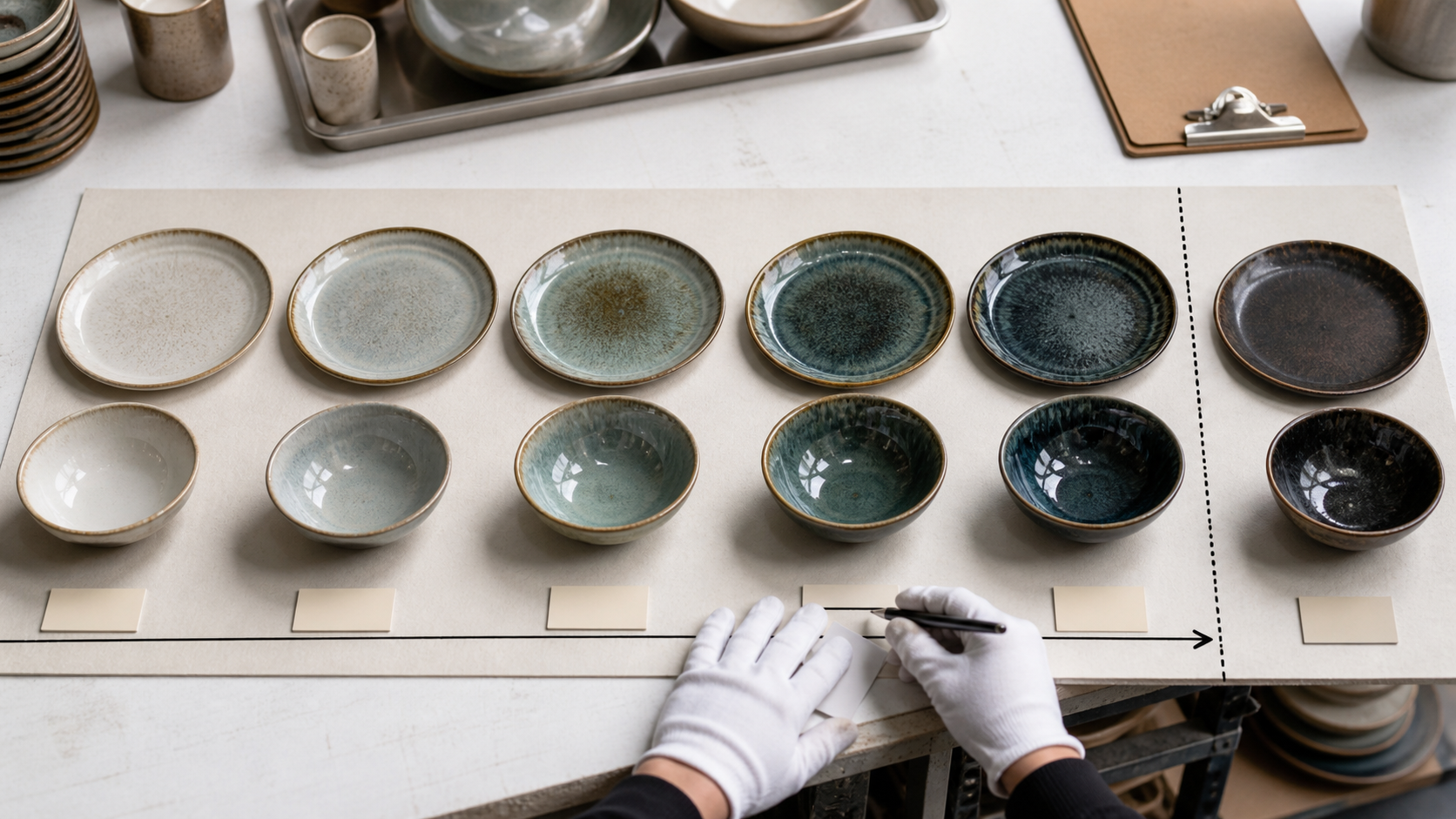
For reactive glaze variation, I prefer to approve a range board before mass production. This board should show the lightest acceptable piece, the darkest acceptable piece, the normal middle range, and any special rim or speckle effect.
The buyer and supplier should agree which pieces are outside the range. Kiln results can change by shelf position and by shape. A deep bowl may collect more glaze in the center. A flat plate may show a wider flow pattern near the rim.
A professional supplier should not only say, “Reactive glaze has variation.” They should show what variation means for your order.
Ask for one approved master sample, one approved range board, stable-light photos, clear reject notes, and retained samples for repeat orders.
What Counts as Acceptable Variation?
Acceptable variation should still look clean, usable, and matched to the brand level.
For many handmade-look or reactive glaze dinnerware lines, small changes in color depth, speckle density, rim flow, and center pooling can be acceptable.
But the variation should stay inside the approved story. If the line is soft blue-green, one almost black bowl may look wrong inside a four-piece set. If the approved rim has light brown flow, a heavy dark drip down the plate face may feel like a mistake.
When we review samples, I ask three questions: does it still look like the same collection, would a normal customer accept it inside a set, and can the factory repeat this range in the next order? If the answer is no, the standard is not clear enough.
Defects Buyers Should Control Strictly
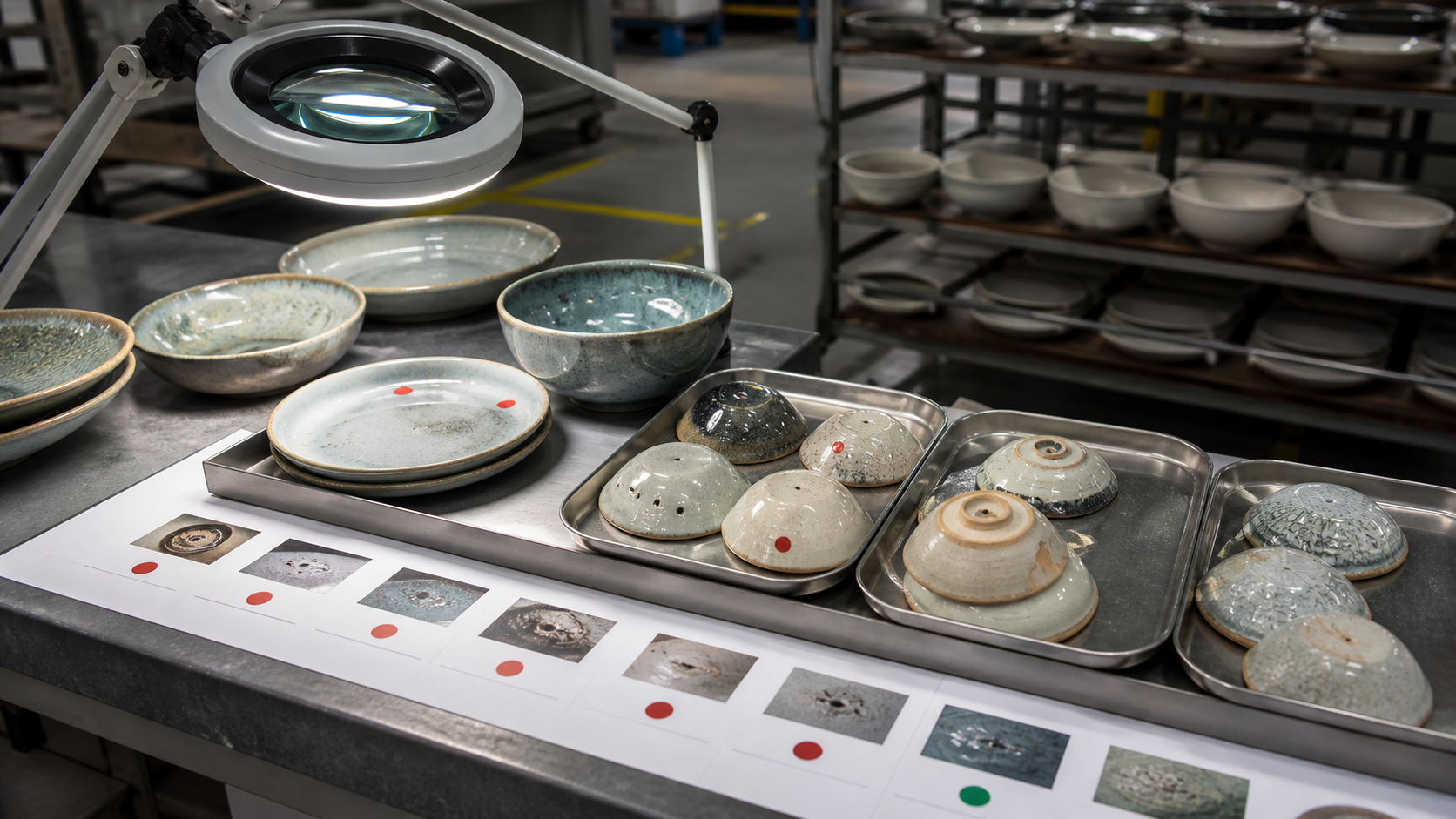
Some defects should not pass just because the product has a handmade look.
| Issue | Usually Acceptable? | How I Judge It |
|---|---|---|
| Small speckle inside approved range | Often yes | It should look natural, not dirty or burnt. |
| Slight color depth change | Often yes | It should still match the approved range board. |
| Small foot-ring mark | Sometimes | It should not scratch tables or make the piece unstable. |
| Large black spot on food-contact surface | Usually no | It can look dirty and create customer complaints. |
| Sharp pinhole or glaze pit | Usually no | Food-contact surfaces should feel smooth and cleanable. |
| Rim chip or crack | No | This is damage, not variation. |
| Heavy warping | No | It affects stacking, use, and brand trust. |
| Bare clay on food-contact surface | No | Glaze coverage must match the approved use standard. |
For safety and compliance claims, do not rely on appearance alone. For U.S. sales, buyers can use FDA lead in foodwares guidance as a source direction. For EU sales, EU ceramic food-contact rules and product-specific documents matter. ISO 6486 is often used for lead and cadmium release testing references, but the report must match the real item, glaze, decoration, and food-contact surface.
Set Matching Is a Separate QC Step
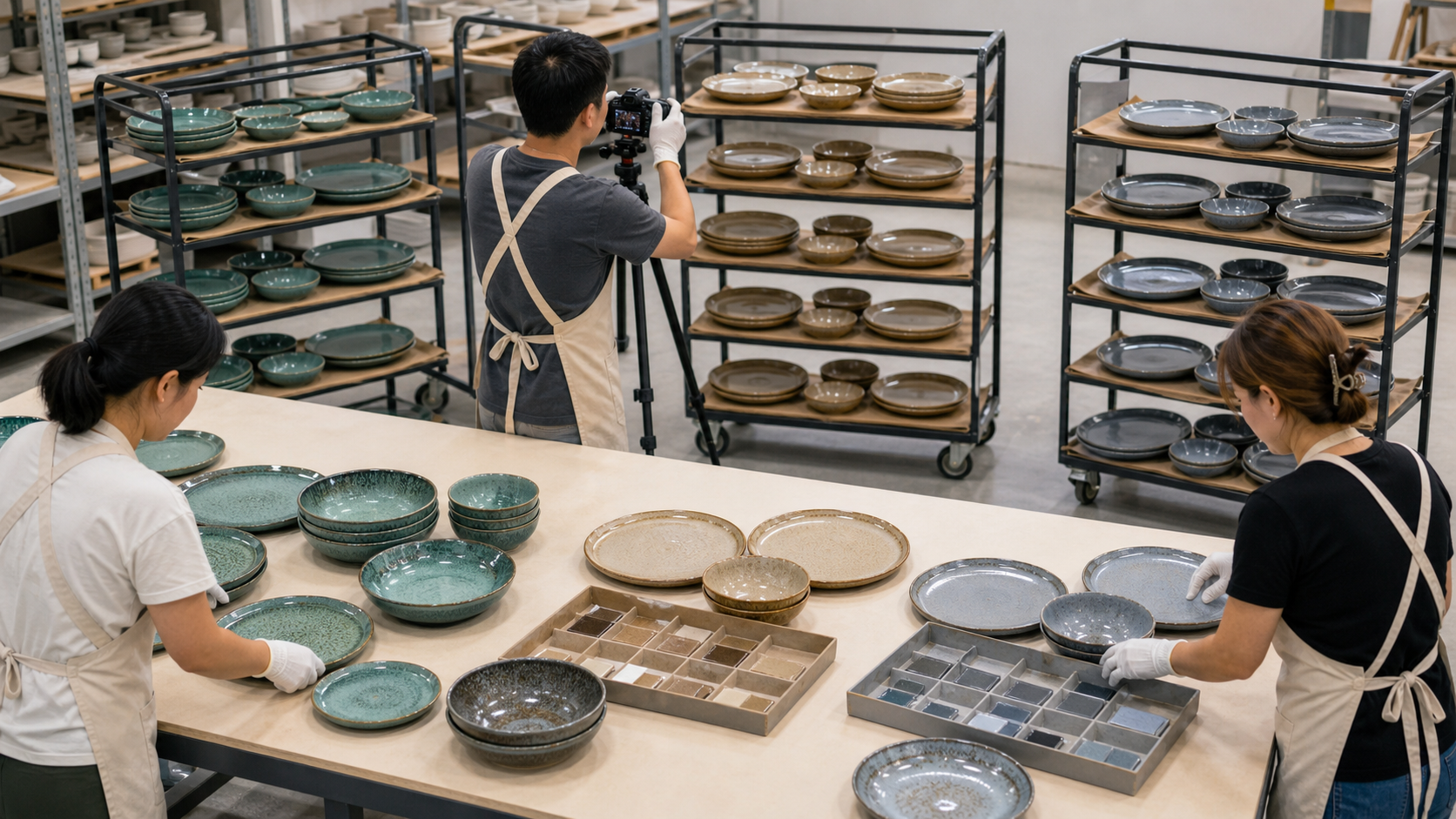
Reactive glaze pieces may pass one by one and still fail as a set.
Imagine a dinner plate, side plate, bowl, and mug packed together. Each piece may be within the approved range, but if one is pale cream and the others are deep teal, the customer may think the set was mixed by mistake.
This is why shade sorting matters. For boxed sets, ask the supplier to group pieces by shade family before packing. The goal is not perfect sameness. The goal is a set that feels planned.
For open stock, the rule can be different. A boxed gift set usually needs tighter matching because the customer sees all pieces together.
Reactive Glaze QC Boundary Tool
Use this tool before approving bulk production.
| QC Boundary | Accept Range | Reject Rule | Evidence to Request |
|---|---|---|---|
| Color | Light, middle, and dark samples approved by buyer | Any piece outside the range board | Range board photos and retained samples |
| Speckles | Natural speckling that looks clean | Dirty-looking spots, large burnt marks, or sharp surface pits | Defect library photos |
| Rim flow | Flow pattern shown on approved samples | Heavy drip, missing rim effect, or uneven bare area | Close-up rim approval photos |
| Food-contact surface | Smooth, cleanable glaze coverage | Cracks, sharp pits, unsafe decoration, or exposed body | Test report and final inspection photos |
| Shape and fit | Normal ceramic tolerance with stable stacking | Heavy warping, rocking, bad nesting, or unstable foot | Measurement and stacking check |
| Set matching | Pieces grouped by shade family | One piece looks clearly from another color story | Pre-packing set photos |
If the supplier cannot show these boundaries, the final inspection will be difficult. ISO 2859-1 AQL sampling can help with inspection planning, but it does not define taste. The visual standard must come first.
Create a Small Defect Library
A defect library is a small set of photos or physical pieces showing what must not pass. It is useful because words are not enough.
For this topic, I prefer a simple library with acceptable speckle, too many black spots, acceptable rim flow, heavy rim drip, acceptable foot-ring marks, rough foot rings, small natural pinholes, sharp pits, accepted shade range, and out-of-range shade.
This library helps the factory sorting team, the final inspector, and the buyer speak the same language. It also protects repeat orders.
What to Ask Before Packing Starts
Before the supplier packs the goods, ask which master sample and range board are being used, whether shades are sorted as full sets, what defects are critical or major, whether food-contact reports match this glaze, whether pre-packing photos will be sent, and how retained samples will be stored.
A professional answer includes photos, samples, records, and clear limits. A weak answer is, “This is reactive glaze, so variation is normal.”
My Advice as a Manufacturer
My advice is to sell the beauty of handmade ceramic variation, but control the parts that damage customer trust.
When we develop reactive glaze dinnerware, I like to approve the range board early, then create a defect library before bulk production. I also prefer shade sorting for boxed sets.
If your brand wants a handmade look, ask for repeatable beauty: controlled color range, clean food-contact surfaces, smooth rims, stable shape, clear packing rules, and honest product photos.
Questions Buyers Often Ask
Is every reactive glaze piece different?
Yes, some difference is normal. The glaze can flow and change during firing. But every piece should still stay inside the approved color, surface, and quality range.
Are pinholes always defects?
Not always. Tiny natural pinholes may be acceptable on some handmade-look pieces, but sharp, dirty-looking, deep, or food-contact surface problems should be controlled strictly.
Can a buyer reject goods because the color is different from the sample?
Yes, if the color is outside the approved range. This is why one sample is not enough for reactive glaze orders. Approve a range board before bulk production.
Should boxed sets have tighter color matching than open stock?
Usually yes. In a boxed set, customers compare pieces immediately. Open stock can sometimes accept wider natural variation because items are chosen one by one.
What proof should I request for compliance?
Ask for test reports that match the actual ceramic body, glaze, decoration, food-contact surface, and target market. A general certificate is not enough for a specific order.
Conclusion
A strong reactive glaze defect standard protects both the buyer and the factory. It lets natural handmade ceramic variation stay beautiful while rejecting real defects. Approve a range board, build a defect library, set shade-matching rules, confirm safety documents, and request pre-packing photos.
If you are preparing a handmade-look or reactive glaze dinnerware order, send FENN your target color, sample photos, set format, quality concerns, and sales market. I can help you turn the look into a practical QC standard before bulk production begins.
Need Help Setting a Reactive Glaze QC Standard?
Send FENN your target glaze, sample photos, set format, sales market, and quality concerns. I can help you turn the look into a clear QC standard before bulk production.