Short Answer
To import ceramic dinnerware to EU markets, build one product file that connects the final fired piece to relevant food-contact evidence, traceability, packaging data, language needs, and the retailer’s own rules. Start with the country and channel, then ask the supplier to identify what the finished item is, what changed from the tested sample, and who holds each record. A general “EU compliant” message is not a launch plan.
I have seen good-looking dinnerware projects become difficult because the commercial team chose a box before anyone recorded its materials, or because a decorated mug was treated as the same product as an older plain sample. My simple advice is to make the product file while the design is still easy to change.
This is practical sourcing guidance, not legal advice. EU rules and national obligations can change, and the importer or brand should obtain market-specific advice for the countries and sales channels involved.
Before You Import Ceramic Dinnerware to EU Markets
The EU is a market framework, but your project is not one generic “EU order.” A direct-to-consumer launch in Germany, a department-store programme in France, and a hospitality sale in Spain can ask for different language, packaging, delivery, and retailer records. I ask the buyer to name the first selling countries and the sales channel before we lock artwork.
Then give every sellable item a stable identity. A useful identity usually includes the shape code, body, glaze, decoration method and position, set contents, packaging version, and target market. It sounds ordinary, but it stops a blue-rimmed bowl and a plain bowl from being treated as interchangeable just because their mold is the same.
My practical standard: if a new colleague cannot look at the SKU record, sample, carton, and report and understand they belong together, the record is not ready for a launch decision.
Build the EU Market Readiness Pack in Four Gates

I use four short gates. They are not official approval stages. They are a buyer’s way to prevent an unanswered question from moving quietly into bulk production.
| Readiness gate | Questions to close | Record to keep | Hold the project when… |
|---|---|---|---|
| Product definition | What exact ceramic item will be sold, and where? | SKU sheet, photos, approved drawing, target-country list | The product or intended market is still described in broad terms |
| Food-contact review | Does evidence match the finished body, glaze, decoration, and use? | Test-report review note, sample identity, laboratory or adviser comments | A decoration, glaze, or contact-area change has no documented review |
| Market information | What consumer, importer, and retailer information is needed? | Artwork checklist, language matrix, retailer requirement file | Packaging artwork is being printed before owners approve the information |
| Shipment and repeat order | Can this batch be traced and repeated? | Batch record, retained sample, packing specification, change log | The packed bulk item differs from the approved reference without a decision |
This table is a working tool, not a substitute for a compliance assessment. It helps the buyer ask better questions early enough to act on the answers.
Match Food-Contact Evidence to the Ceramic You Will Sell
For ceramic foodware, the question is not whether a plate looks safe. The important question is whether the relevant food-contact review and evidence relate to the final article. The European Commission food-contact materials guidance is a good starting point for understanding the EU framework. Ceramic articles have specific lead and cadmium release rules under Directive 84/500/EEC, as amended.
In a real project, I would ask a qualified laboratory or compliance adviser to define the right scope. Give them the actual product: a dinner plate, bowl, mug, or serving item; the body and glaze; decoration method; where decoration sits; intended use; and market. Also request the written declaration of compliance: it should identify the manufacturer and importer, the ceramic item, the date, and the compliance confirmation. Match it to the ordered goods and supporting test documentation.
Look at the sample identity on the report. Then compare it with the proposed production item. Is the interior glaze the same? Did a decal move onto a lip-contact area? Did a gold line appear on the rim? Did a matte finish replace a gloss finish? Those questions are more useful than asking whether the factory has “an EU test.”
For example, a cream stoneware mug with an exterior logo may need a different review from the same mug with a metallic band around the drinking edge. The shape may be unchanged, but the finished configuration is not. I would pause and ask for written confirmation of the evidence route before releasing the decorated version.
Keep Traceability Close to the Fired Ware
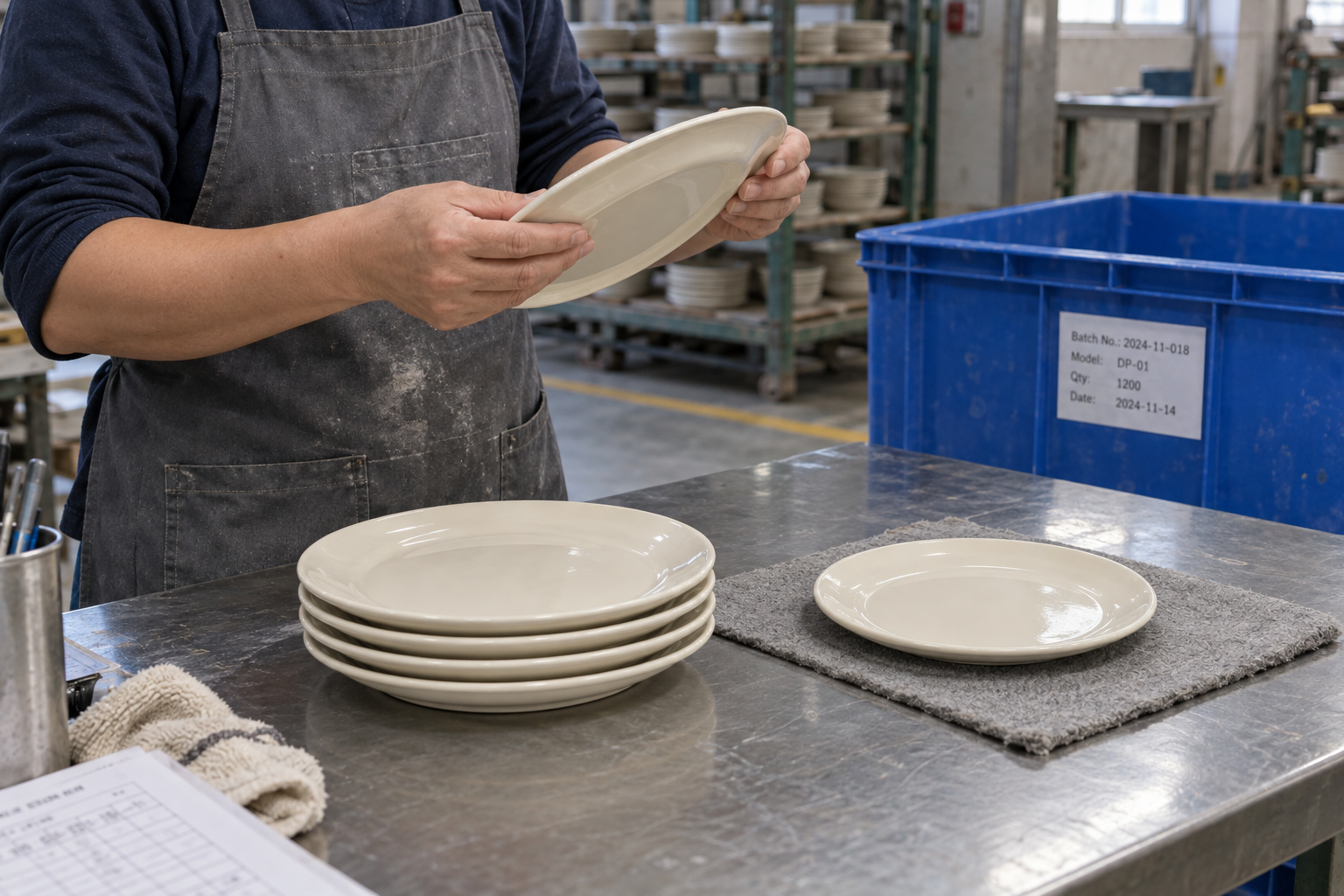
Traceability sounds like paperwork, but it becomes very practical when a buyer receives a complaint. Can the team identify which production batch, glazing run, packing version, and approved sample relate to the carton? If not, even a small issue can turn into a large investigation.
I prefer a compact record, rather than a huge uncontrolled folder:
- Approved product sheet with dated photos of the front, food-contact surface, rim, base, and decoration.
- Retained sample labelled or logged against the approved SKU and production period.
- Batch and inspection reference that links fired ware to the production record.
- Change log for glaze, decal, shape, packaging, or source changes.
- Final pack photos and carton specification for the item actually shipped.
The EU General Product Safety Regulation overview explains the wider product-safety context. Ask your adviser how these duties work alongside food-contact rules for your finished product, including traceability, the responsible EU business, and online listing information.
At the factory, I treat a retained sample as an agreement you can hold. When a later order arrives, we compare the new fired pieces with it under an agreed viewing condition. It will not remove normal ceramic variation, but it makes variation visible and discussable.
Plan Packaging Data Before You Approve the Carton

Packaging is now part of EU market preparation, not just protection for the plates. Start by recording every part: retail carton, corrugated inner, divider, paper wrap, tape, label, and pallet material where relevant. Record the material description and weight in a way your team can reuse. Do this with the real packed version, not an early drawing.
The European Commission packaging waste page explains the Packaging and Packaging Waste Regulation, which generally applies from 12 August 2026, with specific measures phased in separately. Confirm the applicable dates for your pack. National producer-responsibility registrations, reporting, and retailer requirements also need country-specific review.
From my side, I want the packaging brief to answer three questions: what protects the ceramic, what materials are used, and how the buyer will collect the needed data. Avoid promising that a box is recyclable, plastic-free, or compliant until the claim and local requirements have been checked. A lighter pack is not automatically a better pack if it lets rims touch during transport.
Run a packed-sample review before the production carton order. Check fit, empty space, lifting, closing force, and the way pieces are separated. Then store photos of the approved pack. On repeat orders, ask whether any paper, divider, tape, or carton board has changed. Those small substitutions can affect both protection and your records.
Write Information for People, Not Only for Artwork Files
Language planning often arrives too late. The product page, care card, carton, marketplace listing, and retailer data sheet may each need different information. Which languages are required depends on the countries and channel, so create a simple matrix with the country at the top and an owner beside every text item.
For dinnerware, I would review product name, material description, set contents, dimensions, care wording, origin or importer information where applicable, safety notices, and any performance claims. Keep one controlled source text. If the carton says dishwasher safe but the online listing says hand wash only, customers and retailers will ask which version is true.
Be modest with claims. “Dishwasher safe,” “microwave safe,” “durable,” and sustainability language should each have a defined basis. The European Commission unfair commercial practices guidance is useful background for careful commercial communication. It is not a claim template, so use local legal and channel review before publishing consumer-facing text.
My Advice as a Manufacturer
I would put one person in charge of the EU readiness pack. Not because that person must know every law, but because somebody must see when a change affects another file. A buyer may change the glaze for a better photo, while a packaging colleague changes the carton board, and a retailer asks for new language. Without one owner, each change can look small and nobody reconnects the records.
Bring your target countries, SKU list, physical samples, decoration map, packaging plan, and retailer requirements to the first serious supplier meeting. An EU ceramic tableware supplier should explain what is known, what needs confirmation, and what could change in production. Be careful with anyone who says a single old report covers every product without asking about the final configuration.
Questions Buyers Often Ask
Can one food-contact report cover several ceramic colors?
Sometimes a laboratory may support a grouping, but the buyer should ask for the written basis. Color, glaze, decoration, contact area, and final firing can matter. Do not group items only because they share a mold.
Does an EU declaration solve every country requirement?
No. Food-contact records are only one part of a market plan. Packaging obligations, language, importer details, retailer programmes, and national requirements may also apply. Confirm the scope for each selling country.
When should we record packaging weights?
Use the final approved pack. Record each material component before shipment and update the record when a component changes. An early estimate is useful for planning but weak as a repeat-order control.
Should the supplier write all EU packaging and care text?
The supplier can provide product facts and technical input, but the brand or importer should control the final market-facing wording with the right local review. Give the supplier an approved text source rather than allowing several versions to drift.
Build the File Before You Build the Container
To import ceramic dinnerware to EU markets with fewer surprises, treat the finished fired ware, the documents, the packaging, and the product copy as one connected release. That makes it much easier to see a gap while you can still change the sample or carton.
If you are planning an EU dinnerware line, send FENN your target countries, SKU list, glaze and decoration plan, packing outline, and retailer requirements. I can help organize the product and manufacturing details for your review before bulk production. You can also visit the FENN Resources hub for related buyer guides.