
Short Answer
Buyers should test stackable ceramic dinnerware with several separate, production-representative pieces—not one sample or a CAD drawing. Build the quantity used in storage and service, then measure height, lean, rocking, rim and glaze contact, lift-off, scratching, and stability after moving the stack. Repeat the check with the final foot finish and packaging. A good stack saves space without trapping, wobbling, or putting damaging pressure on exposed rims.
I have seen the problem appear only when six or twelve pieces arrive together: the stack leans, one foot rubs a glazed face, or a deep bowl locks onto the bowl below.
> Simple definition: Stackability is the ability of separate dinnerware pieces to sit together in a stable, repeatable stack with controlled height, contact, and removal.
From a factory point of view, stackability is a system result. Shape, foot ring, rim, firing shrinkage, warpage, glaze, and the number of pieces all matter.
Start With the Real Stack, Not a Perfect Pair
Before testing, write down where the product will live. A restaurant may stack plates on a pass shelf and lift them during a busy service. A retailer may display four pieces but ship twelve. A home customer may place bowls in a cabinet with limited height.
Define three quantities:
- Display stack: the number shown on a shelf or in photography.
- Working stack: the number handled or stored in normal use.
- Pack stack: the number placed together inside the approved packaging.
Test all relevant quantities. Two plates can look stable while twelve reveal a small angle that grows with every piece. Use separately made samples because one master or CAD model hides firing variation.
Run This Four-Stage Dinnerware Sample Stack Test
This walkthrough turns stackability into an approval record instead of a feeling.
Stage 1: Build
Place production-representative pieces on a hard, level surface and rotate their position in the stack. Each should settle without twisting. Check whether the foot sits on a designed contact area or touches a food-facing glazed surface, and look for uneven gaps.
For bowls and mugs, test nesting depth and hand access. A space-saving nest is not useful if fingers cannot safely separate the pieces.
Stage 2: Measure
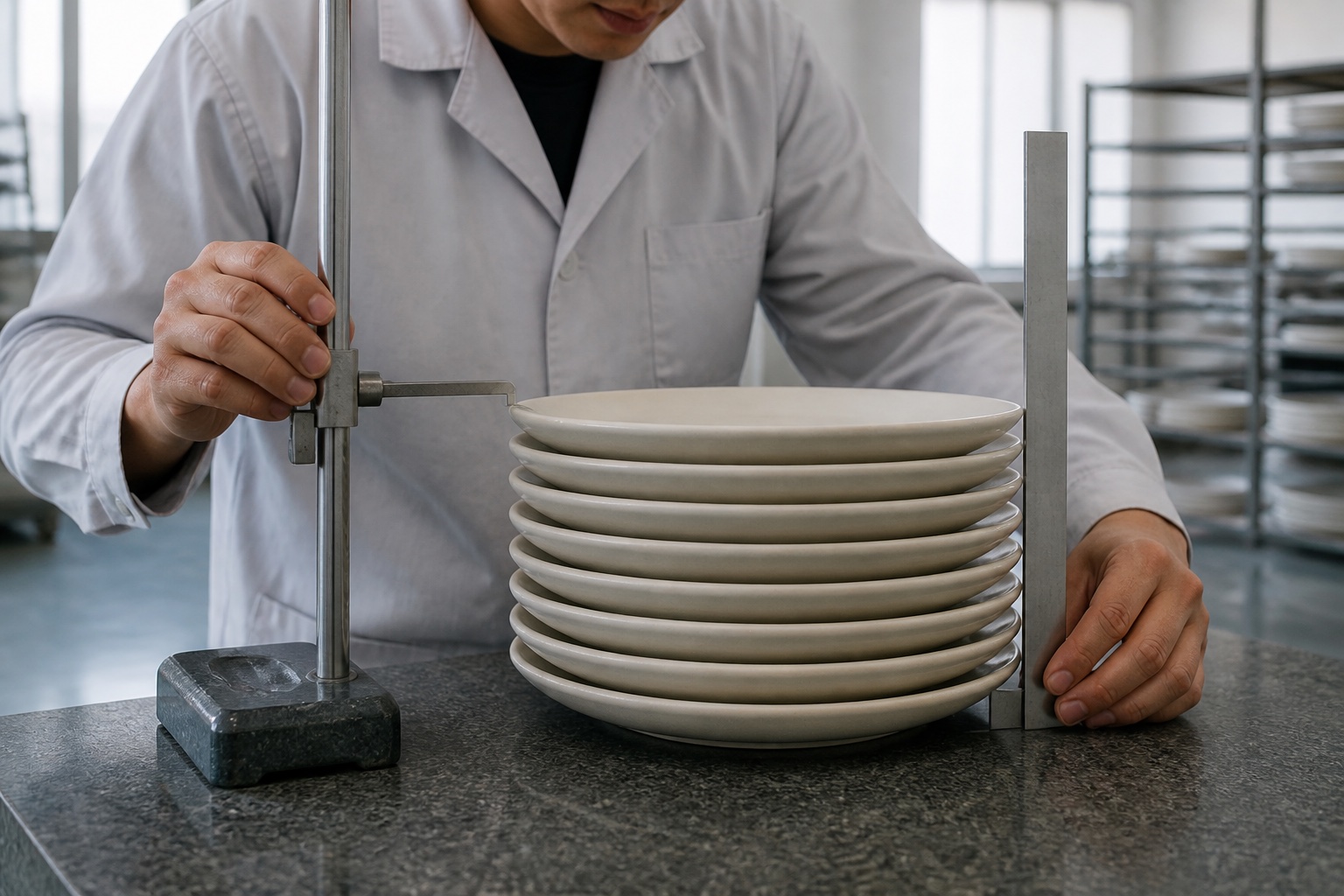
Measure total height at more than one side and compare the footprint with the shelf, rack, dishwasher basket, carton, or display limit. Check lean against a straight vertical reference and keep photos for repeat orders. Set a project limit from real use and sample variation, not a universal guess.
Record the height of every added piece, not only the final total. An unexpected jump can show that one foot, rim, or warped base is changing the contact pattern.
Stage 3: Move
Move the working stack as the user would. A restaurant plate stackability check should include lifting from a shelf, carrying a short distance, setting down, and removing the top pieces with dry and slightly damp hands.
Do not perform unsafe drop tricks. The goal is controlled handling. Listen for hard ceramic-on-ceramic clicking and inspect contact points afterward. A stable-looking stack may still concentrate force at the rim.
Handling does not replace package validation. Build the final pack and use a route-suitable test plan. The ISTA testing overview explains why packaged products should be evaluated against real transport hazards.
Stage 4: Lift
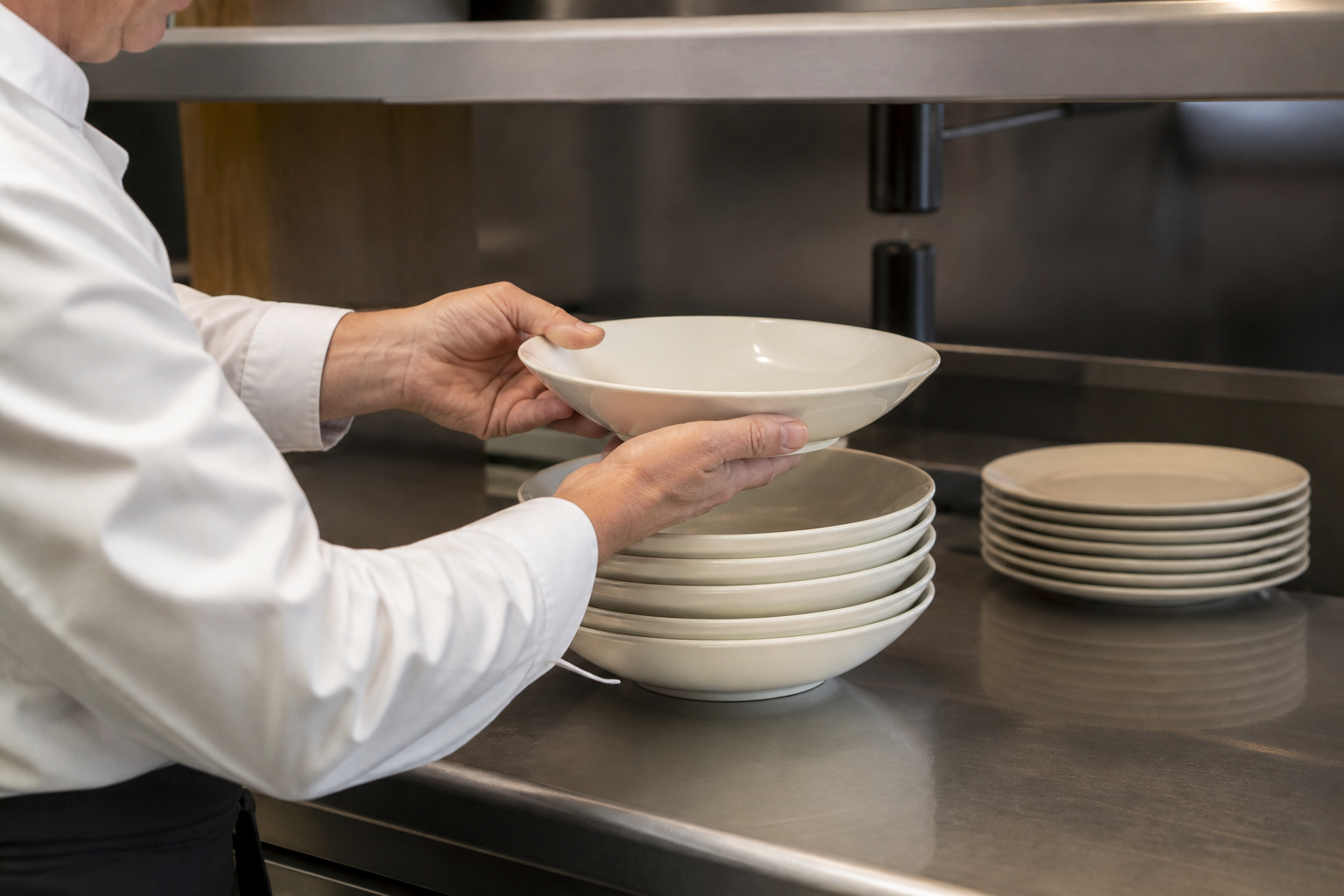
Remove pieces one by one. Each should release without suction, sticking, sudden tilt, or scraping across the decorated surface below.
Deep bowls deserve special care. A close nest can trap air or moisture and make separation awkward. Mugs need handle clearance so handles do not strike or lock together. Plates need enough finger access for the intended service method.
Repeat the build after lifting. A good result should not depend on one lucky order of samples.
Use This Stackability Test Record
| Test Point | What to Record | Practical Pass Sign | Reason to Pause Approval |
|---|---|---|---|
| Sample group | Quantity, sample stage, body, glaze, and date | Several separate pieces represent the intended production route | One perfect showroom sample is treated as proof |
| Stack height | Height at several sides for display, working, and pack quantities | Fits the known space with an agreed allowance | Height or lean grows unpredictably |
| Contact path | Where foot, rim, and wall touch the next piece | Contact is deliberate and avoids exposed weak edges | Rim-on-rim loading or foot scraping a visible face |
| Stability | Rock, lean, rotation, and response to normal movement | Stack settles firmly and remains controlled | Wobble, spiral lean, sliding, or sudden shift |
| Lift-off | Finger access, release, suction, and handle clearance | Pieces separate smoothly in normal use | Sticking, vacuum effect, trapped fingers, or handle collision |
| Surface result | Marks after repeated stacking and lifting | No unacceptable scratches, chips, or metal-like rub marks | Damage appears at repeatable contact points |
| Pack fit | Stack count, separators, carton height, and movement | Final pack restrains pieces without harmful pressure | Carton closes only by forcing the ceramic stack |
Keep photos from the same angle and a short video of build and lift-off. That evidence is much more useful than the supplier writing “stacking okay.”
Understand What Controls the Stack
Foot Ring Geometry
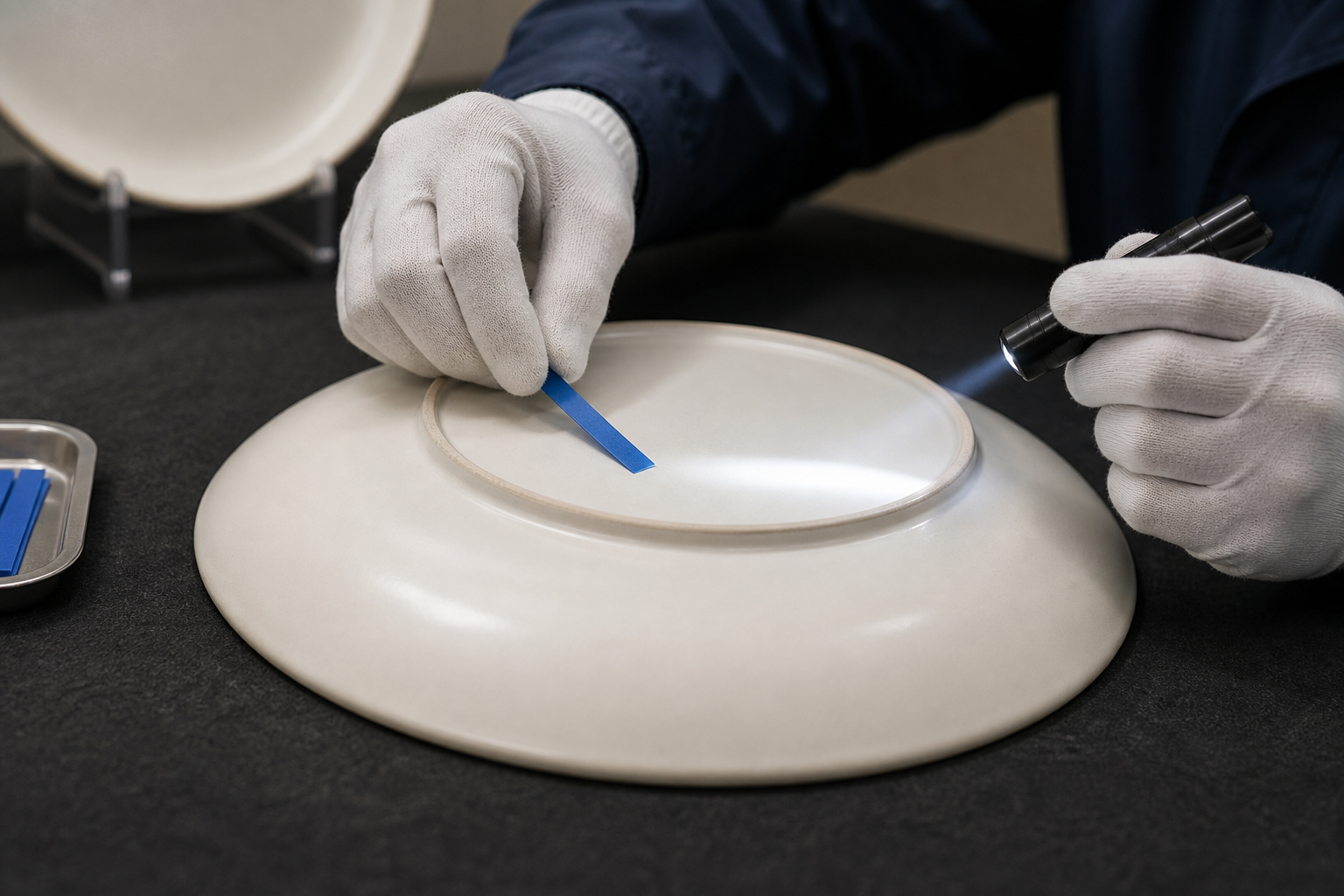
The foot ring often decides where the upper piece rests. Its diameter, height, flatness, and finish affect stability and scratching. If the foot lands on a glazed eating surface, the contact should be reviewed carefully.
An unglazed foot must be smooth enough for the intended use. A rough foot can mark the plate below or a customer’s table. Ask how the foot is cleaned or polished and how that finish is checked in bulk.
Rim and Wall Profile
A raised rim can protect food and change the visual style, but it can also become the load point in a stack. Deep coupe walls may nest closely and reduce height, yet too little clearance can create sticking or sidewall rubbing.
The supplier should show a section view or explain the intended contact path. “They fit together” is not a complete answer.
Warpage and Firing Variation
Clay shrinks during drying and firing. Wide flat pieces are especially sensitive to forming, drying support, kiln loading, and firing conditions. A slight change in one piece can multiply through a tall stack.
This is why I ask for representative fired samples and repeat data. If stackability is critical, add stack height, rocking, and key contact checks to the quality plan. The ISO 2859-1 acceptance sampling framework can help organize lot inspection, but buyer and supplier still need clear defect definitions and measurement methods.
Glaze and Decoration
Matte, reactive, glossy, or decorated surfaces can behave differently at contact points. Check the final glaze, not an unglazed blank. Repeated stacking can reveal abrasion or color transfer that a single visual inspection misses.
Food-contact evidence should also match the actual body, glaze, decoration, and intended market. The FDA guidance on lead in foodwares gives useful U.S. context, while the European Commission food contact materials overview explains the wider EU framework. Neither source makes a generic test report valid for every product.
Connect the Stack Test to Packaging
Stackability and packability are related but different. A stable shelf stack may still need separators, rim clearance, and top restraint. Measure the real stack before locking carton height. Add the protection, close the carton normally, and check for rim pressure or vertical movement. Repeat the pack test after a foot or rim change.
For mixed sets, test each stack separately and then test the complete pack. A bowl nested inside another shape can look efficient but create a concentrated impact path.
What I Want Before Bulk Approval
My preferred approval file contains:
1. Current drawing with rim, wall, and foot details.
2. Sample IDs, dates, body, glaze, decoration, and production route.
3. Display, working, and pack quantities.
4. Stack height, footprint, lean method, and stability results.
5. Photos of actual contact points and any marks after repeated handling.
6. Lift-off notes for finger space, suction, and handle clearance.
7. Final packaging structure and route-appropriate validation results.
8. Retained approved samples and a rule for repeat-order comparison.
After a mold, foot, rim, glaze, forming, or firing-support change, repeat the affected checks.
My Advice as a Manufacturer
My simple advice is to test the stack at the quantity that creates the real risk. Do not approve stackable ceramic plates from a side-view rendering or two hand-picked samples.
Build, measure, move, and lift. Then change the sample order and do it again. A professional result should be stable without being tight, compact without trapping, and easy to separate without scraping.
I would rather adjust a foot ring during sampling than explain chipped rims, marked glaze, or cartons that no longer close after production.
Questions Buyers Often Ask
How many pieces should we use in a stack test?
Use the largest realistic display, working, or pack quantity for the channel. If a restaurant stores twelve plates but a retail box holds four, test both quantities and their different handling conditions.
Does a lower stack always mean better design?
No. A low stack saves space, but very close nesting can cause sticking, abrasion, poor finger access, or concentrated contact. Judge height together with release and damage risk.
Can CAD prove that dinnerware will stack?
CAD can show design intent and clearances. It cannot fully predict forming variation, shrinkage, warpage, glaze thickness, foot finishing, or production handling. Fired samples are essential.
Should bowls touch at the foot or sidewall?
There is no single answer for every shape. The contact should be deliberate, stable, repeatable, and away from vulnerable surfaces. Ask the supplier to identify the intended contact path and prove it with samples.
Conclusion
Stackable ceramic dinnerware should be approved as a repeated system, not as one attractive piece. Define the real quantities, use representative fired samples, record contact and height, simulate normal handling, inspect for damage, and confirm the final pack.
If you are reviewing a private-label dinnerware sample, FENN can help you examine the foot, rim, nesting, stack record, and packaging before bulk production. Bring the intended stack quantity and storage or carton limits; those details make the test useful.
Testing a stackable dinnerware sample?
Send FENN your intended stack quantity, storage limits, sample details, and packaging route. We can help review the foot, rim, nesting, stack record, and pack before bulk production.