
Short Answer
Thin ceramic dinnerware can reduce product weight, but it only saves money when the finished design keeps its strength, fires reliably, and survives the agreed delivery route. I compare the approved plate with a lighter version at the same size, then check rim damage, flatness, packed weight, and the actual freight quote before recommending a change.
A lighter plate can feel lovely in the hand. It can also be a costly way to discover that your packing line puts pressure on the rim. When a buyer asks me to remove weight, I start with a question: where does the weight cause trouble today?
That answer decides whether we should change the ceramic, the pack, or the delivery plan.
Choose the Saving Before Changing the Plate
Thin describes a section of the piece. Lightweight describes its mass. They are related, but they are not the same specification. A plate with a narrow rim and smaller foot ring may weigh less without making the eating surface thinner.
I would judge a lightweight proposal by three things: a measured weight reduction, an agreed performance result, and a saving that remains after packaging and rejects. A photograph cannot settle any of them.
For a restaurant, the useful benefit might be easier handling of a loaded tray. For an online brand, it might be moving a parcel into a lower billing band. For an importer, it might be reducing a heavy carton that warehouse staff handle repeatedly.
Those are different jobs. Ask the supplier to name which one the new drawing solves. “We can make it thinner” is a possibility, not a complete answer.
Lightweight porcelain plates may be worth sampling when the buyer wants a refined feel and easier handling. A broad, handmade-look serving platter may need a different approach because its wide span and irregular profile make shape control important. Neither material name gives a guaranteed strength result.
Three Routes to Thin Ceramic Dinnerware
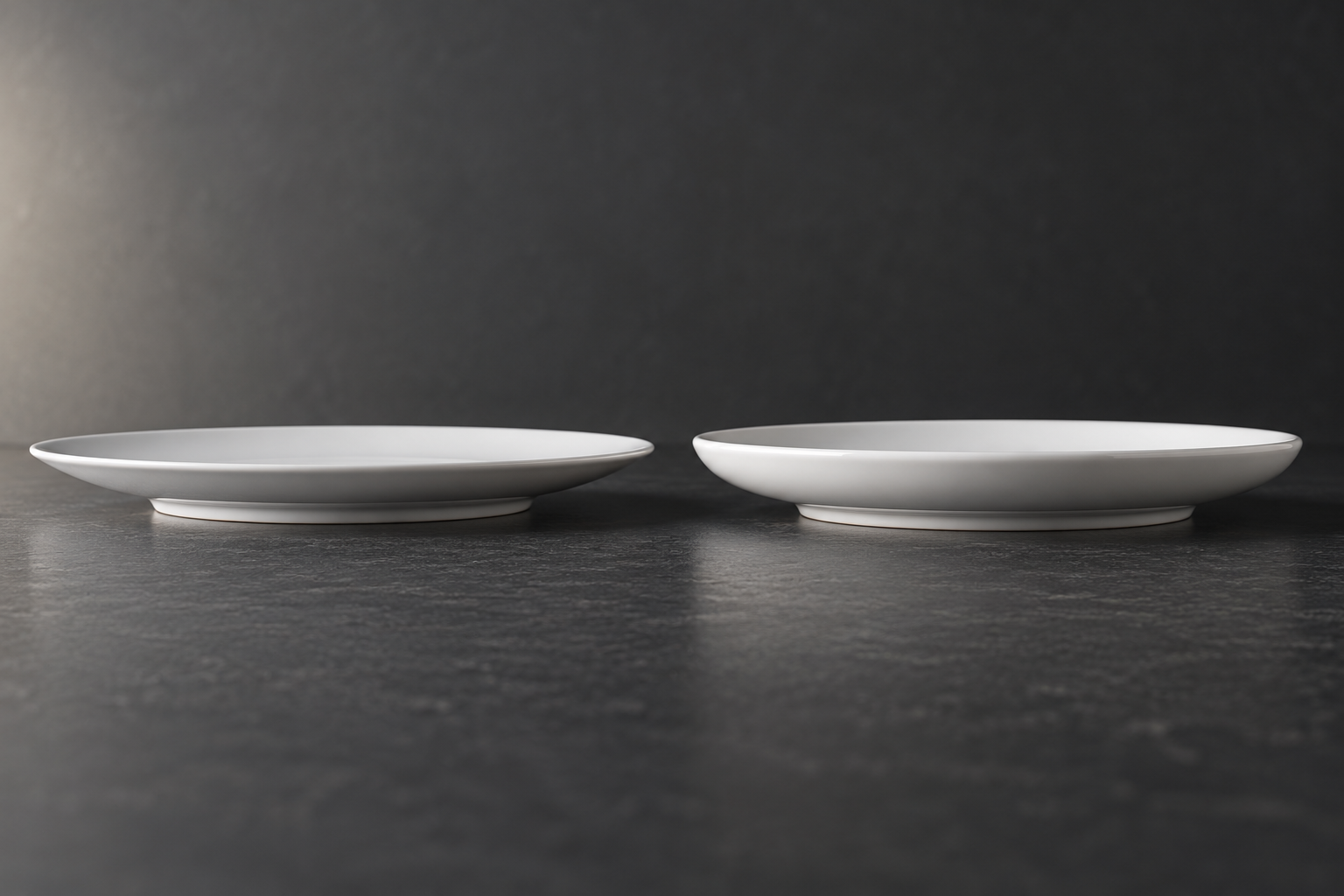
I prefer to review three routes before paying for development. The best one is often less dramatic than the first design idea.
| Route | When I would consider it | What could cancel the benefit | Evidence needed to continue |
|---|---|---|---|
| Keep the plate; improve the pack | Protection or empty space makes the parcel bulky | Tighter packing allows rims to touch | Packed dimensions, contact-point review, and suitable transport testing |
| Remove weight from selected areas | The plate feels heavy but its outline works | A thinner transition or foot becomes vulnerable | Revised section drawing, fired samples, stack fit, and impact comparison |
| Develop a lighter body-and-shape combination | Handling or positioning justifies more development | New tooling, firing losses, or extra protection raise cost | Costed sample route, production trial, and product-specific performance evidence |
I would not ask a factory to trim every wall by the same percentage. The rim, centre, and foot do different work. A stronger body may allow a lighter design, but changing the body can also change shrinkage, glaze behaviour, and the finished colour.
A useful supplier reply marks the proposed changes on a section drawing. It explains which dimensions stay fixed and what must be checked again after firing. A reply that only promises a lower gram weight leaves too much open.
Follow the Weight Into the Freight Quote

Here is a fictional example, not a FENN price or specification. Suppose a plate moves from 720 g to 650 g while its diameter stays the same. That saves 70 g per plate, or 420 g across six plates: about 9.7% of the ceramic weight.
Now suppose the original six-plate parcel weighed 6.20 kg, including its protection and box. With identical packaging, the lighter version would weigh 5.78 kg. If it needs another 180 g of protection, the finished parcel becomes 5.96 kg. The gross saving is now 240 g, about 3.9%.
That still might help. But it does not prove a freight saving.
A carrier may rate the shipment using actual weight, dimensional weight, minimum charges, or other lane-specific terms. If the box size stays unchanged and dimensional weight controls the bill, removing ceramic weight may leave the charge unchanged. Ocean freight also needs its own quote comparison; a lighter plate does not automatically lower a container booking price.
I use a freight provider such as DHL Global Forwarding as a starting point for a shipment-specific discussion. Ask your own forwarder to compare both packs on the same lane, service, shipment size, and quote date. Keep the actual packed measurements beside each quote.
To reduce dinnerware shipping weight usefully, measure the complete shipping unit. Do not multiply a percentage reduction in plate weight by the freight invoice and call it a saving.
Put the Two Designs Through the Same Day
The next decision happens with fired samples, not a calculator. I would ask for an approved reference and lighter candidates made with identified body, glaze, and firing conditions. Record which sample came from which trial.
Start where the plate meets the table
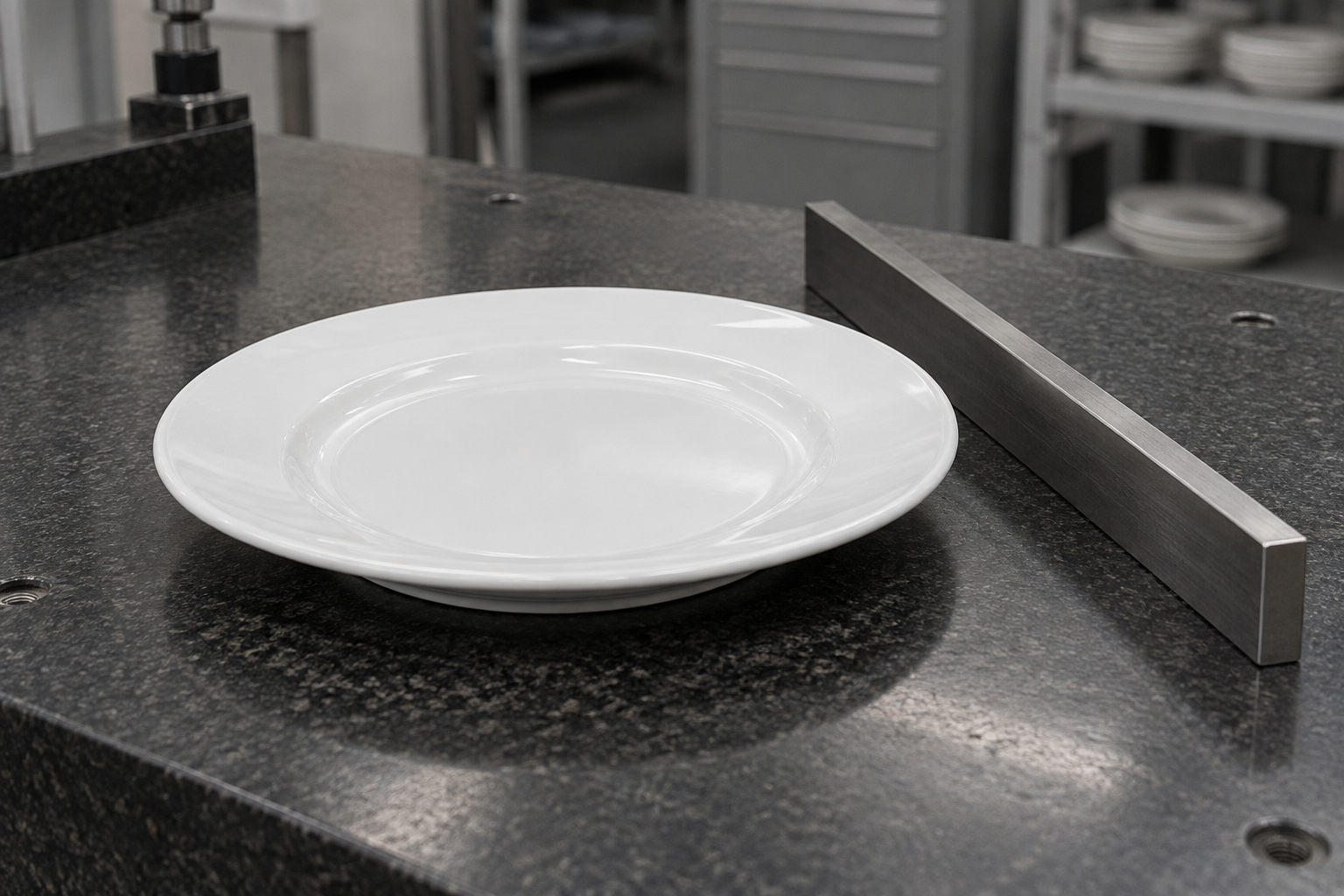
Place each sample on a known flat reference surface, then compare it on the intended tabletop. Check rocking and rim lift. Measure against the drawing and an agreed method; do not invent an allowable gap after seeing the results.
In real ceramic production, drying and firing can distort a broad plate. A thinner section may be less forgiving of uneven drying, support conditions, or a poorly balanced profile. The supplier should explain how it checked these risks across the trial, rather than presenting only its best piece.
Next, stack the intended number of plates. Check where each foot ring rests and whether it loads the glaze or rim below. A stable single plate can still make an awkward stack. Retain photographs of the contact points, not just a tidy stack from the front.
Then check the edge that people actually hit
A thin, sharp-looking lip deserves careful attention because everyday knocks often reach that edge first. I want the rim profile, not simply the centre thickness, included in the review.
Ask a qualified laboratory whether the ASTM C368 impact test method fits the product and comparison you need. Confirm the applicable edition, fixture, impact location, sample count, and reporting approach with the laboratory. A method name alone is not a universal pass mark or proof that a plate cannot chip.
When comparing results, keep those conditions consistent. A supplier should report damage and variation across the tested pieces, including failures. One attractive sample that survives a casual tap tells me very little.
Finish with the packed delivery unit
Use the final inserts, separators, carton, and packing orientation. Pay attention to space around the rim and any point where a plate can strike another piece or a hard support.
The ISTA test procedure selection guidance is a useful starting point when discussing a distribution test with a packaging laboratory. The selected procedure must suit the shipping unit and route. A parcel test is not automatically the right choice for a pallet shipment.
After testing, open the pack and inspect every piece for cracks, chips, and contact damage. Keep the packaging revision with the report. Testing an older, heavier plate in a different pack does not approve the lighter design.
Count Saleable Pieces, Not Just Clay Saved
From a factory point of view, fewer grams of clay do not guarantee a lower unit cost. Forming, handling, firing support, sorting, and packaging still need to work. If the lighter version has more warped pieces or chips during handling, the cost per saleable plate can rise.
I ask for a production trial summary that shows the quantity started, quantity accepted, and rejection reasons. Any comparison needs a similar product scope and an explanation of process differences. A small trial is useful evidence, but it is not a promise of the same yield across every future run.
Then compare the purchase cost, development cost, freight, and expected damage-related costs using your own records. Keep assumptions visible. If the saving depends on a return rate you have never measured, label that number as an estimate and test the decision with a less favourable figure.
My approval choice is simple: continue when the intended benefit is measured and the agreed checks pass; revise when a clear design or packing change can address the weak point; keep the original when the saving disappears. There is no prize for approving the lightest sample.
My Advice as a Manufacturer
I like a precise brief: “Make this six-plate parcel easier to handle while keeping the approved rim performance and stack height.” It gives us a useful problem to solve.
I am less comfortable with “make it as thin as possible.” That removes the limits that protect the buyer. Keep the approved sample, drawing revision, weight range, packing specification, and test evidence together. Changes to the body, glaze, profile, or firing process should trigger a review of the evidence affected.
Thin ceramic dinnerware is worth developing when lightness improves a real buying or use decision. I would choose a modest, repeatable improvement over a dramatic sample that the production team struggles to reproduce.
Questions Buyers Often Ask
Is thinner porcelain always weaker?
No. Performance depends on the body, firing, shape, thickness distribution, and surface condition. Compare finished products under the same relevant test conditions instead of judging strength from thickness alone.
What is the minimum safe plate thickness?
I would not give one number for every plate. Diameter, rim shape, foot support, body, and intended use change the answer. Agree the finished drawing and acceptance tests with the supplier before setting a thickness target.
Will a 10% lighter plate cut freight by 10%?
Not necessarily. Packaging, shipment size, dimensional weight, billing bands, and the service terms all matter. Request a new quote using the measured final pack.
Can we use the old packaging report?
It can help identify earlier risks, but it may not support the revised product. Ask the packaging laboratory which changes need reassessment and document its reasoning against both product and pack revisions.
Does a strength result prove microwave or food-contact suitability?
No. Those are separate questions. Ask the relevant laboratory which existing evidence still applies to the revised finished product and which checks need updating. Do not carry every old claim forward automatically.
Bring One Plate and One Packed Carton
If you are considering a lighter dinnerware line, bring FENN the current drawing, target use, packed dimensions, and the problem you want to solve. I can help turn that into a focused sample discussion. You can also explore related sourcing topics in the FENN Resources library.