
Short Answer
A ceramic plate foot ring affects plate stability, stacking, firing support, glaze cleanup, and how the plate feels on a table. Buyers should check its diameter, height, flatness, contact surface, edge finish, and relationship to the plate profile on several fired samples. A good ceramic plate foot ring sits firmly, supports production well, avoids scratching, and stays consistent after firing—not just in a drawing.
I often turn a sample upside down before I study the glaze color. Buyers sometimes laugh, but the hidden base tells me a great deal about how carefully the plate was designed and finished.
> Simple definition: A foot ring is the raised circular base under a ceramic plate. It supports the piece during use and often during firing, while keeping most of the plate body away from the table or kiln shelf.
Read the Symptoms Before Changing the Design
A foot-ring problem usually arrives as: “The plate rocks,” “The base feels sharp,” or “The stack leans.” Yet rocking may also come from a warped body, kiln debris, or glaze on one contact point. Before changing a mold, compare several pieces and find the repeatable pattern.
Foot-Ring Diagnosis Map for Buyers
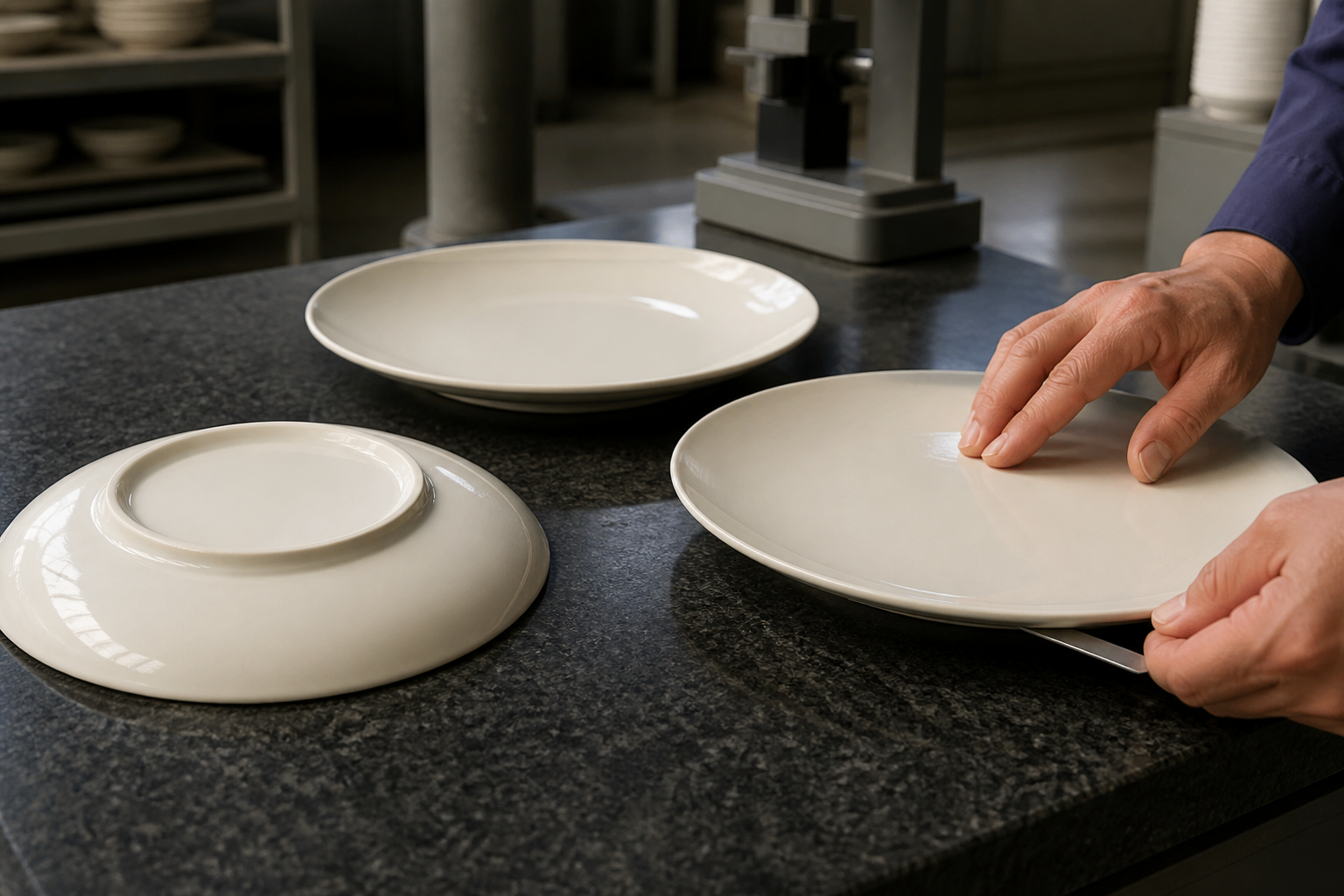
Use this table during sample review. It links what you see to the checks that should follow.
| What You Notice | Possible Cause | How to Check It | Practical Buyer Action |
|---|---|---|---|
| Plate rocks on a flat table | Uneven foot, warped body, glaze drip, or kiln debris | Test several pieces on a verified flat surface; rotate each plate and inspect the contact points | Record the sample IDs and separate one-off debris from a repeated geometry problem |
| Plate slides too easily | Contact ring is too narrow, too smooth for the surface, or not level | Compare on the intended table materials; do not judge only on a soft cloth | Review contact width and flatness before adding pads or changing finish |
| Foot scratches a table or plate below | Rough unglazed clay, sharp edge, trapped abrasive grain, or incomplete polishing | Wipe the foot clean, feel it carefully, and use a controlled rub test on a suitable witness surface | Agree a finishing standard and visual/touch reference for bulk QC |
| Stack leans or rubs | Foot diameter, foot height, rim profile, or warpage changes the contact path | Stack the real working quantity, rotate pieces, and mark where they touch | Review the full plate section, not the foot ring alone |
| Bare patch looks dirty or uneven | Glaze wiping is inconsistent or the designed wipe line is unclear | Compare several samples upside down under even light | Approve a boundary reference showing acceptable width and appearance |
| Plate cracks or deforms in firing trials | Support position, body thickness, drying, or firing setup is not balanced | Ask where the piece is supported and compare distortion across positions or trials | Let the factory review body, profile, and kiln support as one system |
The best supplier response explains the pattern, shows several samples, and connects the proposed change to a cause. “We will be more careful” is not enough.
Separate the Five Jobs of a Ceramic Plate Foot Ring
1. It Creates a Stable Contact Point
The contact surface should sit evenly without rocking. A wider foot increases the base area but may add visual weight, affect stacking, or create more unglazed area to finish. A smaller foot can look elegant but make a wide plate feel less settled. Judge it with the plate diameter, wall angle, weight, and use case.
2. It Supports the Plate During Firing
Clay changes size during drying and firing. Wide plates are sensitive because the center, rim, and base must settle together. Foot-ring support matters, but so do forming, body recipe, drying, firing curve, and kiln loading. The Digitalfire glossary on warping explains why distortion has connected causes.
If a supplier proposes a foot change to solve warpage, ask to see fired trials. A CAD update proves the drawing changed; it does not prove the fired plate is stable.
3. It Defines the Glaze Wipe Area
Many plates have an unglazed contact area so glaze does not fuse them to kiln furniture. The wipe line should look controlled. Glaze left on a contact point can cause sticking, extra grinding, or a rough defect.
Ask for an approved underside photo showing the expected wipe width, edge shape, color, and acceptable small variations. This is far clearer than writing “clean bottom” in a specification.
4. It Controls Stacking Contact
The foot ring can land on the back, rim, or food-facing area of the plate below. That contact path affects stack height, stability, scratching, and rim pressure.
Place removable marking film or another safe indicator at likely contact zones, then build the working stack. Rotate the pieces and lift them one by one. If the contact changes greatly between samples, check warpage and dimensional variation before approving the design.
For a deeper method, buyers can also use our guide to testing stackable ceramic dinnerware alongside this foot-ring review.
5. It Shapes the Customer’s Quality Impression
Customers handle the base when loading a dishwasher or lifting a plate. A sharp foot feels unfinished. Handmade-look dinnerware need not be machine-perfect, but even a rustic line should sit safely and avoid damaging normal table surfaces.
Judge the Foot Finish With a Simple Three-Surface Test
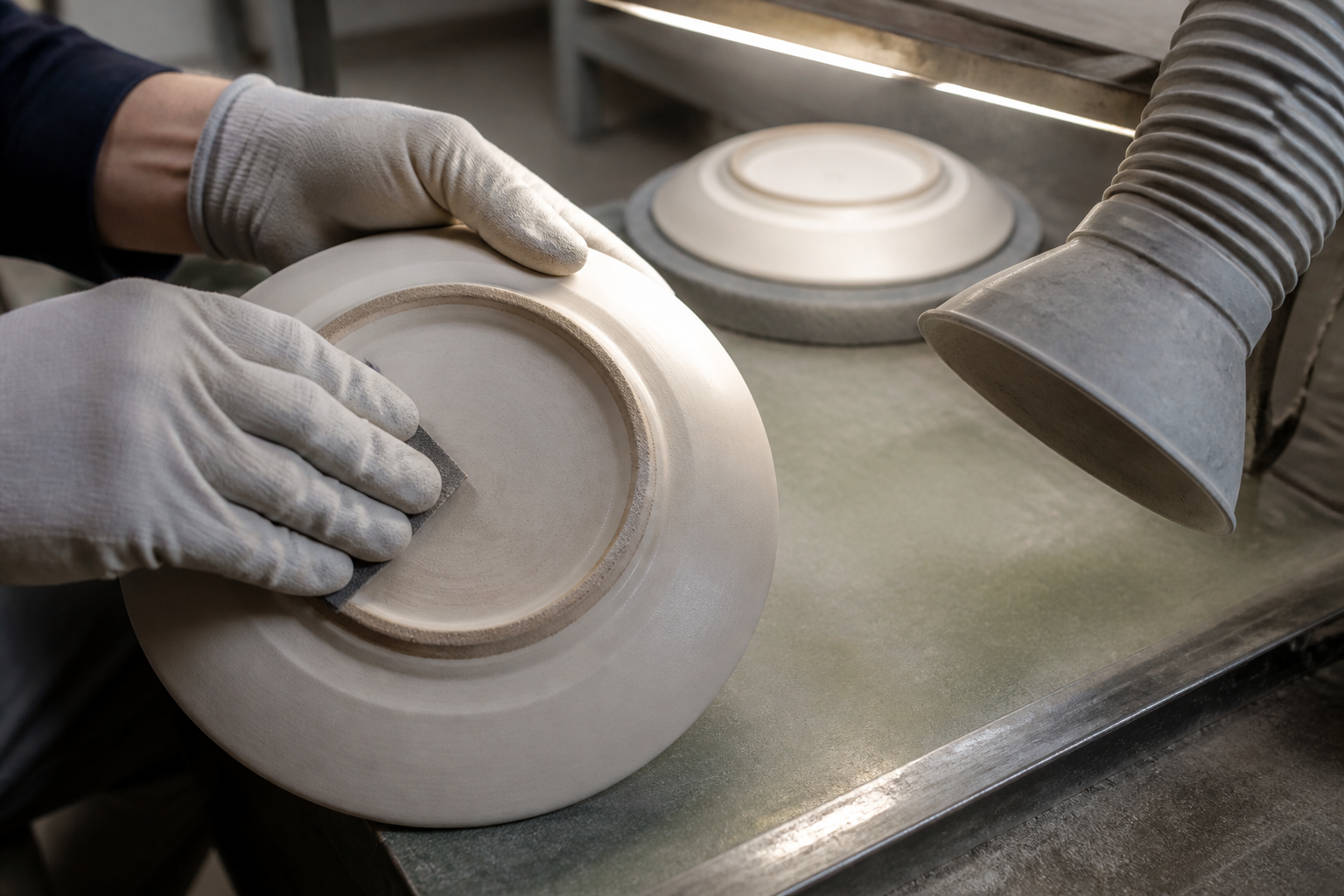
One test surface can mislead you. I prefer a small review using three relevant surfaces:
1. A verified flat inspection surface to find rocking and uneven contact.
2. A typical customer table surface to judge feel, movement, and scratching risk.
3. The approved plate or bowl below it to check stacking contact and abrasion.
Clean both surfaces first because loose grit can create a false scratch result. Record whether the issue appears on one piece or across the group. Low-angle photos make chips, glaze beads, and uneven contact easier to see.
What to Put on the Drawing and Approval Record
The drawing should identify key dimensions, but the approved fired sample remains essential because ceramic shrinkage changes the final size.
My preferred foot-ring record includes:
- Foot outer and inner diameter, height, and intended contact width.
- Underside glaze boundary and approved wipe reference.
- Edge profile and finishing method.
- Flatness or rocking check method on an agreed surface.
- Intended stacking contact point and working stack quantity.
- Photos of acceptable and unacceptable foot defects.
- Retained approved samples for bulk and repeat-order comparison.
If the plate is intended for food contact, test reports should match the actual body, glaze, decoration, and market. The FDA lead and foodwares guidance gives official U.S. context, while the European Commission food-contact materials overview explains the broader EU framework. These sources do not replace the product-specific evidence a buyer may need.
For lot inspection, the official ISO 2859-1 acceptance sampling standard can provide a framework for sampling by attributes. Buyer and supplier still need to define what counts as a critical, major, or minor foot-ring defect and how rocking or roughness will be judged.
My Advice as a Manufacturer
My simple advice is to review a ceramic plate foot ring as part of the whole plate. Turn several fired samples over. Check the base under good light, then place, rotate, stack, and lift them on the surfaces that matter.
Do not demand perfect sameness without thinking about the product style. Instead, define safe contact, stable use, acceptable finish, and a clear visual range. When those four points are agreed early, the factory has a much better standard to follow in bulk production.
Questions Buyers Often Ask
Should a ceramic plate foot ring be glazed?
Often the kiln-contact area is unglazed so it does not stick during firing. The method must suit the body, glaze, kiln setup, finish, and intended use.
Is a wider foot ring always more stable?
No. Stability also depends on diameter, weight distribution, flatness, profile, and table surface. A wider foot can create stacking or appearance tradeoffs.
How much rocking is acceptable?
There is no useful universal answer. Agree on the test surface, method, sample range, and severity. Movement during normal use matters more than variation found only under forced pressure.
Can rough foot rings be fixed after firing?
Light controlled finishing may improve roughness, but it must not leave sharp areas or an uneven base. Inspect a corrected sample group before approval.
When should we approve the foot-ring design?
Approve it on representative fired and finished samples before bulk production. Repeat the relevant checks after changes to the mold, body, profile, glaze, firing support, or finishing method.
Conclusion
A ceramic plate foot ring is small, but it connects design, firing, glaze cleanup, plate stability, stacking, and customer experience. Diagnose the visible symptom, compare several fired pieces, define the contact and finish standard, and keep an approved underside reference for production.
If you are developing a private-label plate, FENN can help review the foot-ring drawing, fired samples, stacking contact, underside finish, and approval record before bulk production. Send the plate size, intended use, stack quantity, and any rocking or scratching concern so the review starts with the real buyer problem.
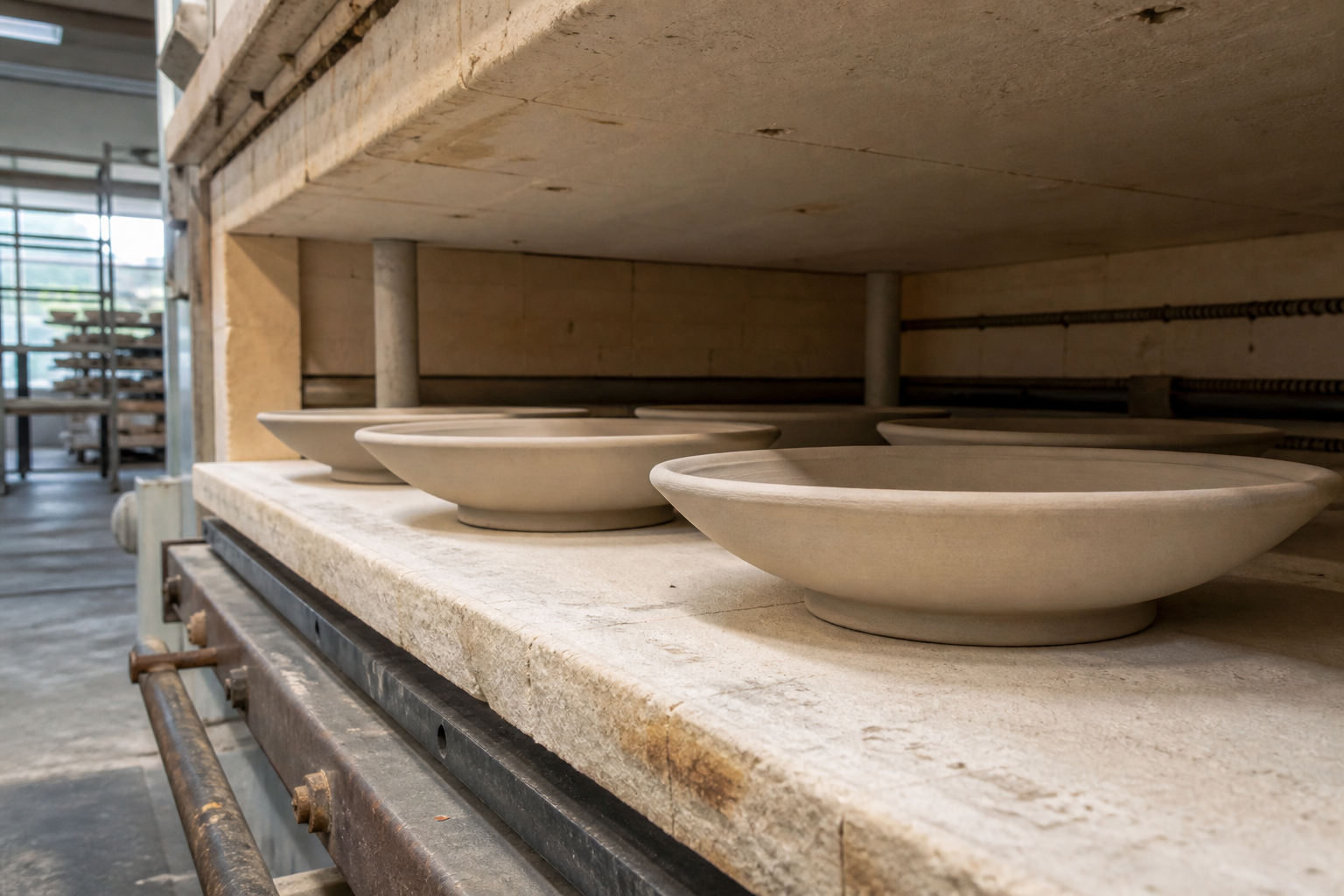
Reviewing a new ceramic plate design?
Send us your plate drawing, intended use, stack quantity, and sample concerns. We can help review foot-ring geometry, finish, stability, and bulk approval points before production.